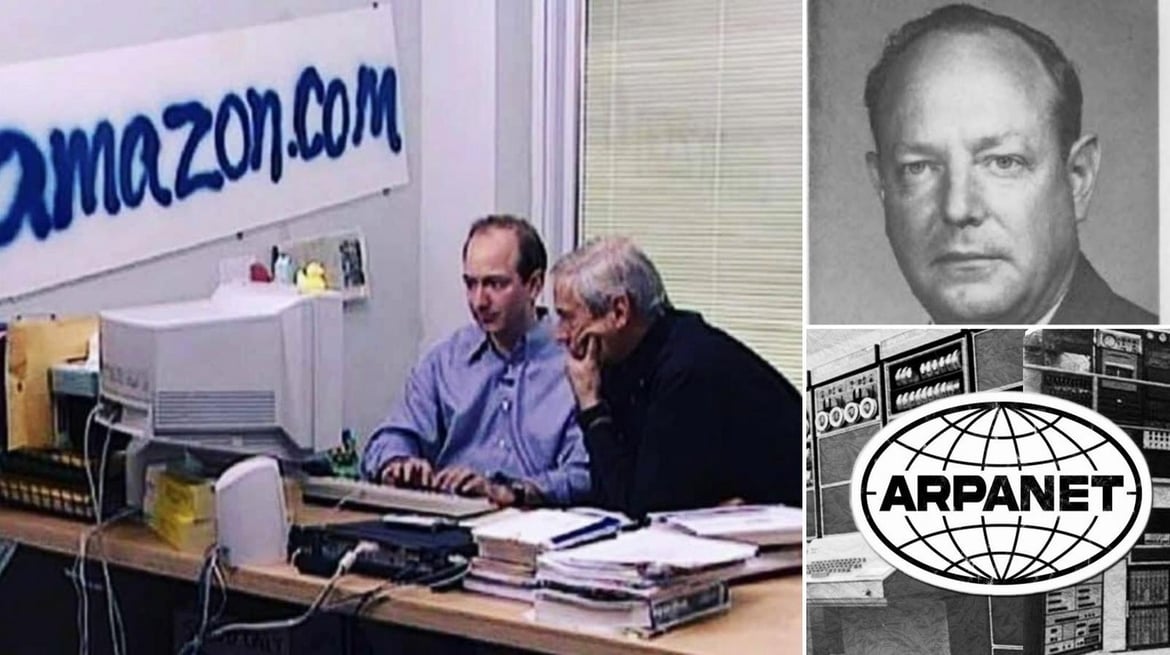
Lawrence Preston “Pop” Gise is not a name most people recognize, yet his fingerprints are on one of the most transformative inventions of the modern era. Long before his grandson Jeff Bezos turned shopping into a one-click experience, Pop (the name his family affectionately called him) was laying down the administrative backbone that would allow the Defense Department’s Advanced Research Projects Agency (ARPA) to exist. ARPA, created on February 7, 1958, was the seed from which the internet eventually grew. While scientists and engineers often take center stage in this story, the quiet technocrats who built the scaffolding of the agency deserve their own recognition. Among them was Lawrence Gise.

Pop’s role was never glamorous. He was not designing rockets or coding communication protocols. But within months of ARPA’s birth, he was listed as Director of Program Control and Administration. A declassified Army message from September 1958 confirms his title, showing that he was part of the agency’s first leadership team. By 1959, CIA records show him as Assistant Director for Administration, ensuring that the bold ideas ARPA managers pursued had the budgets, contracts, and internal reporting systems to make them real.

ARPA was brand new and had no existing template to follow. Everything had to be invented from scratch, from how funds flowed to how projects were authorized. Pop oversaw the creation of what became known as the “ARPA Order,” a contracting mechanism that gave researchers unusual flexibility. This administrative architecture was essential. Without it, there would have been no stable ground for program managers to chase radical R&D projects, from satellite systems to the early computer networks that became the foundation of the internet. Freedom of Information Act documents even show Pop personally authorizing and coordinating some of these early work streams.

Gise’s career did not end with ARPA. He later managed large atomic energy operations, again in a behind-the-scenes capacity. He was the kind of figure Washington relied upon: calm, steady, and capable of making vast systems run without drawing public attention. He preferred his time away from bureaucracy, returning whenever possible to the family ranch near Cotulla, Texas. Known as the “Lazy G” ranch, it was the place where his grandson, Jeff Bezos, spent every summer. Those long months instilled lessons that would shape the future founder of Amazon.

Jeff has often spoken of “worshipping” his grandparents. At the ranch, he learned patience, problem-solving, and a sense of belonging. Chores were not optional. If something broke, you figured out how to fix it with what was on hand. There were no experts to call, no quick services to rely on. It was a place where self-reliance was the only option, and young Jeff absorbed that mindset deeply. Pop, with his quiet authority and capacity to manage complexity, became an enduring model of competence for his grandson.

His grandson changed how the world shops
If Pop helped create the environment in which the internet could be born, Jeff Bezos harnessed that environment to revolutionize commerce itself. In 1994, when Bezos founded Amazon, the notion of buying books online seemed niche. Thirty years later, Amazon has become the infrastructure of online retail. By 2024, the company handled roughly 40 percent of all U.S. e-commerce sales, a staggering share that shows just how completely it captured the default online checkout.

Bezos’ genius was to make buying feel effortless. Amazon’s patented 1-Click checkout eliminated the friction that made digital shopping cumbersome. The system was so influential that Apple licensed it, a cultural signal that purchasing online could be as simple as tapping a button. Beyond consumer convenience, Bezos also built a vast platform for others. Today, more than 60 percent of items sold on Amazon come from independent sellers. That means Amazon is not just a store but a marketplace, the rails on which millions of small businesses move their goods.

The contrast between grandfather and grandson is striking. Pop Gise quietly built the administrative foundations for one of the boldest government agencies of the twentieth century. Jeff Bezos, with a far louder public presence, built one of the most dominant companies of the 21st century. Yet the connection between them is not so far-fetched. Both men shaped the systems on which others could build, whether those systems were Pentagon contracting processes or global e-commerce networks.

The story of the internet is often told as one of brilliant engineers, and the story of Amazon as one of bold entrepreneurship. Yet behind both lies the imprint of Lawrence Preston Gise and the lessons he passed on at a dusty Texas ranch. The grandfather gave his grandson both a template for competence and a world in which the internet could exist. The grandson took that inheritance and forever changed the way humanity shops.