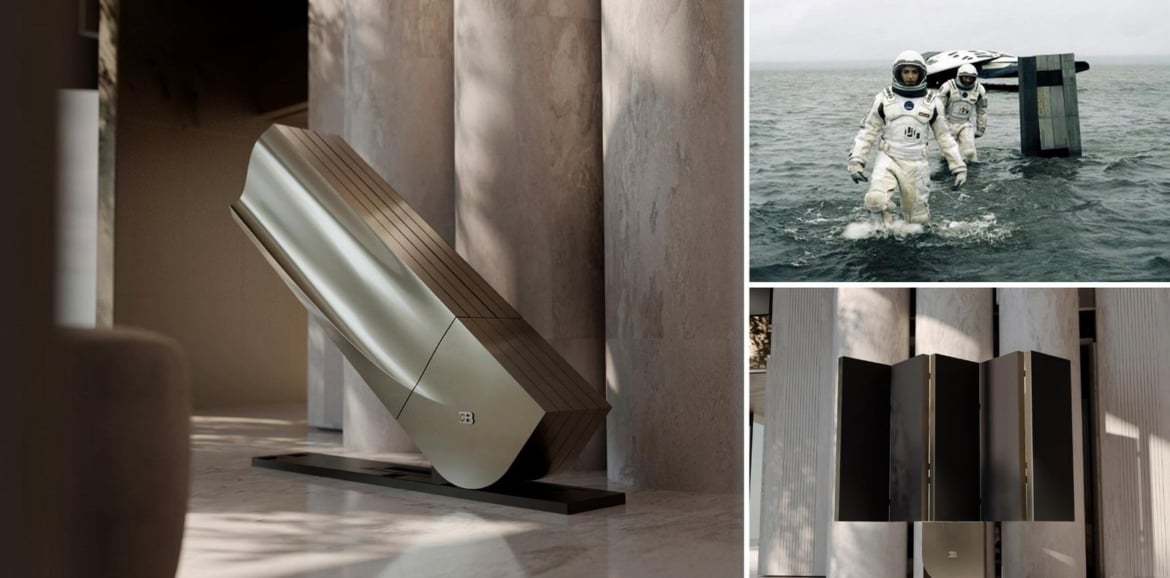
Bugatti has built some of the fastest and most exclusive machines ever to wear a license plate, but its latest creation will spend its life standing quietly in a living room. Developed with Austrian luxury display specialist C Seed, the new Bugatti N1 is not a television in the conventional sense. It is a piece of furniture, a kinetic sculpture, and a home cinema system wrapped into a single object whose sculptural shape is inspired by the new Bugatti Tourbillon hypercar.
The collaboration sits at an unusual intersection of technology, architecture, and luxury design. Rather than simply attaching a Bugatti badge to an existing product, C Seed and Bugatti have infused the N1 with visual cues drawn directly from the Tourbillon, including the unmistakable C-line profile that has become a signature across generations of Bugatti models.

According to the official press release, automotive-grade aluminum, carbon-fiber detailing, and the company’s longstanding philosophy of “Art, Forme, Technique” transform the television into something that feels more closely related to a hypercar than a consumer electronics product.

What makes the N1 fascinating is that its most impressive feature is not the display itself. When switched off, the television resembles a sculptural sideboard designed for a contemporary luxury residence. At the touch of a button, however, five MicroLED panels begin unfolding in a carefully choreographed sequence. Over the course of around 45 seconds, the structure transforms into a giant 110-inch or 137-inch 4K display, creating a theatrical experience that feels every bit as engineered as a Bugatti’s door mechanism or instrument cluster.

The transformation is not just a flex, though it is a very good one. In homes where the glass is floor-to-ceiling, the art is museum-grade, and every sightline has been fussed over by an architect, a giant black screen can feel like an aesthetic intrusion. The N1 solves that problem by vanishing completely when the show is over, letting the room go back to being the room. And when it does emerge, unfolding with that tall, modular precision, it has a hint of TARS from Interstellar about it, not literally, but in that same cool, monolithic, faintly unnerving way. Which is what makes the whole thing so compelling: this is a television that understands true luxury is not only about presence, but knowing when to disappear.

That philosophy extends throughout the design. The screen can rotate up to 180 degrees to accommodate different viewing positions, while an optional center-sliding mechanism allows even finer alignment with furniture layouts and seating arrangements. The integrated Wisdom Audio system participates in the same ritual as the display itself, with speakers that elegantly deploy when activated and retract when the system is powered down. Every movement is designed to feel deliberate.

The technical specifications are substantial. Buyers can choose between 110-inch and 137-inch versions, both using 4K MicroLED MiP technology with brightness rated at 1,000 nits. The system delivers 16-bit color processing and a color spectrum of 64 billion colors. Pixel pitch measures 0.6 mm on the smaller model and 0.7 mm on the larger version. Beneath the surface, the N1 platform also benefits from a reported 30,000:1 contrast ratio, a 3,840 Hz refresh rate, viewing angles of up to 170 degrees, and an LED lifespan rated at as much as 100,000 hours.

The sheer scale of the system is reflected in its weight. The 110-inch model tips the scales at roughly 1,058 pounds, while the larger version weighs around 1,500 pounds. This is not a television that arrives in a box from an electronics store. It behaves more like a bespoke architectural installation, complete with separate media hardware and specialized setup requirements.

Pricing has not been officially announced, though outside reports suggest the 137-inch version could cost comfortably more than $400,000. If accurate, that would place it in the same financial territory as a new Ferrari Purosangue. Then again, that comparison may be exactly the point. The Bugatti N1 is not trying to compete with televisions. It is trying to become the Bugatti of televisions.