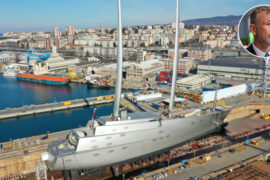
Bill Gates has never been subtle about his climate ambitions. Over the past decade, the Microsoft cofounder has poured billions into technologies that promise to reshape the global energy system, often with the confidence of a man who believes engineering can outrun the climate clock. One of his more unusual statements arrived on the water with the commissioning of Breakthrough, widely described as the world’s first hydrogen-powered superyacht. The vessel was a symbol of futuristic luxury wrapped in green credentials. Now Gates is making a far more consequential bet on land with a nuclear power project that could define the next chapter of his environmental crusade.

From hydrogen at sea to nuclear on land
The 390-foot Feadship superyacht Breakthrough captured headlines because it pushed the idea of hydrogen propulsion into the rarefied world of ultra-high-end yachting, making it a revolutionary step in the industry. The vessel was designed around hydrogen fuel cells that generate electricity through a chemical reaction between hydrogen and oxygen, producing nothing more than water vapor as exhaust. The system was conceived as a radical departure from the diesel engines that dominate the superyacht industry, replacing traditional fuel tanks with cryogenic hydrogen storage and a propulsion architecture built around electric motors.

At the heart of the concept is a 3.2-megawatt fuel cell system powered by cryogenic liquid hydrogen stored at minus 253 degrees Celsius in specialized insulated tanks. The hydrogen feeds the fuel cells, which generate electricity for the yacht’s propulsion and onboard systems without producing direct emissions.

The setup allows the vessel to operate in near silence while at anchor or cruise at around 10 knots using hydrogen alone, turning the yacht into a floating demonstration of what zero-emission maritime propulsion might look like at the highest level of luxury engineering.

The appeal was symbolic as much as technical. For Gates, the yacht functioned as a floating demonstration that uber luxury engineering could still point toward a cleaner future. Hydrogen propulsion promised silent operation, zero direct emissions, and a futuristic aesthetic that fit neatly with the billionaire’s broader investment narrative around climate innovation. Yet even with all its spectacle, Breakthrough was always closer to a proof of concept than a solution to the energy problem. A hydrogen superyacht can turn heads in Monaco. It cannot power cities.

The Natrium bet
That is where TerraPower enters the story. Gates co-founded the company in 2006 after becoming convinced that nuclear energy could be one of the few technologies capable of decarbonizing electricity at scale. Nearly two decades later, he remains its most visible champion, serving as chairman while personally committing around $1 billion to the effort.

TerraPower recently cleared one of its biggest hurdles after US regulators granted federal approval for the Natrium reactor to begin construction, marking the first new commercial nuclear plant in nearly a decade to receive such clearance. TerraPower’s flagship project is the Natrium reactor now under development in Kemmerer, Wyoming, a town better known for coal mining than nuclear innovation.

The location was chosen deliberately. The plant is being built near the retiring Naughton coal facility, turning an aging fossil fuel site into a launchpad for advanced nuclear energy while preserving grid connections and a skilled energy workforce. For Gates, the project represents something larger than a single reactor. It is an attempt to prove that nuclear power can evolve beyond the massive plants of the 20th century. Natrium uses a sodium-cooled reactor paired with molten-salt energy storage, allowing the plant to adjust its power output and making it easier to work alongside wind and solar generation on a modern grid.

Gates has long framed nuclear as a cornerstone of any realistic climate strategy. “Nuclear is ideal for dealing with climate change, because it is the only carbon free, scalable energy source that’s available 24 hours a day,” he has said in interviews. He also argues that nuclear provides something renewables alone cannot guarantee. “Nuclear energy, if we do it right, will help us solve our climate goals without making the electricity system far more expensive or less reliable.”

The contrast between Breakthrough and Natrium captures two sides of billionaire climate futurism. One floats through marinas as a glamorous symbol of clean technology. The other rises in a quiet corner of Wyoming with the far heavier ambition of reshaping the electrical backbone of the modern economy. One makes headlines for its engineering spectacle. The other could determine whether Gates’ long campaign to reinvent nuclear energy actually works.