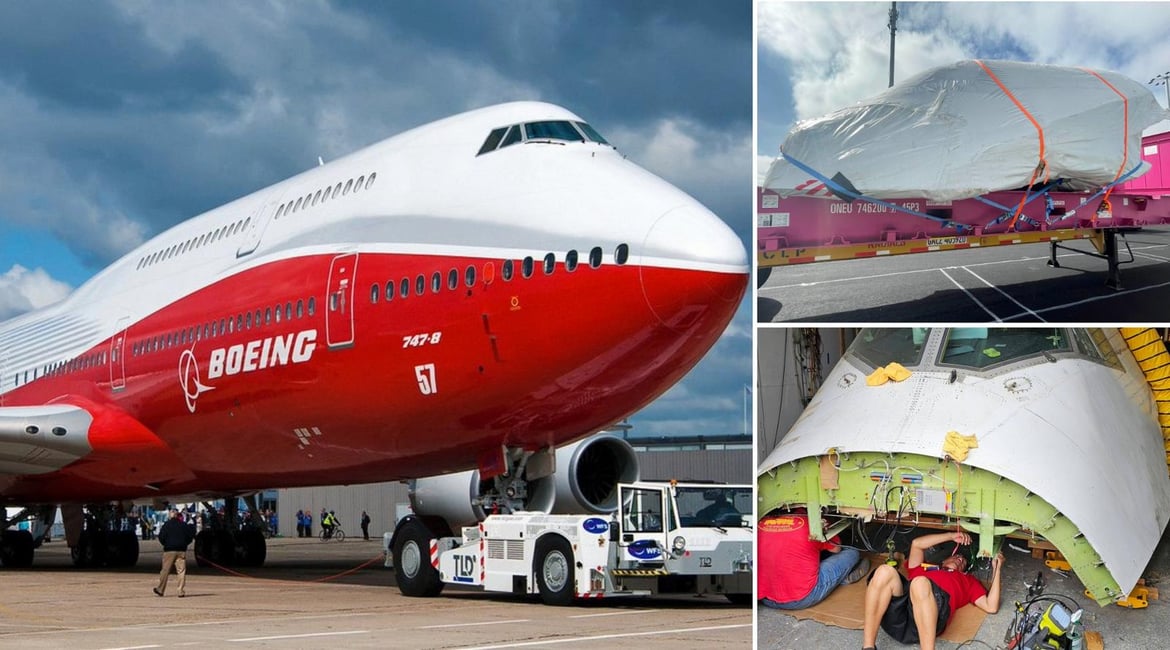
In a modest garage in San Jose, a group of California flight simulation enthusiasts is attempting something most pilots only dream of. Calling themselves the Jurassic Jets, they have purchased the cockpit of a real Boeing 747 Classic and are converting it into a fully functional simulator. Their goal is to have it ready for WorldFlight 2025, a week-long global charity event where teams around the world fly continuous virtual routes across every continent on the VATSIM network. While most groups use modern two-crew jets with digital “glass” displays, Jurassic Jets is doing something far more ambitious. They are rebuilding and flying a classic 747-200 in X-Plane, using a real 747-300 cockpit shell as the foundation.

The story began with a remarkable find. Their donor cockpit, airframe MSN 23640, rolled out of Boeing’s factory in 1987 and entered service with Japan Airlines as JA8179. Later, it was re-registered as VP-BGY for Transaero in Russia before ending its flying days in the United Kingdom.

For years, it sat parked at Bruntingthorpe Airfield, once a busy RAF base and now a home for retired airliners. When the aircraft was finally dismantled at St Athan, the cockpit section was separated and listed for sale on eBay in 2024. To the Jurassic Jets team, this was not just an opportunity to build a simulator but to save a piece of aviation history.

Unlike modern airliners that rely on digital avionics, the 747 Classic is entirely analog. Every gauge, switch, and lamp has its own wiring, and each of those wires must be identified, tested, and reconnected. The cockpit contains thousands of cut wires, remnants from its separation from the fuselage. Rebuilding it requires patience, documentation, and plenty of detective work. Classic instruments use systems like synchros and 400 Hz AC power, which are far more complex than modern DC or USB-based hardware. To make these gauges work with X-Plane, the team must design custom circuit boards that convert computer data into analog signals. It is a form of modern-day restoration, combining vintage engineering with digital ingenuity.

Authenticity is their priority. The Jurassic Jets have chosen to retain the original analog gauges, annunciators, and even the flight engineer’s station. They could have simplified everything with digital replacements, but the team believes that the tactile and visual authenticity of the real cockpit is what gives the 747 its soul. This decision also transforms the simulator into a unique teaching platform. Unlike two-crew jets where computers manage most systems, the 747 Classic demands full crew coordination. A captain, first officer, and flight engineer must constantly communicate, adjusting fuel transfers, managing pack temperatures, and balancing engine performance. It is a lesson in teamwork and old-school flying discipline that few modern pilots experience.

Building such a simulator is not just a technical challenge but a financial one. A cockpit shell alone can cost between $5,000 and $25,000, depending on its condition. Shipping and logistics, especially for a move from the UK to the United States, can easily add $10,000 to $30,000. Electronics, microcontrollers, and interface boards account for another $5,000 to $15,000, while computing hardware and visual projection systems can range from $5,000 to $12,000.

Even the structural work, including frames, casters, and stairs, adds several thousand more. The team keeps a contingency of around 20 percent, knowing that parts will break, designs will need rework, and nights will be long.
Yet the motivation is not commercial. It is passion. The Jurassic Jets are preserving aviation heritage in a living, functional form. When their simulator powers up for WorldFlight 2025, the hum of real relays and the glow of vintage instruments will tell a story that stretches from the factory floors of Seattle to the skies over Tokyo and Moscow. What began as a salvaged cockpit is becoming something greater — a tribute to the era when flying was mechanical, human, and gloriously complex.
Follow Jurassic Jets on their Twitch channel. If you’re flying WorldFlight, you can fly with them.