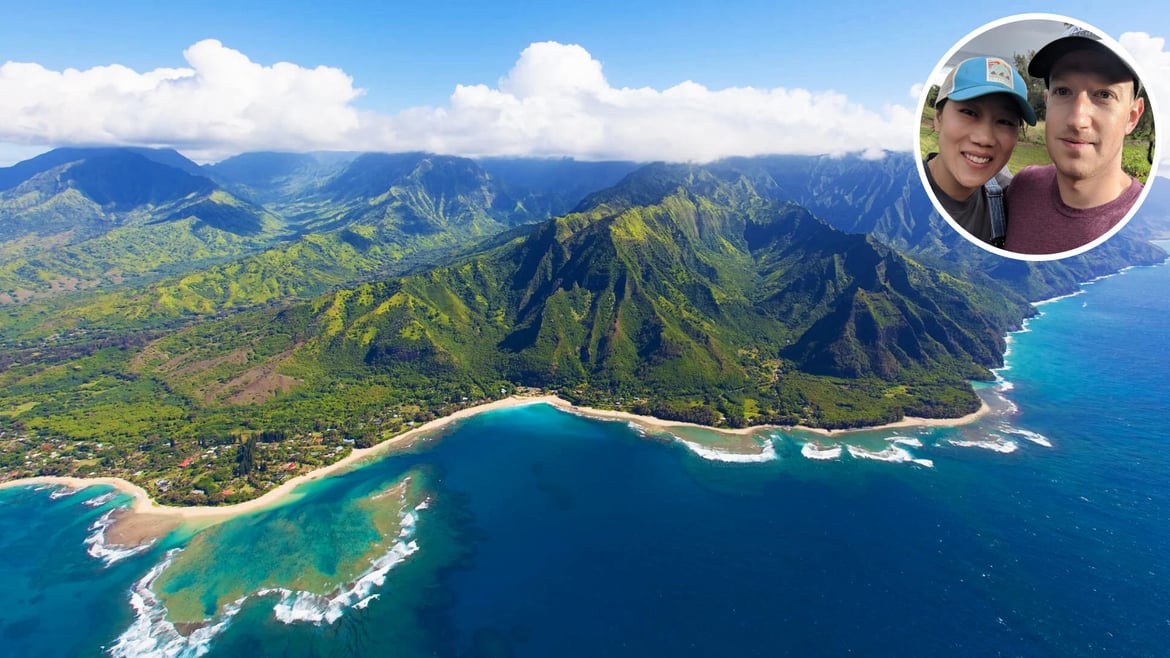
In 2014, Mark Zuckerberg arrived in Hawaii with a checkbook and a vision. He began by purchasing 700 acres of oceanfront land on Kauai’s north shore for $100 million. That marked the start of what would become one of the most controversial land acquisitions in modern Hawaiian history. A decade later, the Meta CEO has steadily, quietly expanded his footprint to over 2,300 acres, building a high-tech private compound so massive it now rivals the island’s annual operating budget in value.

While the initial land purchases were publicized with some fanfare, the more recent acquisitions have been deliberately low-key. The latest addition, a 1,000-acre parcel acquired for an estimated value of $65 million, was finalized without much attention, as reported by the New York Post. Yet the numbers are staggering. Zuckerberg’s Koʻolau Ranch now spans an area nearly three times the size of New York’s Central Park and as large as 1,740 NFL football fields. The property stretches from the mountains to the ocean and encompasses forested hillsides, pristine farmland, and sacred burial grounds.

Quiet lawsuits, loud backlash
For many Native Hawaiians, Zuckerberg’s landholdings are more than just a billionaire’s playground. They represent a painful chapter in the long struggle to retain ancestral land. That pain resurfaced in 2016 when Zuckerberg filed a series of lawsuits aimed at identifying the descendants of 14 small Kuleana land parcels scattered throughout his estate. These parcels, awarded to Native Hawaiian commoners during the 1800s land reform known as the Great Mahele, were tiny by comparison and often less than an acre each, but they carried deep cultural and genealogical significance, as pointed out by Civil Beat.

Zuckerberg’s lawsuits were filed under a legal process called “quiet title,” often used to clarify ownership when parcels are split among many descendants. However, critics say the process is frequently abused by wealthy landowners to pressure families into selling. In many cases, descendants do not even know they own a share until a court summons arrives. Few can afford the legal fees to fight back. The backlash was immediate. Native Hawaiian families accused Zuckerberg of using the courts to dispossess them of their birthright. Activist Healani Sonoda-Pale likened it to legal stealing and called for Kuleana landowners to be protected like endangered species.

The lawsuits sparked national headlines and local outrage. Under pressure, Zuckerberg dropped the lawsuits in 2017 and issued a statement saying he wanted to make things right. However, for many residents, the damage was done. The quiet title strategy had exposed the imbalance of power between tech billionaires and island communities, where a modest plot of land carries generational meaning that goes far beyond its market value.

Lawmakers respond with reform
In the wake of the lawsuits, Hawaii lawmakers introduced a bill aimed at curbing the use of quiet title lawsuits. The legislation would require wealthy landowners to first attempt mediation before heading to court. This move was designed to reduce legal costs for small landowners. The bill, passed by the state House and later amended by the Senate Judiciary Committee, also requires that plaintiffs, typically large estate holders, pay the cost of mediation. Only if deemed equitable by a judge could they recover those costs.
Though slow-moving, the bill marked a turning point. It acknowledged that Kuleana land and the people who inherit it deserve a level of protection from predatory legal tactics. Still, critics argue that legislation alone cannot stop the tide of wealth reshaping the island’s cultural and physical landscape.

A fortress in paradise
Zuckerberg’s estate is more than just expansive. It is fortified. Koʻolau Ranch is a self-sustaining fortress, outfitted with its own water, food, and energy infrastructure. Permits and drone imagery reveal two massive mansions connected by underground tunnels, several guesthouses, a gym, a tennis court, and even disc-shaped treehouses suspended in the forest. The centerpiece is a 5,000-square-foot underground bunker, complete with blast-resistant doors and a tunnel with a hidden escape hatch.

The level of secrecy rivals that of a tech campus. Workers are bound by strict non-disclosure agreements. The estate is lined with motion sensors, security cameras, and keypad-controlled entrances. In one part of the property, a known Native Hawaiian burial site is fenced off and reportedly maintained by the staff. One local resident, Julian Ako, whose family members are buried there, had to petition for access. He fears other burial sites may never come to light if discovered.

Most recently, Zuckerberg filed for permits to construct three more multi-million-dollar buildings on the estate. These are described as large dormitory-like structures with 16 bedrooms and 16 bathrooms, complete with a 1,300-square-foot open-air lanai. The construction cost alone exceeds $30 million, a sum nearly equivalent to the entire annual public infrastructure budget of the island of Kauai.

Zuckerberg’s representatives say the ranch is a hub for regenerative agriculture and conservation. They point to orchards of macadamia nuts and fields of turmeric and ginger. They highlight the estate’s contributions to local nonprofits and sustainability efforts. However, critics argue that the larger narrative is one of imbalance. In an island state where locals struggle with housing, food security, and cultural loss, one man now owns a private refuge larger than many small towns.
For locals, the fear is not just about acreage. It is about the precedent. If one billionaire can use his wealth to slowly absorb an entire coastline, what stops others from following? The island may be lush and tranquil on the surface, but beneath it lies a simmering tension. This tension pits money against memory and private ambition against public heritage.
Zuckerberg’s Hawaiian dream is a reality built on stone, steel, and silence. For many on Kauai, it is also a painful reminder of how easy it is to lose paradise, one parcel at a time.