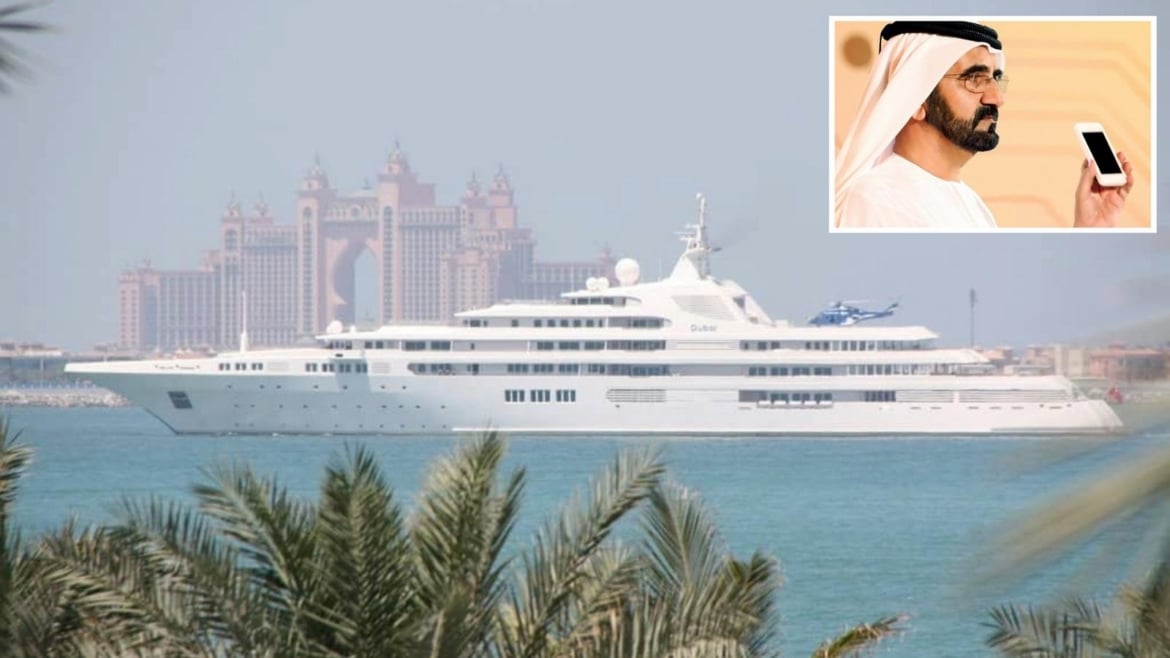
The story of the 531-foot superyacht Dubai has always been framed through scale, ambition, and the kind of opulence that borders on architectural excess. Yet one of its most revealing moments is not about gold finishes or cascading staircases but about something far more ordinary. During a late-stage visit, the Emir of Dubai stepped onboard and realized that his $500 million floating palace had a flaw that could not be ignored, because the lower decks did not offer a clear mobile signal.

What followed was not a software fix or a quiet engineering tweak hidden behind panels, but a physical reversal of finished work. Ceilings that had already been installed were ripped open again so that repeaters could be fitted into the structure, a decision recalled by Kostis Antonopoulos, the former managing director of Platinum Yachts, to Boat International. His brief but vivid account captures the moment when luxury collided with usability in the most literal way.

When a floating palace behaves like a building
The problem itself was entirely logical once you step back from the spectacle. Dubai is not just a yacht but a multi-deck structure built from dense layers of steel, aluminum, cabling, and richly finished interiors that naturally weakened mobile signals as they traveled inward. Lower decks, buried deep within the hull and surrounded by thick structural elements, became inevitable dead zones where reception dropped from inconvenient to unusable.

On a vessel of this scale, the physics begins to resemble that of a high-rise building rather than a boat. Signals that move freely across open decks struggle to penetrate enclosed compartments, and without a distributed system in place, entire sections of the yacht fall silent. The issue was not the absence of signal altogether but the inconsistency of it, the kind of patchy reception that undermines the expectation of seamless connectivity in a world where communication is assumed to work everywhere.

Solving that problem required a solution borrowed from land-based infrastructure. External antennas positioned higher on the yacht would capture the strongest available signal, while internal repeaters would rebroadcast it through corridors, cabins, and lounges that otherwise sat cut off from the outside world. To install that system at such a late stage meant reopening headliners, routing new cabling, and carefully integrating components into spaces that had already been completed to an exacting standard.

What makes this episode so compelling is not just the technical explanation but the timing. By the point where ceilings are being reopened, a yacht is no longer a construction project in the conventional sense. It is a finished environment where every surface has been designed, installed, and approved. Any change at that stage carries a ripple effect that touches craftsmanship, cost, and schedule all at once.
There is no cost published for the refit, but given that Dubai was the largest yacht in the world at the time, even a focused intervention like this would likely have run into hundreds of thousands of dollars.

The decision to proceed anyway reveals something essential about the priorities behind Dubai. The owner, Sheikh Mohammed bin Rashid Al Maktoum, was not simply inspecting grandeur or admiring scale but testing how the yacht functioned in everyday terms. On a royal vessel, connectivity was not treated as an optional extra but as a baseline expectation, something as fundamental as lighting or climate control.

It also underscores how even a project involving nearly 800 workers and a vast network of contractors could still pivot around a single observation. One moment of dissatisfaction was enough to send teams back behind finished surfaces, carefully undoing and rebuilding parts of a yacht that was already nearing completion.

In the end, the image lingers because it strips away the illusion of perfection. Beneath the polished surfaces of one of the world’s most extravagant yachts, there was still room for correction, adjustment, and the kind of practical problem-solving that turns a showpiece into something truly livable.