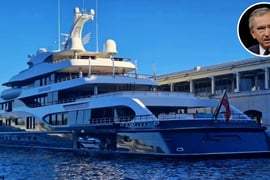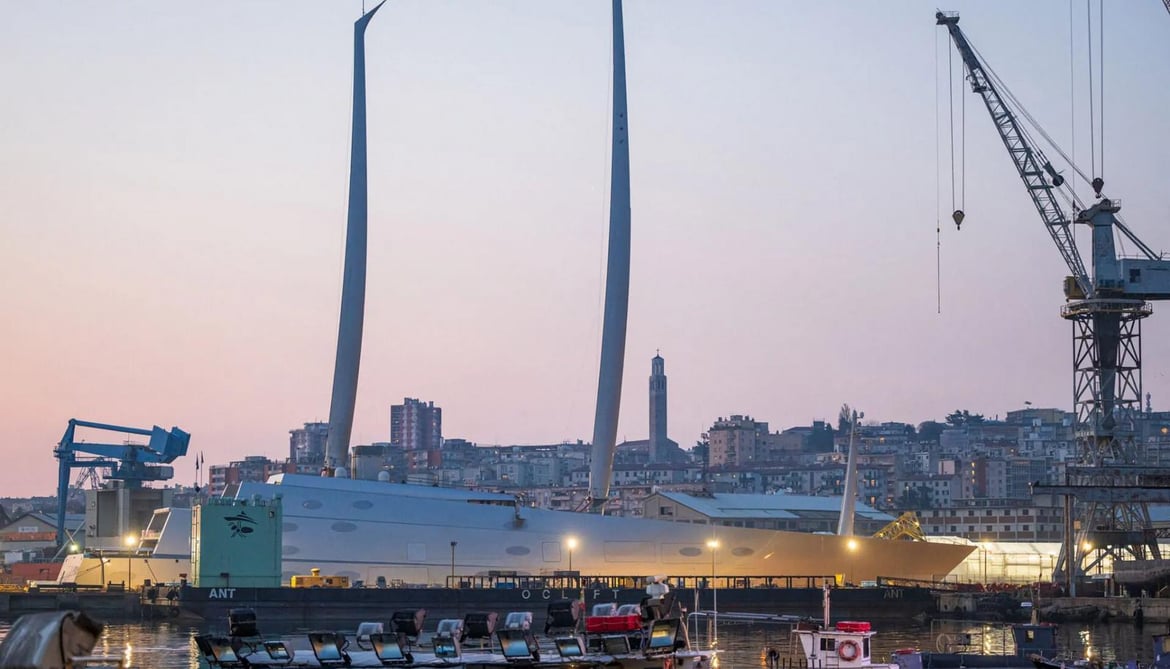
For three years now, the Italian port city of Trieste has lived with one of the most surreal backdrops in Europe. Anchored just off the Rive is Sailing Yacht A, the futuristic 143-meter vessel owned by Russian-linked billionaire Andrey Melnichenko and seized under European Union sanctions in March 2022.

Its towering masts now form part of the city’s skyline, attracting tourists who gawk at the massive silhouette. Yet behind that spectacle lies a less glamorous reality. The upkeep of the yacht has become a financial thorn, and Trieste’s mayor Roberto Dipiazza has grown vocal about it.
In late September, Dipiazza vented his frustration by publicly asking, “Chi pagherà i 30mila euro di spese al giorno?” or “Who will pay the €30,000 in daily expenses?” His words underline the cumulative burden of keeping the yacht safe and operational while it remains immobilized. Local outlets have estimated the tally at between €20,000 and €30,000 per day, which translates into about €9 million (about $10.5 million) a year. After three years, the cost nears €27 million (almost $32 million), a staggering sum by any civic yardstick.

What does this daily bill cover? It is not just a parking fee. A skeleton crew remains on board to keep essential systems alive. Security patrols monitor the vessel, port pilots remain on call, fuel is burned to power the generators, and insurers demand their share. The yacht may be frozen, but its systems cannot be allowed to fail. Italian reporting has pieced together how each of these costs combines into a daily total that rivals the operating budget of many municipal projects.

Dipiazza’s frustration becomes even clearer when compared to the city’s own spending priorities. Trieste recently earmarked €850,000 (roughly $1 million) for the maintenance of its historic tram network, a sum that barely covers a month of keeping Sailing Yacht A afloat. The contrast between local investment in public services and the millions spent preserving a sanctioned oligarch’s toy captures the essence of the mayor’s anger.

Legally, the matter is complex. The vessel is under “congelamento amministrativo,” an administrative freeze, not a confiscation. That distinction is critical. Courts have consistently ruled that a frozen asset must be returned in comparable condition should sanctions be lifted or if the owner successfully challenges the listing.

Italy, acting as custodian, must cover the expenses now. Later, if Melnichenko regains control, the state can attempt to recover those custodial costs. Until then, taxpayers effectively bankroll the yacht’s preservation.

For Trieste, this leaves an odd duality. On the one hand, Sailing Yacht A is a bizarre tourist curiosity, a symbol of wealth and power stranded in limbo. On the other, it is a financial liability, a floating reminder that geopolitics can reach deep into local ledgers. For Mayor Dipiazza, the sight is less a marvel of design and more a daily invoice that refuses to go away.