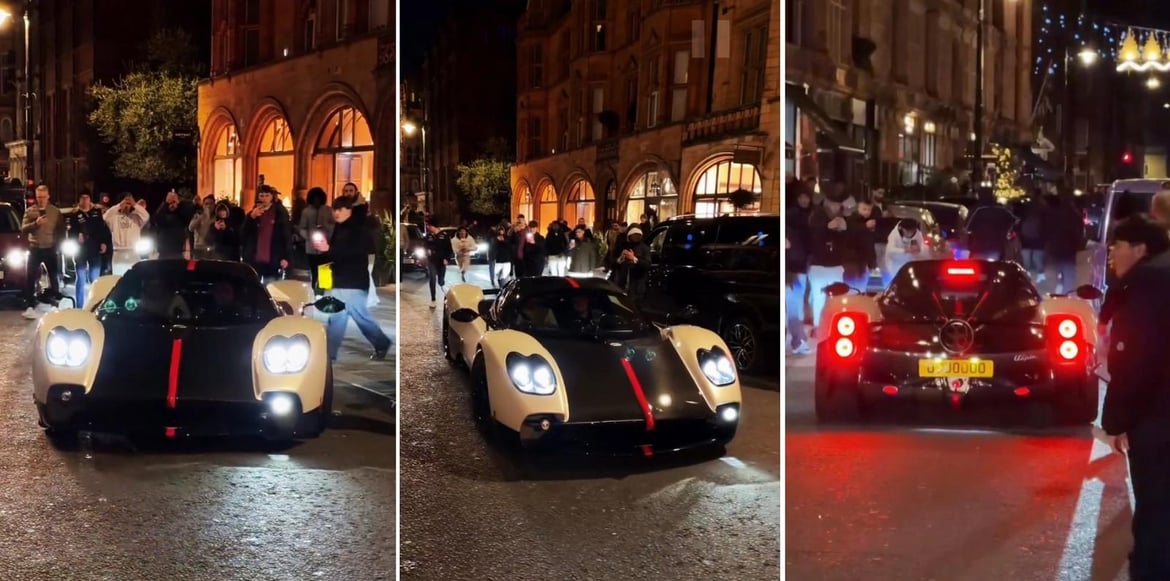
On a Saturday that should have been unremarkable by London standards, a quiet street briefly turned into a theatre. Phones came out first. Then people stopped walking. Then traffic slowed. A Pagani Utopia, finished in a Cinque-inspired livery, sat still while the city reorganized itself around it. In a place where Lamborghinis idle at cafés, and Bugattis do school runs, this one still managed to pull a crowd in minutes.

The reason was obvious once you got closer. This was not a standard Utopia. The car wore the unmistakable visual language of the Zonda Cinque, one of the most revered hypercars built by Pagani. White bodywork met exposed carbon fiber in sharp, deliberate contrast. Red accents cut through the surfaces with intent rather than decoration. A single red stripe ran down the centerline, unapologetic and perfectly straight, as if daring you to look away.

The details did most of the talking. The wheels carried red pinstripes, subtle but precise, paired with matching red center-lock nuts that tied the whole composition together. It was the kind of spec that does not shout from across the street, but once spotted, refuses to let go. People leaned in. Photos turned into videos. Conversations shifted from casual to reverent.

Inside, the Cinque theme continued without theatrics. Black leather wrapped nearly every surface, stitched through with red thread that traced the cabin like a heartbeat. Red leather inserts on the doors broke up the darkness, reminding you that this was not just a design exercise but a deliberate homage. The interior felt crafted rather than assembled, a place shaped by hands rather than software.

Underneath the visual drama sat the reason the Utopia exists at all. A 6.0-liter twin-turbo V12 producing 864 horsepower and 811 pound-feet of torque, delivered with a flexibility that feels increasingly out of step with modern hypercars. The engine pulls hard from low revs and keeps pulling, less about peak numbers and more about sensation. Buyers can choose a seven-speed automated manual, or something far rarer now, a proper three-pedal manual that treats driving as an act rather than a setting.

What made the moment remarkable was not just the car, but the reaction to it. London sees everything. Yet this Utopia managed to stop strangers mid-sentence and hold their attention without so much as a blink. It did not need noise or speed. It relied on presence, heritage, and restraint. For a brief stretch of the afternoon, the city belonged to a parked Pagani. And nobody seemed to mind waiting.