Boom Supersonic is once again resetting the clock on the return of commercial supersonic travel, this time with a claim that lands with unusual precision. According to CEO Blake Scholl, the company expects its long-awaited airliner to enter production in about 2 years. It is a statement that cuts through years of concept art and prototype testing and plants a firm marker on the timeline, one that now invites scrutiny as much as it signals ambition.
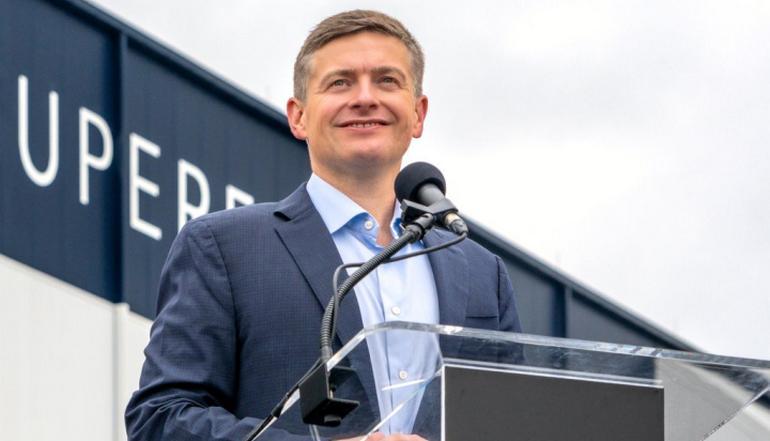
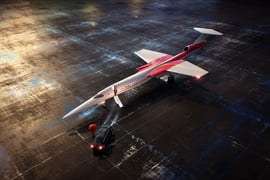
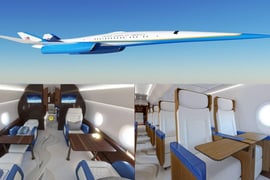
The aircraft in question is Overture, a Mach 1.7 jet designed to carry between 60 and 80 passengers across 4,250 nautical miles at 60,000 feet. “We’re starting production of that airplane in about two years,” Scholl said on Fox News Business’ Varney & Co. show.

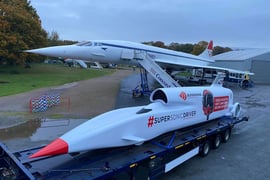
Boom continues to position it as a premium business tool rather than a nostalgic tribute to Concorde, with fares aligned closer to modern business class than the rarefied pricing of the past. Orders and pre-orders from American Airlines, United Airlines, and Japan Airlines give the program a commercial outline, but the credibility of that outline now rests heavily on the two-year production claim. Boom’s demonstrator aircraft, the XB-1, has already completed supersonic test flights, offering an early proof point for the aerodynamics and control philosophy behind the larger jet.

A factory with scale, ambition, and a ticking clock
That claim runs directly through Greensboro, where Boom has established its manufacturing base at Piedmont Triad International Airport. The site has been framed as the first dedicated US factory for supersonic airliners, with long-term plans that read like a statement of industrial intent. At full stride, the assembly lines are expected to produce 33 aircraft annually, with a second line doubling output to 66.

The reality on the ground is more layered. Early descriptions pointed to a 400,000-square-foot campus spread across roughly 65 acres. More recent updates describe an initial factory building closer to 150,000 square feet, alongside about 24,000 square feet of office space on a 62-acre site. The distinction matters because it separates the idea of a completed campus from the more complex challenge of a production-ready facility. A finished building is not the same thing as a functioning assembly line capable of delivering supersonic aircraft at rate.
Greensboro is also carrying weight beyond manufacturing. Boom and North Carolina officials have positioned the project as a regional catalyst, with projections of more than 1,750 jobs by 2030 and over 2,400 by 2032, alongside hundreds of internships and a multibillion-dollar economic impact. Beneath that optimism sits a quieter pressure point. Public reporting indicates the lease could be terminated if the workforce falls short of 500 employees by the end of 2026. That does not end the program, but it does place a visible clock on the site that underpins the two-year production narrative.

The engine that decides whether 2 years is realistic
If the factory defines the stage, the engine defines whether the play can begin at all. Overture depends on Symphony, Boom’s in-house turbofan developed after the company failed to secure a traditional engine partner. It is described as a purpose-built, medium-bypass design capable of running on sustainable aviation fuel, meeting modern noise standards, and operating without afterburners. Recent figures place it in the 40,000-pound thrust class, a subtle evolution from earlier numbers that hints at a design still being refined.

Testing is the immediate hurdle. Boom has established a development site at the Colorado Air and Space Port and plans to expand full-scale testing through 2026. The engine’s progression from prototype to production will ultimately dictate whether the broader timeline holds. Even the planned manufacturing pathway, which includes engine production at StandardAero’s San Antonio facility, depends on Symphony reaching maturity on schedule.

This is where the two-year claim sharpens into something more consequential than a headline. Supersonic travel has always struggled in the gap between engineering possibility and commercial execution. Boom is attempting to close that gap with a synchronized push across aircraft design, engine development, and factory readiness. The promise of production within 2 years suggests that all three will converge at precisely the right moment. History suggests that it is the hardest part.