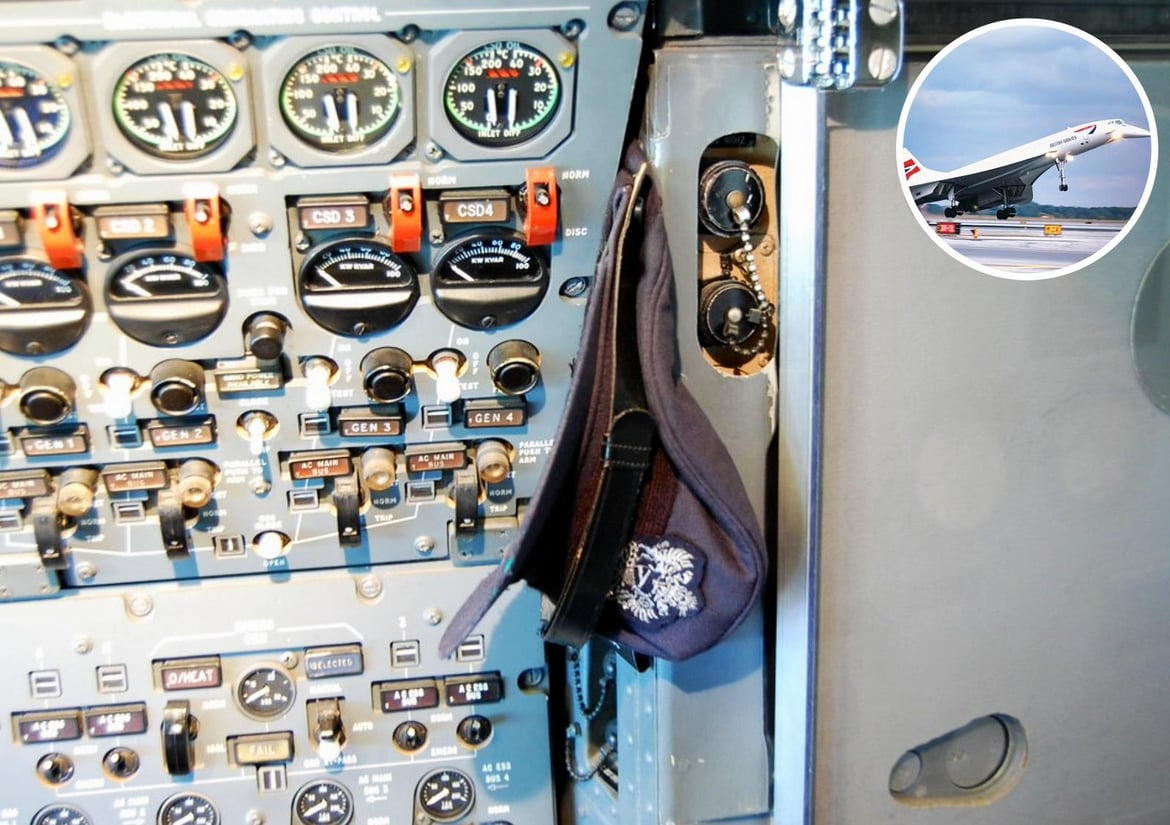
The Concorde is an engineering marvel that is yet to be commercially replicated. On its final flights, crews carried out a ritual that perfectly symbolized the jet’s astonishing abilities. As the aircraft settled into its cruise at Mach 2, the fuselage heated up and stretched. A narrow seam would open beside the flight engineer’s electrical panel, wide enough to slip in a British Airways cap.

At the end of the flight, as Concorde descended and cooled, the aluminum skin contracted again, closing the gap and trapping the cap forever within the airframe. An extremely rare photograph captures this very moment, making the ritual more than just a story passed down among crews.

This simple act wasn’t just a quirky tradition. It was living proof of the extremes Concorde endured every time it pierced the sky at twice the speed of sound. Supersonic cruise generated fierce aerodynamic heating, raising the skin to temperatures that would alarm passengers on any other jet. At the nose, engineers recorded figures as high as 261°F (127°C). The wing leading edges often reached about 212°F (100–105°C), while most of the fuselage settled between 194 and 203°F (90–95°C).

The jet’s airframe was made of Hiduminium RR.58, a specialized aluminum alloy. It could tolerate around 261°F (127°C) for its operational life, which meant pilots carefully managed speed not for lack of thrust, but to protect the metal from overheating. At those temperatures, the entire 202-foot Concorde stretched by 7 to 12 inches. That expansion was most visible to the crew at the seam beside the engineer’s station, where the caps went in.

Paint even played a role in Concorde’s performance. Its brilliant white finish was not chosen for style but for survival. A darker color would have absorbed heat, raising the skin temperature by several degrees and shortening the airframe’s life. On Concorde, even aesthetics bowed to the physics of speed.

The ritual of sealing a cap in the fuselage became most famous during the retirement era. On British Airways Concorde G-BOAG’s delivery flight to Seattle in 2003, flight engineer Trevor Norcott slipped his BA cap into the expansion gap while supersonic over Canada. As he later explained, “The Hat was meant as a permanent link between the aircraft and the crews.” Hours later, as the jet cooled on the ramp in Seattle, the seam clamped down, locking the cap inside. To this day, visitors walking past G-BOAG at the Museum of Flight unknowingly pass a hidden time capsule wedged between metal panels.

Concorde itself was a marvel that redefined commercial flight. Launched in the 1970s, it carried fewer than 100 passengers in unparalleled luxury, crossing the Atlantic in just three and a half hours. Life on the flight deck was intense, as Chief Concorde Pilot Capt. Mike Bannister famously put it: “Twice as fast, twice as high, and twice as many things to do.” The aircraft demanded absolute concentration but rewarded its crews with experiences no other airliner could offer.

Yet it’s stories like the cap ritual that preserve Concorde’s mystique. More than a technical demonstration, it was a human gesture acknowledging the bond between crew and machine. The hats, sealed forever inside aluminum seams, stand as quiet reminders of the only airliner to live and die at Mach 2.