Emirates is preparing to redraw the boundaries of commercial aviation luxury once again, this time by exploring something that sounds less like an airline feature and more like a private residence in the sky. We’re talking about fully enclosed en-suite bathrooms for every first-class passenger. The idea, revealed by Emirates’ President Tim Clark at an industry summit in Berlin, is not a confirmed product but a carefully signaled ambition that fits neatly into the airline’s long-standing habit of announcing the future before it exists.
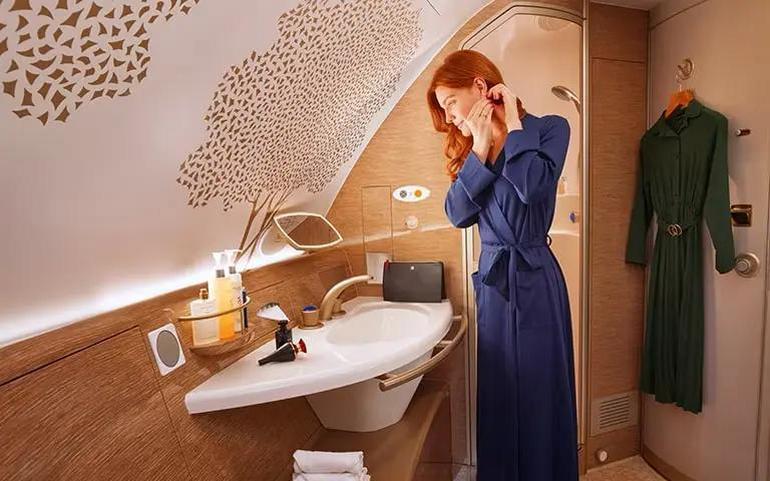
For an airline that turned heads in 2008 by installing shower spas on the Airbus A380, this is not a sudden leap but a deliberate next step. Emirates has spent the last two decades transforming first class from a premium seat into a self-contained experience defined by privacy, spectacle, and excess. Fully enclosed suites with floor-to-ceiling doors, on-demand dining, and personalized cabin environments have already blurred the line between commercial aviation and private travel. Adding a private bathroom to each suite pushes that logic to its natural extreme.

The distinction here is important because private bathrooms in the sky are not entirely new. Etihad Airways introduced a private shower and bathroom within its Residence suite more than a decade ago, but that was a singular offering designed for one passenger or a couple at the very front of the aircraft. Emirates is contemplating something far more ambitious by attempting to scale that level of privacy across an entire first-class cabin, effectively turning each suite into a sealed personal space that removes the last remaining shared element of the experience.

What makes this proposal particularly intriguing is where it might land. The long-delayed Boeing 777X has quietly become the most likely platform for such a concept, given its wider cabin and the opportunity it presents for a clean-sheet interior design. A low-density configuration with only a handful of suites could make the spatial mathematics just about workable, although the engineering challenges remain formidable. Water storage, waste systems, weight penalties, and certification requirements are not design details that can be solved with mood lighting and polished finishes, and each of them carries real implications for range, efficiency, and cost.

Yet the technical hurdles are only part of the story. Emirates is not simply designing a bathroom but redefining what first class is supposed to represent in an era where business class has become increasingly sophisticated. By pushing toward complete privacy, the airline is effectively repositioning first class as a hybrid between commercial aviation and private jet travel, where the passenger is not just comfortable but entirely insulated from the rest of the aircraft.

There is also a competitive undertone to this announcement that is difficult to ignore. When Clark speaks publicly about ideas still on the drawing board, it is rarely accidental. It is a signal to the industry that Emirates intends to set the pace once again, forcing rivals to decide whether to follow into a space that is as expensive as it is exclusive or concede the uppermost tier of luxury altogether.
Whether en-suite bathrooms in every first-class suite ever make it from concept to cabin remains uncertain, but the direction of travel is unmistakable. Emirates is testing how far the idea of privacy can be pushed inside a metal tube at cruising altitude, and in doing so, it is quietly turning the future of first class into something that looks less like a seat and more like a collection of private worlds, each one complete, enclosed, and entirely its own.