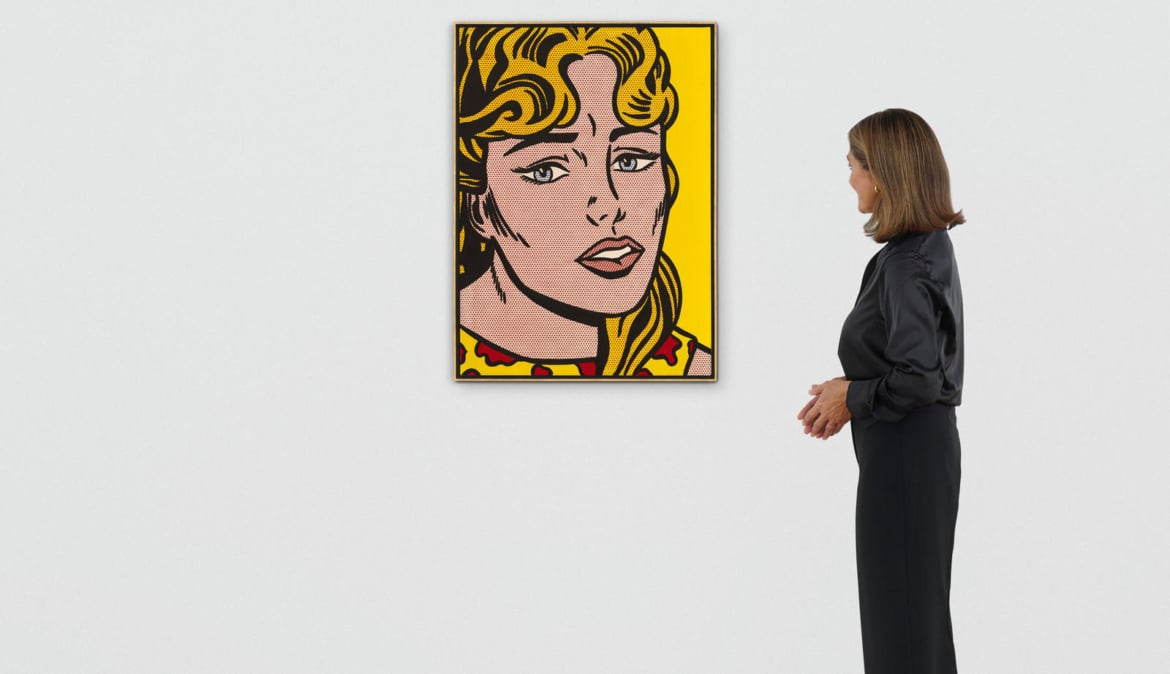
With just one stroke, Roy Lichtenstein turned a love-triangle illustration into a psychological portrait, and that masterpiece is now heading to auction with a $60 million high estimate. Christie’s 20th Century Evening Sale in New York will witness the action unfold, first from comic book to canvas, and now from a private collection to the auction block, where this 1960s work by the Pop master could rank among his most expensive works ever sold. Anxious Girl (1964) carries an estimate of $40 million to $60 million and features a troubled blonde inspired by the woman gracing the cover of DC Comics’ 1963 publication Girls’ Romances #97, “Too Much to Ask!”

The 36-by-26-inch artwork, made in acrylic and graphite pencil on canvas, has been kept away from public view for more than 30 years. Once owned by Horace and Holly Solomon, the flamboyant New York collectors deeply tied to the Pop Art world, the painting now returns to the spotlight as one of only ten works from Lichtenstein’s 1963 to 1965 breakthrough period that show an individual woman as the sole subject. At first glance, Anxious Girl appears to be a screenshot from a comic book scene. In reality, it is a painstakingly handmade image formed by a field of Lichtenstein’s iconic Ben-Day dots, each meticulously applied by the artist’s hand.

Right: Anxious Girl (1964), the present lot illustrated in close-up detail.
Unlike the original comic cover, which portrayed a chic 1960s blonde caught in a love triangle, Lichtenstein’s retelling strips away the plot, the men, and the obvious drama. What remains is her face, her gaze, and one tiny but powerful addition, a furrowed brow. That single painted line changes everything, converting her expression into one of worry, turning a mass-market romance image into a multi-million psychologically loaded masterpiece. Lichtenstein once said, “I don’t draw a picture to reproduce it, I do it in order to recompose it.”

True to his words, Lichtenstein’s creation, Anxious Girl, displays a masterful use of bold outlines, a Pop palette, and hand-painted dots that mimic mechanical printing. And boy, does he make them count. What began as a disposable comic-book image has become a handmade icon of art and culture, that could now sell for the price of a Gulfstream. The painting, which will lead the house’s marquee 20th-century art evening sale on May 18.