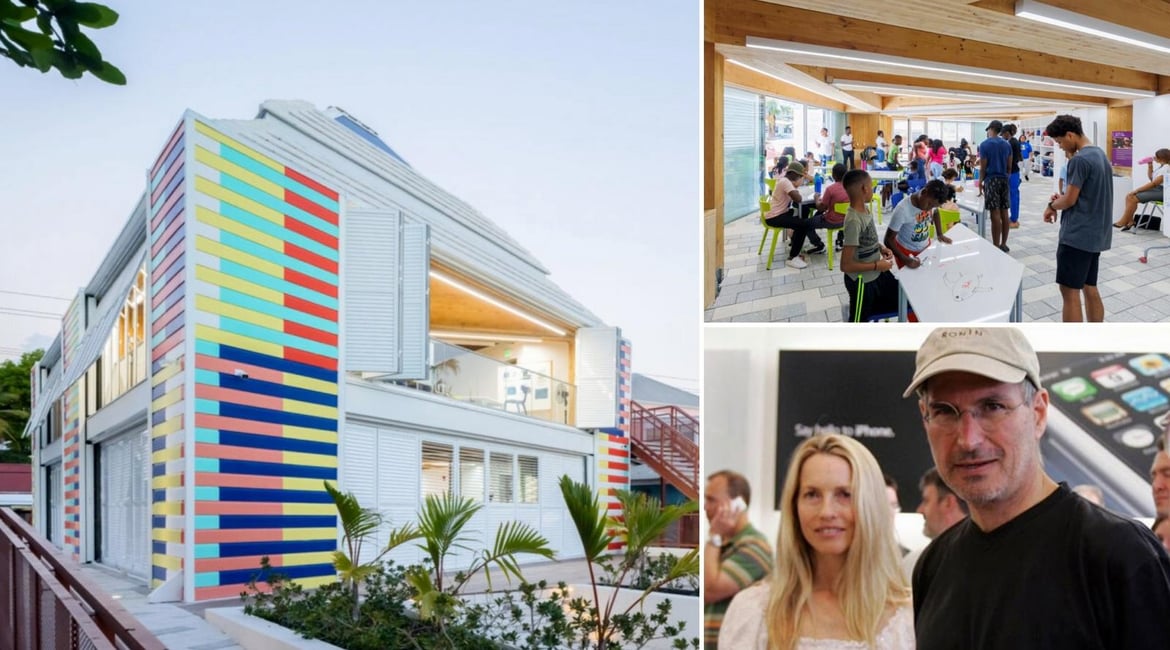
When you think of the late Steve Jobs, you think of a visionary. The same can be said of his widow, Laurene Powell Jobs, who is certainly carrying the baton with indisputable elan and efficiency. The founder of Emerson Collective has done the unthinkable and is quietly helping to revolutionize both architecture and education. Through Laurene’s XQ Institute (part of Emerson Collective), and working with design studio AMMA alongside architects Débora Mesa and Antón García-Abril of Ensamble Studio, the first structure in a system of modular schools was developed in an industrial warehouse in Pinto, Madrid, and is now up and running on the beachfront at Carlisle Bay in Bridgetown.

Called the Oceana Innovation Hub, it opened in June 2025 and is being lauded by locals, ministers, and students as a climate-resilient, zero-carbon, zero-energy, self-cooling facility powered by solar and wind. It is not only an example of the power of design but also of execution, as everything was prefabricated in Spain, shipped across the Atlantic, and assembled in about ten months.

The mass-timber classroom modules were developed with Madrid-based WoHo Systems, using Spanish timber at a time when Barbados has strict limits on local timber because of historic deforestation. The bespoke school building, spread across 7,075 square feet with a construction budget of nearly $6 million, has set a precedent that many will follow in Barbados, as stated by Prime Minister Mia Mottley. She has even praised the idea of stacking the same triangular modules into a residential tower in Barbados, whose revenue could help finance more schools.

Speaking of the triangular modules, each classroom is an equilateral triangle of eleven meters per side and two floors high, specifically designed to handle humidity, high winds, and termites in Barbados. The form borrows from the island’s traditional chattel house, with a steep pyramidal roof that sheds wind and allows the building to act as a safe haven during those dreaded one-hundred-year storms. The entire system is engineered to fit in standard shipping containers and be assembled on simple flat slabs, so a project that starts in Pinto can quite literally land on the sand at Carlisle Bay as an Apple-grade school system for climate-hit regions. Inside, everything follows this triangular, chattel-house-inspired logic, from the structure to the way space is carved up for teaching and collaboration.

The openness, mathematics, treatment of space, and overarching vision bring to mind an eerie similarity to Apple Stores that work on a similar platform of purity and precision. There are no unnecessary or distracting design elements; in fact, quite the opposite. The structure is stripped back to exposed mass-timber frames and large, clear volumes.

Akin to Apple’s giant glass walls, the school structure pours in oodles of natural light through the pyramidal skylights. There is a deliberate lack of convention inside. Instead of fixed rows of desks, students use triangular, multi-postural furniture and layouts that change as per need, flipping from intimate clusters to presentation mode in minutes.

Thanks to Laurene Powell Jobs’ vision and dedication to education, the facility functions as a hub where students, locals, and visitors engage with ocean resources and marine ecosystems, while also supporting research, public programming, and entrepreneurial development tied to Barbados’ Blue and Green Economies. The Oceana Innovation Hub is only the first step, the opening move in a three-campus system that XQ and Barbados plan to roll out nationally and then globally.

It offers genuine hope to other hurricane-belt geographies that are watching closely. It is incredible what minds can achieve when they decide to surpass traditional roadblocks and even geography. A beautiful butterfly effect in my opinion, and a hugely beneficial one.