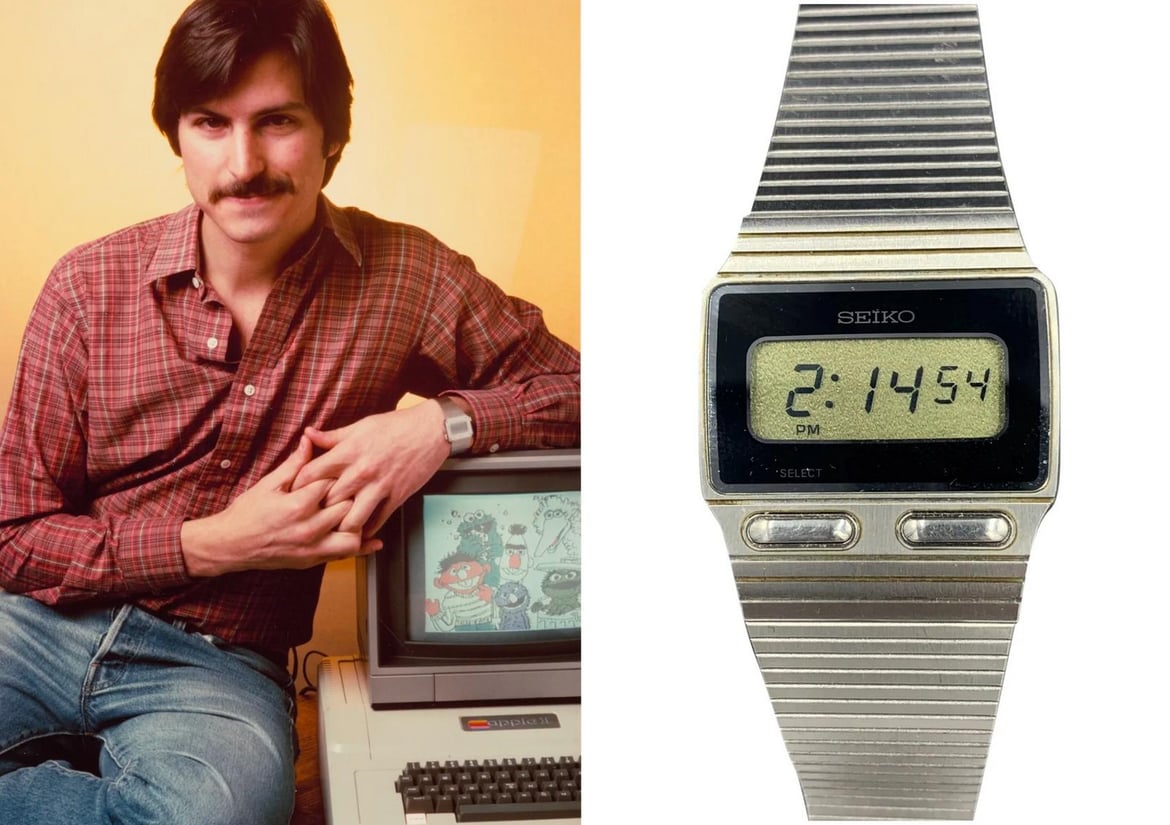
The most Apple Watch before there was an Apple Watch might not have been made in Cupertino at all. In a rare 1981 photo included in Make Something Wonderful, a posthumous collection of Steve Jobs’ words released more than a decade after his death, Jobs is pictured wearing a Seiko D031-4000 “Dot Matrix” watch. It is a simple, rectangular digital tool with a pioneering dot-matrix screen, and in many ways, it embodies the same design philosophy that Jobs later embedded into Apple’s DNA.
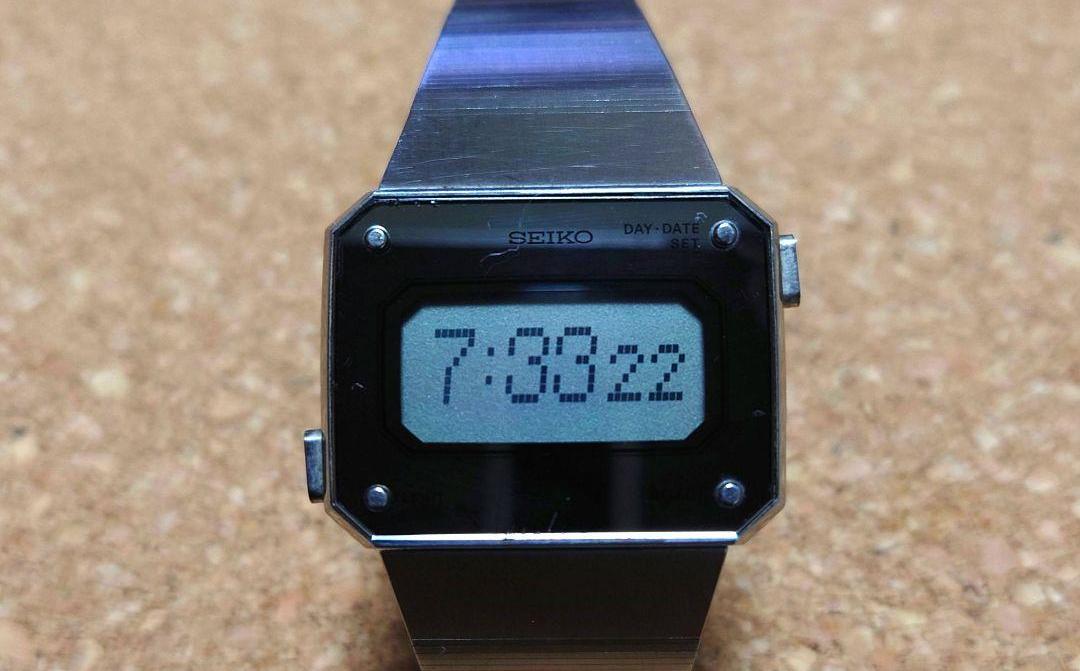
The D031 was Seiko’s first watch to feature a dot-matrix LCD. Released around 1980, it offered a handful of straightforward functions: time, day, date, alarm, and a backlight. In Japan it retailed for about ¥25,000 to ¥30,000 at launch (roughly $110 to $150 in 1981). Some versions even allowed multilingual day displays. Most distinctive was its animated right-to-left sweep that appeared on the hour. Unlike the calculator watches and feature-cluttered novelties of the time, the D031 was built with focus and clarity, leaving out gimmicks in favor of a cleaner experience. Jobs’s own words on design seem to apply directly here: “Design is how it works” and “Simple can be harder than complex.

Jobs had long credited Zen aesthetics and Japanese minimalism with shaping his approach to design. The Seiko D031 mirrored that sensibility — an unfussy, mass-market watch designed to do a few things well, rather than many things poorly. The plain case and practical strap fit neatly into Jobs’s larger vision that tools should be elegant by virtue of their clarity, not by decorative excess. He may have driven a Porsche, but he wore a Seiko that cost little, proving that for him, design integrity mattered more than price.

The parallels with Apple’s later design language are striking. The watch case is a soft rectangle with rounded edges, close to the “squircle” geometry that Apple later used for iOS icons, the iPhone’s silhouette, and the Apple Watch case. Its dot-matrix numerals echoed the bitmap grids of the Macintosh era, where Susan Kare’s pixel-based icons defined Apple’s first human interfaces.

The D031’s layout, large numbers for the time, smaller information tucked below, anticipated the information hierarchy Apple would later adopt in menu bars, status areas, and Apple Watch faces.

Even the controls spoke Apple’s language. Two labeled buttons, “light” and “select,” reflected the kind of functional reduction Jobs insisted upon, the same thinking that gave rise to the one-button mouse, the iPod click wheel, and the iPhone’s home button. Restraint was not a limitation but a strategy: by saying no to distractions, Apple could refine what mattered most.

The materials, too, are telling. A plain metal bezel and simple strap created an impression of honesty and function, much like Apple’s later use of unibody aluminum, stainless steel, and ceramic. The Seiko D031 was not jewelry; it was a tool. And yet, by being so straightforward, it was more timeless than its flashier competitors.

Above all, the D031 captured the essence of glanceable computing decades before Apple shipped a smartwatch. It delivered tiny, contextual pieces of information that could be checked in a second before moving on, exactly what the Apple Watch would one day promise with its complications and subtle alerts.

In choosing this watch, Jobs revealed that even in the early 1980s, he was drawn to objects that placed clarity, discipline, and human-centered design above all else. Seen on his wrist in that 1981 photo, the Seiko D031-4000 feels less like a relic and more like a preview. It was the most Apple Watch before Apple ever made one.