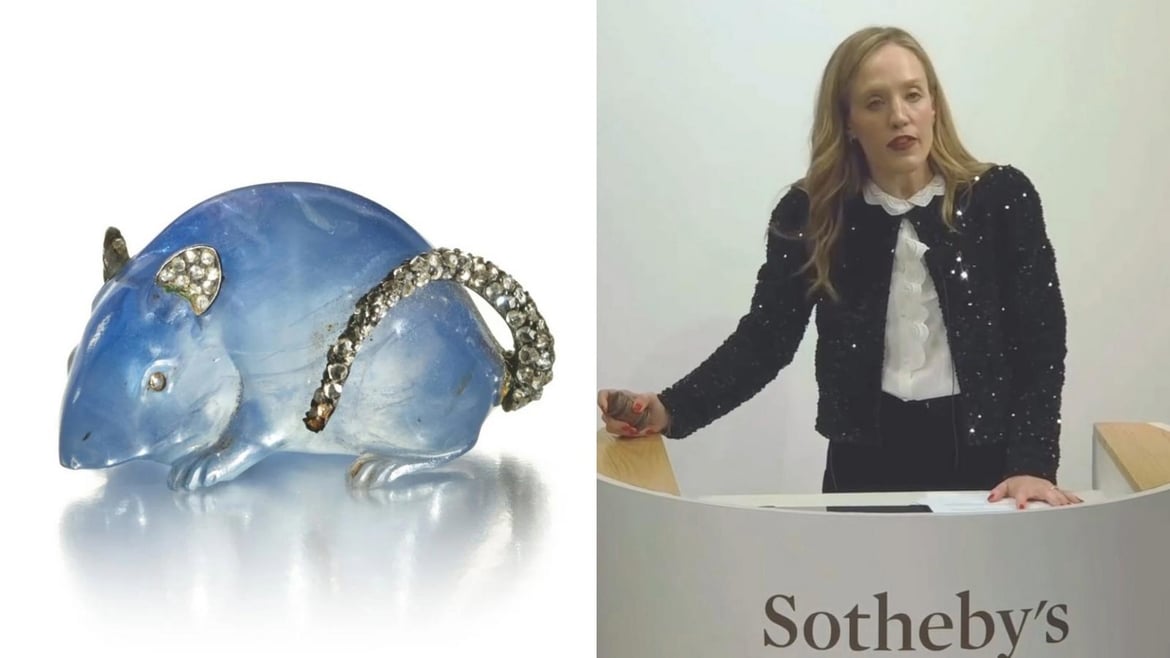
Fabergé’s rare and precious Jewelled Sapphire Model of a Mouse has instantly cured my musophobia (fear of rats). Not only am I staring into the pavé-set eyes of a 1.25-inch Fabergé mouse, I am also tempted to turn into a millionaire overnight so I can bid the next time this icy-blue sculpture hits the auction block. The lifelike miniature, carved skillfully from icy-blue sapphire, went under the hammer at Sotheby’s New York for $355,600, a result that made its $50,000 to $70,000 estimate look almost modest. Part of “Swinging on a Star: The Collection of Bing & Kathryn Crosby,” this rather small object with a big price tag was catalogued as St. Petersburg, circa 1900, with provenance through A La Vieille Russie (New York).

So why did this tiny treasure sell for roughly five times its high estimate? It was not just money, luck, or auction-room enthusiasm. It was a collector’s perfect storm: a virtuoso understanding of material, Fabergé-level craftsmanship, exceptional carving quality, and the fact that Fabergé’s carved animals are among the firm’s most beloved creations. This literal palm-sized monument feels fully deserving of the price it commanded. The genius is in the anatomical cues, the slope of the back, the tension in the crouch, the toe spacing, the tucked forepaws. Sotheby’s even spotlights the kind of detail experts love to see: every toe and finger is defined, which is a quiet flex at this scale.

Fabergé also could not have selected a trickier material. Sapphire is corundum, famously hard, and that toughness makes it perfect for jewelry but far less forgiving when you are carving a rotund little animal with a flawless silhouette. In this mouse’s case, the work would have been slow and painstaking, with very little room for error, especially if the goal was to achieve that rounded form without chipping the stone.

The real treat is the translucency and that “icy” glow, achieved through polishing, which makes the Fabergé Jewelled Sapphire mouse look almost ethereal. The winning bidder did not just splurge on a cute creature. They paid for a sapphire sculpture with expression, and the diamond work makes sure the personality lands. The ears and curled tail glitter with diamonds, and the eyes are diamond-set too, placed with such precision that the mouse looks alert and lifelike, not cartoonish.

There is also an expert-level detail that collectors clock instantly: the piece is described as apparently unmarked. On an object this small, that is not necessarily a deal-breaker. What matters is whether the construction, materials, and carving quality align with the catalogue note, and whether the provenance is strong enough to support the attribution. Here, the A La Vieille Russie link does a lot of the heavy lifting.

Rarity then seals the deal. Sotheby’s notes that the closest comparable models are two chalcedony mice in the Royal Collection, made as part of the Sandringham commission in 1907 for Edward VII, and that inventories list many rats and mice in various hardstones, but none recorded in sapphire. That absence is exactly what makes this mouse feel like an outlier, and outliers are what collectors chase.

Then comes the Crosby factor; being part of Bing and Kathryn Crosby’s collection adds its own gravitational pull. The Crosbys admired Fabergé so deeply that they built a formidable group of pieces, and they developed a strong relationship with the Schaffer family at A La Vieille Russie in New York. With this sale, perhaps a new owner begins an equally devoted relationship with the maison.
And if anyone doubts that Fabergé still has the power to melt wallets a century later, December 2025 delivered the ultimate proof point. The Imperial Fabergé Winter Egg, commissioned by Emperor Nicholas II in 1913, sold at Christie’s London for $30 million resetting the record for a Fabergé object and reminding the world that true workmanship never stops appreciating.