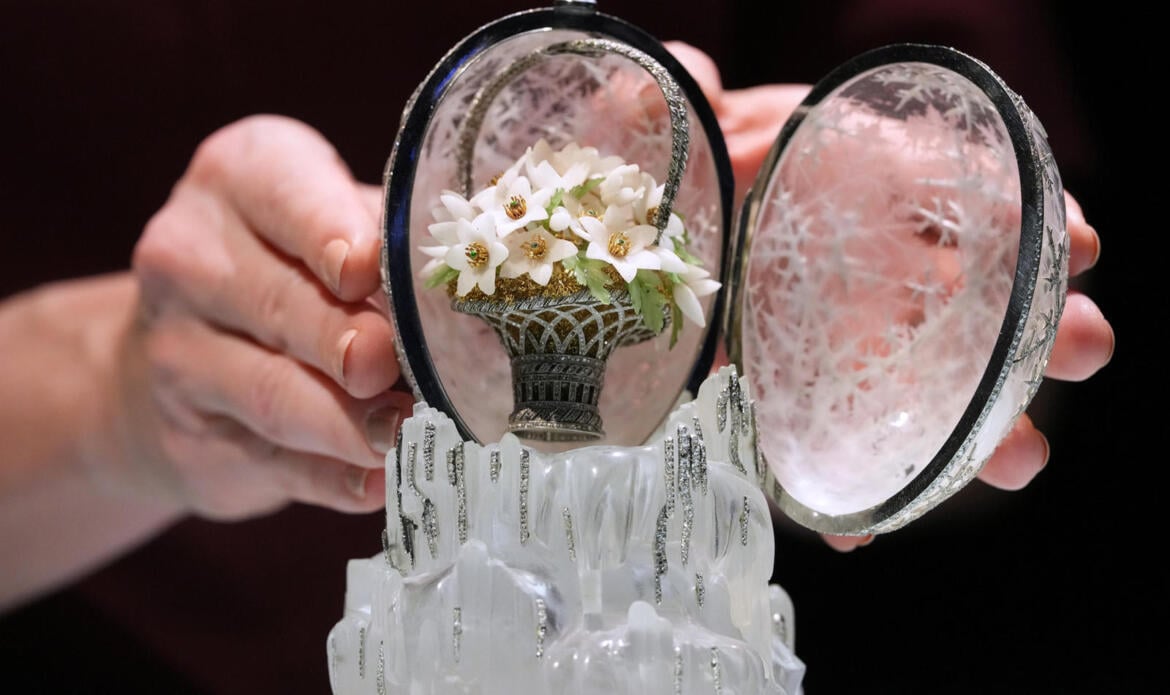
Today’s billionaires gift their mothers superyachts; over a century ago, Russia’s last emperor offered something far more delicate, a Fabergé Winter Egg. In 1913, Emperor Nicholas II presented it to his mother, Dowager Empress Maria Feodorovna, as an Easter gift in St. Petersburg. It cost 24,600 roubles then. Over a hundred years later, the same glittering treasure has fetched $30 million at Christie’s London, becoming the most valuable Fabergé egg ever sold. Its beauty transcends its mammoth price, but the true marvel lies in the genius of Alma Pihl, one of the few women to grace the jewelry workshops of St. Petersburg in the early 1900s.

The designer behind this mystical winter wonderland found inspiration in snowflakes while fulfilling a commission for an oil baron who had asked for 40 small jewelry pieces. She sought to translate that delicate motif into the grandest vision possible, and thus was born Fabergé’s Winter Egg. More than an assembly of rare materials, the egg carries a quiet metaphor within its finely worked rock-crystal shell. Its frosted exterior mirrors the beautiful brutality of winter, while the warmth concealed within hints at spring and renewal, a poetic reminder that beauty often shelters rebirth beneath its chill surface.

Standing four inches tall and encrusted with over 4,500 diamonds, the Winter Egg remains one of Fabergé’s most lavish Imperial creations. Inside, it opens to reveal a charming basket of white quartz flowers that seem to have captured the first breath of spring. At first glance, it appears deceptively simple, but a closer look reveals extraordinary craftsmanship. The platinum trelliswork is paved with diamonds, while delicate petals are sculpted from white quartz. Nephrite leaves and gold wire stems rest atop textured gold moss, forming a miniature world of icy elegance and eternal bloom.

The Fabergé masterpiece sits on a rock-crystal base resembling melting ice, where diamonds and platinum “rivulets” create the illusion of thawing water. This rare artistry explains why the Winter Egg holds an unmatched record, having topped Fabergé auction prices three times, in 1994, 2002 (when it was sold to a Qatari royal for $10 million), and now in 2025. No other Fabergé creation has reset its own record across three decades, reaffirming its place as one of the most exquisite among the roughly 50 Imperial eggs ever made for the Romanovs. More than a century later, its story continues to enchant. The inspiration, a simple frost traced across an atelier window, still captures imaginations and holds time still, proving that great art, like the Winter Egg itself, is forever.