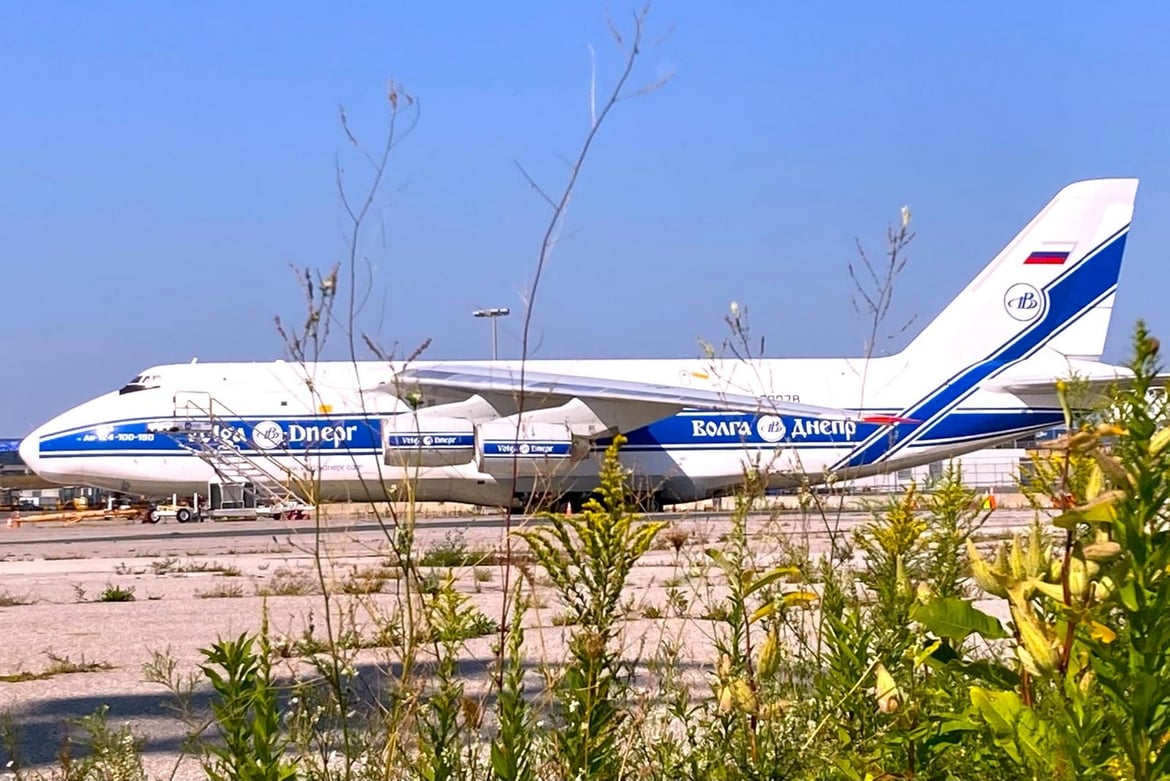
For nearly four years now, one of the largest airplanes ever built has been sitting quietly on a remote corner of Canada’s Toronto Pearson Airport, accumulating parking fees with the slow, steady rhythm of a metered taxi. It arrived in Canada on a practical, unglamorous mission, carrying COVID-19 rapid test kits at a moment when logistics mattered more than symbolism. It never left. Instead, the Antonov An-124, a flying warehouse capable of swallowing locomotives whole, became Canada’s most expensive long-term parking guest.

In the years since the Russia–Ukraine war began, governments around the world have made headlines by freezing and pursuing luxury yachts, villas, and penthouses linked to sanctioned Russian oligarchs. Canada, notably, never became a major player in that spectacle of maritime seizures and billionaire assets. What it did end up holding onto, almost by accident, was something far rarer and far more industrial. It’s a 400-ton heavy-lift aircraft designed to move the things that cannot be moved any other way.

Parked at Pearson since February 27, 2022, the aircraft has been subject to the airport’s standard parking rate of CA$1,065.60 every 24 hours, according to Toronto City News. That number sounds modest in isolation. Over 1,436 days, it becomes something else entirely. By early February 2026, the bill will have crossed roughly CA$1.53 million, or about $1.1 million, purely for sitting still.

The irony is difficult to miss. This was not a luxury asset meant to impress. It was a working machine, flown in to support public health logistics at the height of a global emergency. Within hours of unloading, it was effectively frozen in place. While superyachts continued to cruise under other flags and private jets found alternative routes, this aircraft became Canada’s unintended trophy.

A giant that redefined cargo
The Antonov An-124 is not just large. It operates in a category of its own. At nearly 69 meters long, with a wingspan wider than a Boeing 747, and a maximum takeoff weight of around 405 tons, it exists to solve problems that defeat ordinary freighters. Its signature feature is a nose that swings open to reveal an integrated loading ramp, allowing vehicles, turbines, helicopters, and even rail equipment to roll directly into the fuselage.

In commercial service, it routinely carries between 120 and 150 tons of payload, sometimes more, depending on configuration. This is the aircraft that moves satellites when rockets are delayed, power station components when grids are rebuilt, and humanitarian cargo when roads and ports are unusable. When one is grounded indefinitely, it is not merely a private inconvenience. It quietly erodes global heavy-lift capacity.

Every month this aircraft remains in Toronto is another month when oversized cargo must be squeezed into smaller freighters, split across multiple flights, or routed through slower, more complex supply chains. Meanwhile, other An-124s elsewhere in the world continue to haul massive energy equipment and space hardware, underlining just how commercially valuable this “static exhibit” would be if it were free to operate.
Over time, Pearson’s stranded giant has become an accidental landmark. Parked far from passenger terminals but close enough to major roads, it is visible to commuters and aviation enthusiasts alike. Social media is filled with reels and time-lapse videos treating it as part of Toronto’s skyline. Because it has barely moved in years, it now appears on satellite imagery and mapping platforms as a semi-permanent fixture, an unusual fate for a commercial aircraft designed to roam continents.

A machine that cannot be forgotten
Leaving a 400-ton aircraft outdoors through Canadian winters is not a passive act. Long-term parking is not abandonment. It is a different form of operation, governed by maintenance schedules that exist to prevent decay from becoming irreversible.

Large aircraft in extended storage require corrosion control through washing and protective coatings, environmental sealing of engines and sensors, and constant monitoring of moisture levels. Electrical systems must be powered up periodically. Tires need to be rotated by moving the aircraft slightly to avoid permanent flat spots. Brakes can seize if left untouched. Inspections continue on calendar cycles, even if the plane never flies.

This particular An-124 has endured repeated freeze-thaw cycles, heavy snow loads, and strong winds since 2022. In September 2025, it was towed to another stand for a technical inspection and then returned, with authorities confirming that maintenance teams would be working on and around it for about ten days. Reports from Russian aviation sources suggested that spare parts had been ordered to keep the aircraft closer to airworthy condition, indicating that someone, somewhere, still sees it as a potential operational asset rather than a stranded relic.
That ongoing attention matters. Without it, a machine of this complexity would slowly turn into an aluminum liability, fit only for parts or scrap. With it, the possibility remains that this giant could one day fly again, carrying the kinds of loads few other aircraft can manage.

Behind the scenes, Canadian authorities are now working toward formal forfeiture of the aircraft, a slow legal process complicated by layered ownership structures and cross-border registration, according to CBC. The longer-term plan, if courts approve it, is to transfer the jet to Antonov, the Ukrainian manufacturer that originally designed and built it. In that scenario, the stranded freighter would not be scrapped or auctioned off, but returned to service under Ukrainian control, effectively turning a grounded logistical anomaly into a working asset once again.
For now, though, it remains parked, ticking away another thousand dollars every day. It arrived to move medical supplies, but became a lesson in how even the most powerful machines can end up grounded by circumstance, accounting schedules, and the simple arithmetic of days multiplied by fees.