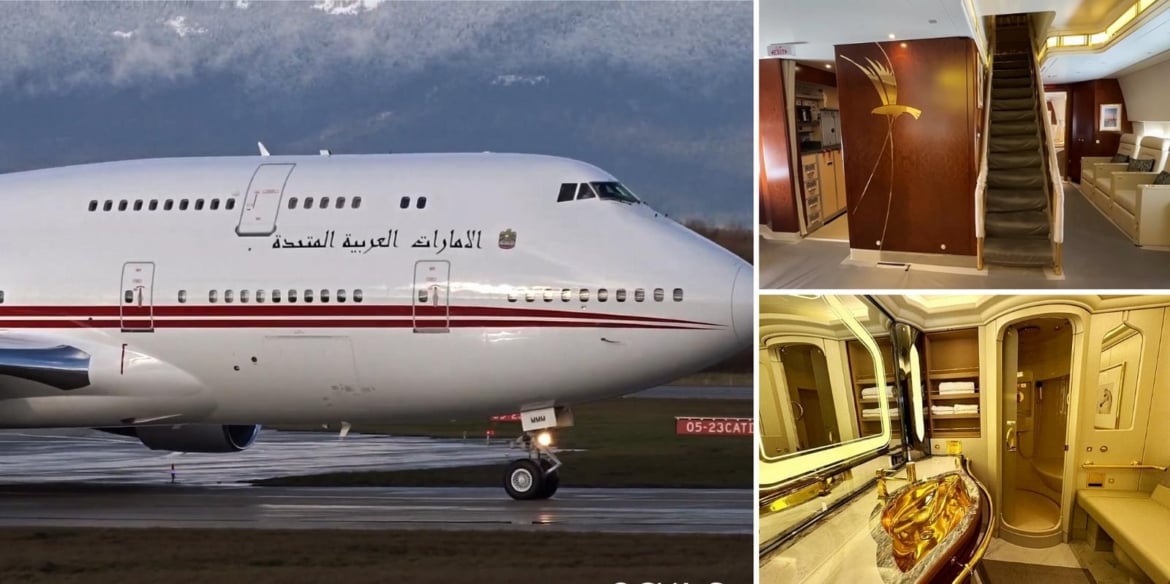
The runway at Badajoz Airport does not usually see giants, yet on an April afternoon it received one with unmistakable intent. Mohammed bin Rashid Al Maktoum, the Emir of Dubai, arrived aboard a Boeing 747, the largest aircraft ever to land at the regional Spanish airport, in what was officially described as a short visit to inspect his estate near Táliga. The scale of the jet immediately set the tone, turning a routine arrival into an operational event that required the airport to step beyond its usual limits.

According to local news outlet Al Correo, behind the scenes the arrival forced Badajoz to temporarily operate like a major international hub, with special equipment arranged to handle a wide-body aircraft far beyond the airport’s usual traffic profile, including high-reach passenger stairs for the upper deck and heavy-duty towing gear rated for a jumbo jet.

Ground power units with enough capacity to sustain a fully active VIP cabin were positioned, along with air conditioning support to keep the aircraft comfortable while parked. Even fueling logistics had to be adjusted to handle the volume required by a 747, while engineers assessed pavement strength, taxi clearance, and stand positioning to ensure the aircraft could safely maneuver without stressing infrastructure built for smaller planes.

What unfolded on the tarmac was a layered exercise in precision. Wide-body marshalling procedures were implemented, safety zones were expanded, and firefighting readiness was elevated to meet the category required for a 747 movement. Security arrangements reflected the passenger’s stature, with controlled access zones, coordinated escort units, and a direct transfer from the aircraft to the motorcade. The visible choreography, from the positioning of vehicles to the sequencing of ground crew movements, hinted at the less visible technical work that had made the landing possible.

The aircraft itself remains largely undocumented in public detail, yet it is widely believed to follow the template of Gulf VVIP conversions. The interior is believed to be arranged less like an airplane and more like a flying residence, with private bedrooms, formal meeting rooms, and majlis-style lounges designed for receiving guests in flight.

Conference spaces, secure communications areas, and a layered cabin layout would allow the aircraft to function as both transport and office, turning long-distance travel into uninterrupted governance and negotiation time. Unlike this completely decked-out Jumbo, the Emir used a specially converted 747 to transport his race horses to Miami.

The estate and the strategy behind it
Once on the ground, the transition was immediate. A G-Wagen stood ready alongside a convoy of security vehicles, forming part of a 14-car escort that moved the Emir from the runway to the road within minutes. The destination was a 200-hectare estate along the Santo Domingo to Táliga route, near land associated with El Juli, and already described in regional reporting as the foundation of a much larger equestrian footprint.

The property itself appears to be more than a private retreat. Local accounts suggest it functions as a base for a broader horse-centered ecosystem, complemented by interest in the nearby Las Arenosas site, a 44-hectare municipal property proposed as a competition venue. Together, the two locations point toward a deliberate structure, with the Táliga estate acting as a private stud farm and operational hub, and Las Arenosas envisioned as a public-facing endurance racing center.

This distinction matters because of the discipline involved. Endurance riding, known locally as raid hípico, is built around long-distance competition that can stretch up to 160 kilometers (about 100 miles) in a single day, with strict veterinary controls and multiple checkpoints. It demands land, route planning, recovery zones, and logistical depth on a scale that traditional equestrian venues do not. The ambition described by local organizers was to elevate Badajoz into a recognized international node for the sport, comparable to established European centers.

A short visit, a long signal
The timeline of the visit underscores the point. The aircraft landed in the early evening, the Sheikh traveled with an entourage of around two dozen people to inspect the estate and engage with local officials, and within roughly three hours, he departed again for Seville to participate in an endurance event. The brevity of the stop contrasts sharply with the scale of preparation, reinforcing that the significance lay less in the duration and more in the signal.
A Boeing 747 touching down at a regional airport is not simply an arrival; it is a statement about reach, capability, and intent. In Badajoz, that statement required a temporary transformation, turning a modest facility into one capable of handling one of aviation’s largest passenger aircraft. The estate visit may have been the official reason, yet the more lasting impression was the infrastructure bending, however briefly, to accommodate the ambitions that arrived with it.