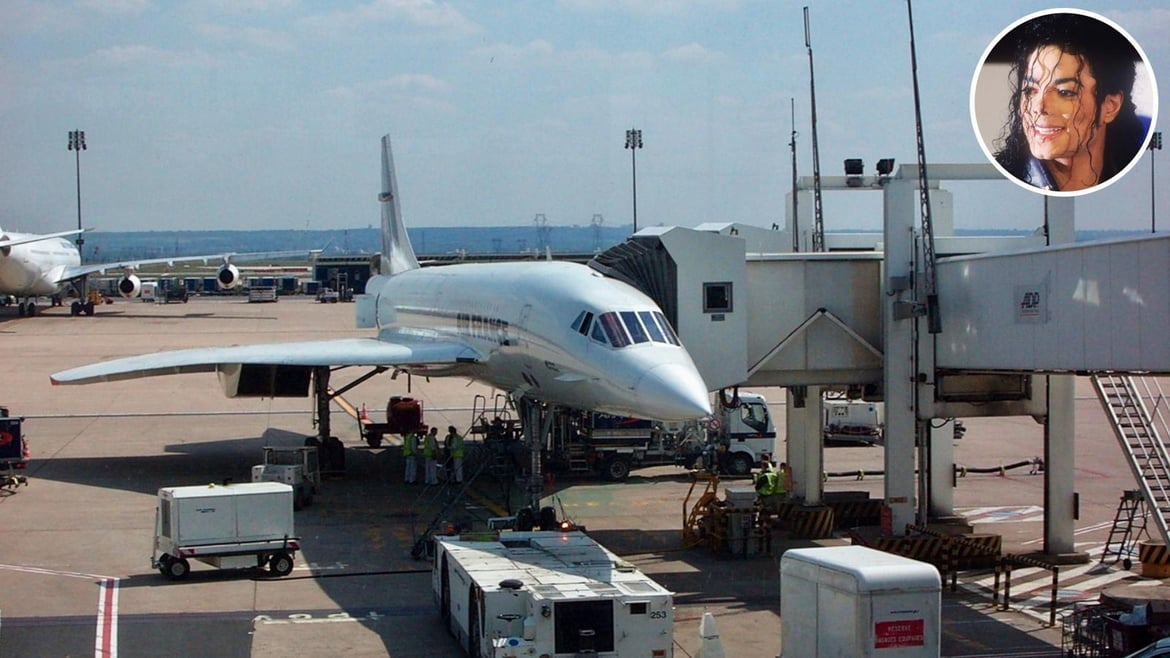
For most of its working life, Concorde sold an idea as much as a seat. It promised speed wrapped in ceremony, velocity softened by crystal glasses and vintage labels, and a 3.5-hour Atlantic crossing presented as a floating salon. Passengers were meant to sip champagne at Mach 2 and feel briefly elevated above ordinary travel. Which is why one of the most revealing Concorde stories of the 1990s is not about presidents or engineers, but about a delay caused by a shortage of Coca-Cola, requested by Michael Jackson.
The story has circulated for years in French aviation and business circles, most clearly through accounts linked to Ouest-France. It has survived because it exposes something essential about both Concorde and one of its most famous passengers. It shows the tension between spectacle and privacy, between ritualized luxury and deeply personal habit.

Buying out the back of the plane
The episode is reconstructed through the testimony of Reynald Szatapski, a French investment banker who frequently crossed the Atlantic in the mid-1990s. On one New York to Paris Air France Concorde flight, he and a colleague were seated in the first row of the rear cabin. At the time, the aircraft was divided into two sections, a forward cabin and a smaller rear one, both fitted with narrow seats designed more for speed than comfort.

Almost immediately, something felt unusual. The front cabin was full, while the rear was nearly empty. Apart from a small group seated at the very back, most of the section appeared vacant, creating the strange impression of a private jet attached to a supersonic airliner. With limited legroom and empty seats in sight, Szatapski asked a flight attendant if he could move sideways. The response was polite but firm. All remaining seats, she explained, had been sold. There was nowhere to move.

Only later did the explanation become clear. Those apparently unused seats were not unsold at all. They had been purchased together by a single passenger. The entire rear cabin, roughly 56 to 58 seats depending on the account, had been reserved for Michael Jackson and a small group of companions. In practical terms, around 60 seats had been bought simply to guarantee privacy.

At mid-1990s fares, a Concorde round trip cost about $6,400, placing a one-way crossing near $2,800 to $3,000. Buying out the rear cabin would therefore have cost roughly $160,000 to $180,000 at the time, close to $300,000 to $350,000 today. It was the price of a large business jet charter, paid for the privilege of reaching Paris in just over three hours.

Champagne at Mach 2, Coca-Cola on the ground
What followed disrupted Concorde’s carefully cultivated image. The flight was delayed. Slightly, but noticeably. For an aircraft known for strict schedules and runway priority, even a minor delay was rare. The reason, according to Szatapski, was surprisingly mundane. Jackson wanted Coca-Cola. Either there wasn’t any or just not enough on board. Additional cans had to be sourced before departure.

The contrast was striking. This was the aircraft where passengers were served champagne before takeoff and fine wine at twice the speed of sound. Yet its most famous customer had halted operations for a soft drink. The moment quietly undercut Concorde’s mythology and revealed how personal preferences could override even the most polished rituals of luxury.

After takeoff, the mystery resolved itself. The veiled passenger at the back stood up, walked down the aisle, and sat just behind the two bankers. He began signing Concorde menus. Only then did Szatapski realize who had been sharing his almost private cabin.

The episode fits a broader pattern in Jackson’s life. He routinely transformed public spaces into controlled environments, closing amusement parks, reserving entire cinema screenings, and booking whole hotel floors. Concorde was no exception. French archival sources note that he preferred the very last row, often with his head under a blanket, and refused to travel any other way. By purchasing the rear cabin, he erased the space around him.
There is a final irony to the story. Jackson once recalled writing a song at 50,000 feet on a Concorde flight without a recorder, holding the melody in his head until landing. Somewhere between champagne service and a delayed Coca-Cola delivery, he turned the world’s fastest airliner into a private writing room.

In the end, the story is not really about a drink. It is about how, even inside aviation’s most theatrical machine, one of the most famous men on earth reshaped the environment to fit his own rhythms. Concorde promised transcendence. Michael Jackson, sipping Coca-Cola at Mach 2, insisted on familiarity instead.