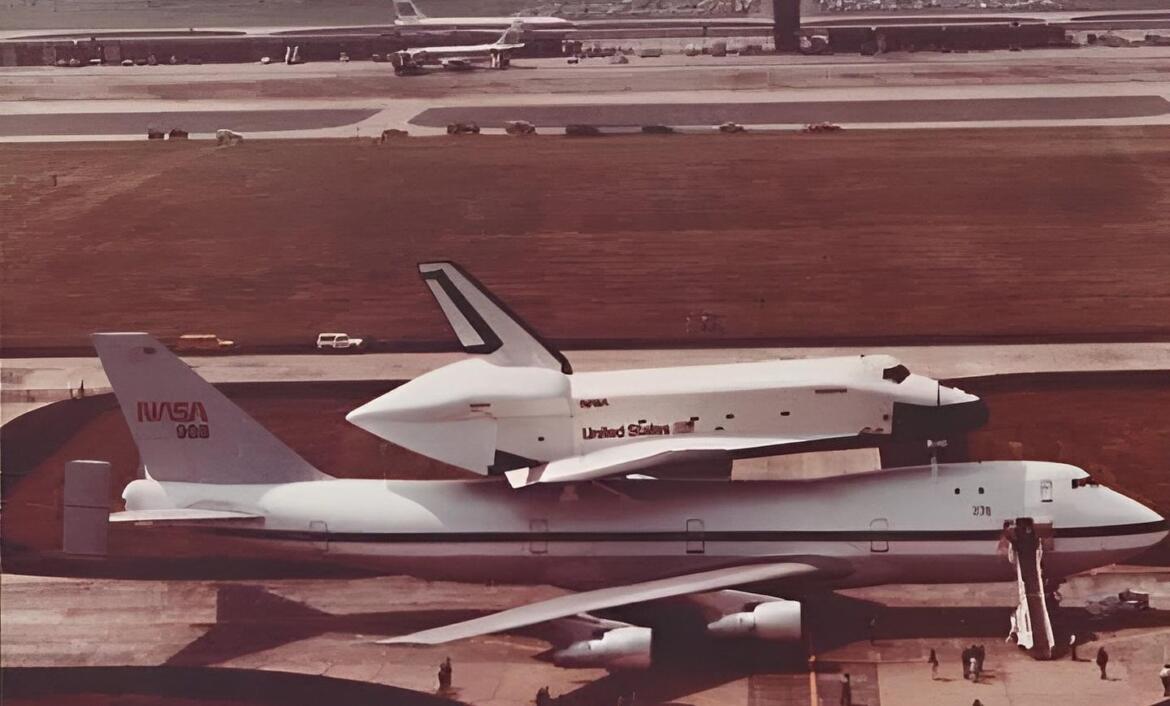
Some photographs capture aircraft, but a select few capture entire eras of ambition, and this incredibly rare image does exactly that. Among the rarest of them all is an image that captures three icons of twentieth-century aviation and space exploration in one frame. In the foreground sits the Space Shuttle Enterprise mounted atop NASA’s Shuttle Carrier Aircraft, a heavily modified Boeing 747.

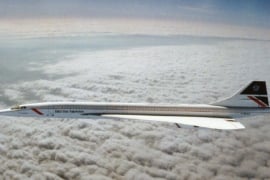
In the background, climbing steeply into the sky, is Concorde, the supersonic airliner that made routine Mach 2 travel possible. Taken in the early to mid-1980s, this once-in-history shot embodies the overlap of three technological dreams that defined speed, ambition, and ingenuity.

The story begins with Enterprise, designated OV-101, the very first shuttle ever built. Completed in 1976, it was never designed for spaceflight. Enterprise had no engines and lacked the thermal protection tiles needed to survive reentry. Instead, it was America’s aerodynamic test article, built to validate how a reusable spaceplane would behave when unpowered and gliding back to Earth.

NASA used Enterprise in the Approach and Landing Tests, where it was carried aloft by the Shuttle Carrier Aircraft and released to glide down to Edwards Air Force Base. As NASA’s own historical accounts note, these flights “validated the orbiter’s aerodynamics and handling, clearing the way for Columbia’s first space mission.” Enterprise served its purpose as a pathfinder, proving that the shuttle’s winged design was viable.

Carrying Enterprise in this photo is one of only two Shuttle Carrier Aircraft ever created. NASA 905, a Boeing 747-123 originally delivered to American Airlines, was stripped and reinforced for one of the most unusual assignments in aviation. Engineers added special mounts to secure the orbiter, strengthened the tail with twin vertical stabilizers, and removed much of the interior to save weight. With the shuttle strapped to its back, the SCA cruised at just 15,000 to 20,000 feet and about Mach 0.6.

The extra drag and weight reduced its range to less than 1,000 miles, meaning long ferry flights required multiple stops. During separation tests for Enterprise, engineers even adjusted the relative pitch between the orbiter and the 747 to ensure a clean peel-away at release. The SCA was not glamorous, but it was indispensable. Without it, the shuttle fleet could not be moved across the country or tested in the skies.

Sharing the frame with this unlikely pairing is Concorde, perhaps the most famous airliner in history. Designed jointly by Britain and France, Concorde was the world’s first successful supersonic passenger jet. Just 20 were ever built, with only 14 entering commercial service. Its performance was extraordinary: a cruise speed of Mach 2, or 1,350 mph, with passengers flying “23 miles a minute,” as longtime chief pilot Mike Bannister liked to remind audiences. Tickets were bought not only for speed but for the experience, what Bannister described as “the ability to fly faster than the sun traveled across the sky, exquisite cuisine, wonderful wine.”

Concorde’s sleek profile was defined by its slender delta wings and distinctive droop nose, which lowered during takeoff and landing to improve runway visibility before tucking up into its streamlined supersonic stance. After 27 years of service, Concorde retired in 2003, leaving behind a legacy unmatched by any other commercial jet.

What makes this photograph so astonishing is how narrow the window was for it to happen. Enterprise was unique, the only shuttle built exclusively for atmospheric testing, and it toured only briefly. NASA 905 was one of just two Shuttle Carrier Aircraft ever created. Concorde was rare in its own right, with fewer than two dozen built. To capture all three together required the early to mid-1980s, when Concorde was still flying passengers and Enterprise was on a world tour that brought it to Europe and beyond. Once Enterprise was transferred to display status in the late 1980s and Concorde began to age, the opportunity closed forever. We are unlikely to see such a trio assembled again.

As for the location, the photo circulates with conflicting captions. Some enthusiasts and aviation historians place it at the Paris Air Show in 1983, when Enterprise visited Europe and drew immense crowds. Others, including the Museum of Flight in Seattle, caption it as Washington Dulles in the 1980s.

What is certain is that Enterprise’s 1983 European tour included Paris and a highly publicized stop at London Stansted, where crowds estimated at 175,000 to 200,000 gathered to witness the shuttle’s arrival atop the 747. Wherever the exact setting, the image speaks for itself: a moment when three dreams of human flight briefly crossed paths.

Looking at the photograph today is like glimpsing an alternate timeline. The shuttle promised routine access to space, Concorde promised supersonic travel for the masses, and the 747 itself symbolized the dawn of global air mobility. Not all of those promises came true, but the ambition was real. In that fleeting frame, Concorde arcs into the sky, Enterprise rides high on the back of a Boeing giant, and the world’s imagination soars with them.