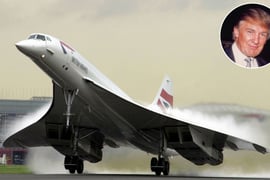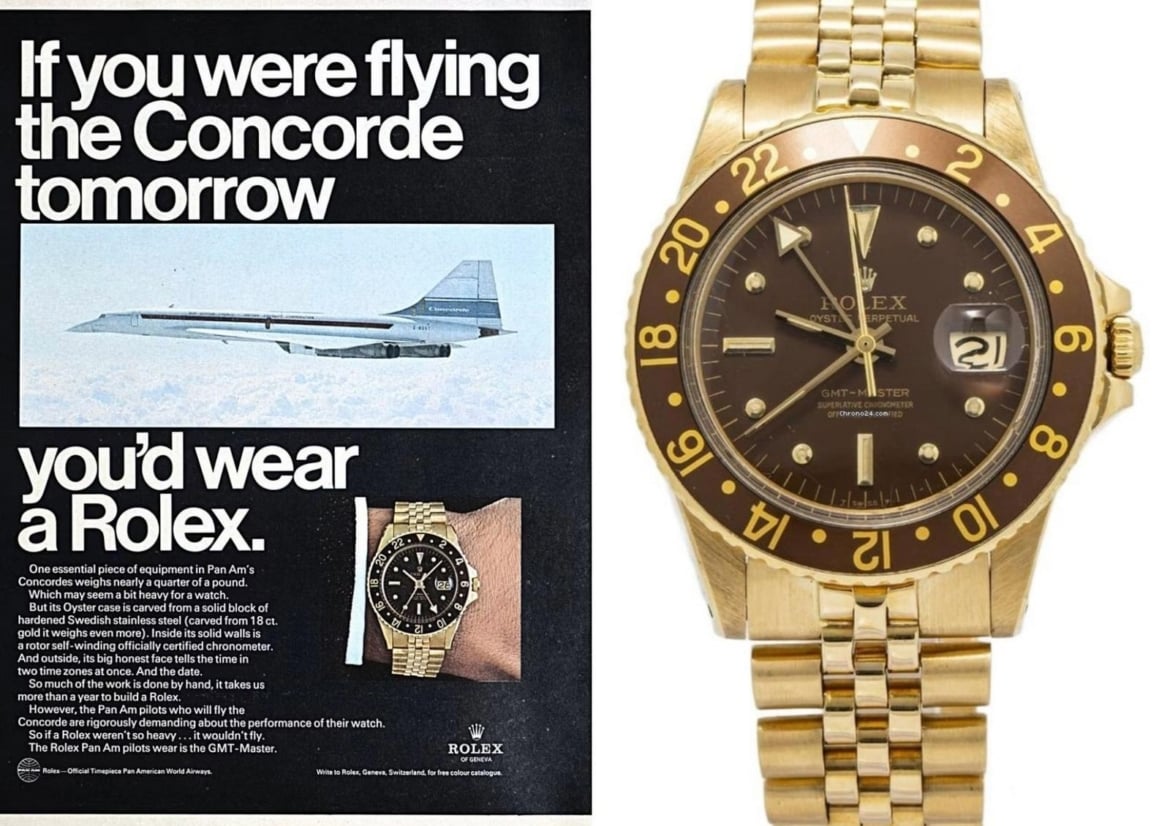
Before the world or its watch wearers could define what their timepieces signified, Rolex decided to tell them. In typical Rolex fashion, they didn’t just state facts; they associated their brand with a peerless contemporary, the Concorde. In 1968, Rolex pulled off the ultimate product placement by turning the gold GMT-Master (Ref. 1675/8) into a member of the “Mach 2 Club.” Just before the aircraft’s maiden flight in March 1969, Rolex launched a campaign that captured the attention of the elite travelers in Concorde’s first-class cabin. The centerpiece was the iconic 1969 advertisement by J. Walter Thompson, featuring the daring headline, “If you were flying the Concorde tomorrow, you’d wear a Rolex.”

More Than Just An Advertisement
The association between the solid 18k yellow gold GMT-Master and the supersonic jet ran so deep that the watch became known as the “Concorde GMT.” It didn’t just match the visual language of the era; it mirrored the very interiors of the aircraft. To cement its status, Rolex placed the watch on the wrists of two legendary chief test pilots: André Turcat, the first man to fly the Concorde in March 1969, and Brian Trubshaw, the first British pilot to fly it a month later. While they served as brand ambassadors, these men were pioneers first. They proved that even at 1,350 mph, the watch’s chronometer precision held firm against the intense vibrations and pressure changes of supersonic flight.

Furthermore, with tickets costing roughly 30 times more than a standard flight, every passenger was a member of the 20th-century “Who’s Who.” Through this single partnership, Rolex became the definitive watch for the VIP, a symbol of a lifestyle that could take a traveler from breakfast in Mayfair to a lunch meeting in Manhattan.

Anatomy of the timepiece
At the time of its release, the 18k Gold GMT-Master retailed for approximately $1,100 to $1,125, the same price as a Ford Capri, the “cool car” of 1969. To deliver something truly novel, Rolex ditched its traditional design cues. The signature “Mercedes” hands were replaced by straight baton hands (often called “Concorde hands”). It featured a “nipple dial” with raised gold cones and a touch of lume at the center, set against a rich chocolate brown backdrop.

Today, finding a Concorde GMT with its original baton hands intact is nearly as difficult as finding a piece of the aircraft’s original fuselage. The model was only produced for about two years, disappearing almost as fast as the jet it was modeled after. Because it lacks the instantly recognizable Pepsi bezel, the Concorde GMT is so subtle and niche that a novice might mistakenly think it’s a fake due to those unique straight hands.

The legacy
Rolex was not only offering an aspiration, it was becoming part of the ecosystem. Not a utility brand but one that deserved a pedestal it targeted royalty, high flyers and the very men who ensured their safety, the pilots. It featured among the list of things one could spot in a first-class space from cocktails, caviars, lobsters to now, Rolex! As envisioned, the gold 1675/8 did in fact become synonymous with first-class excess.