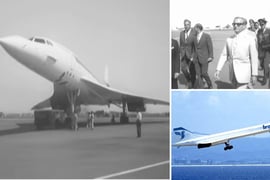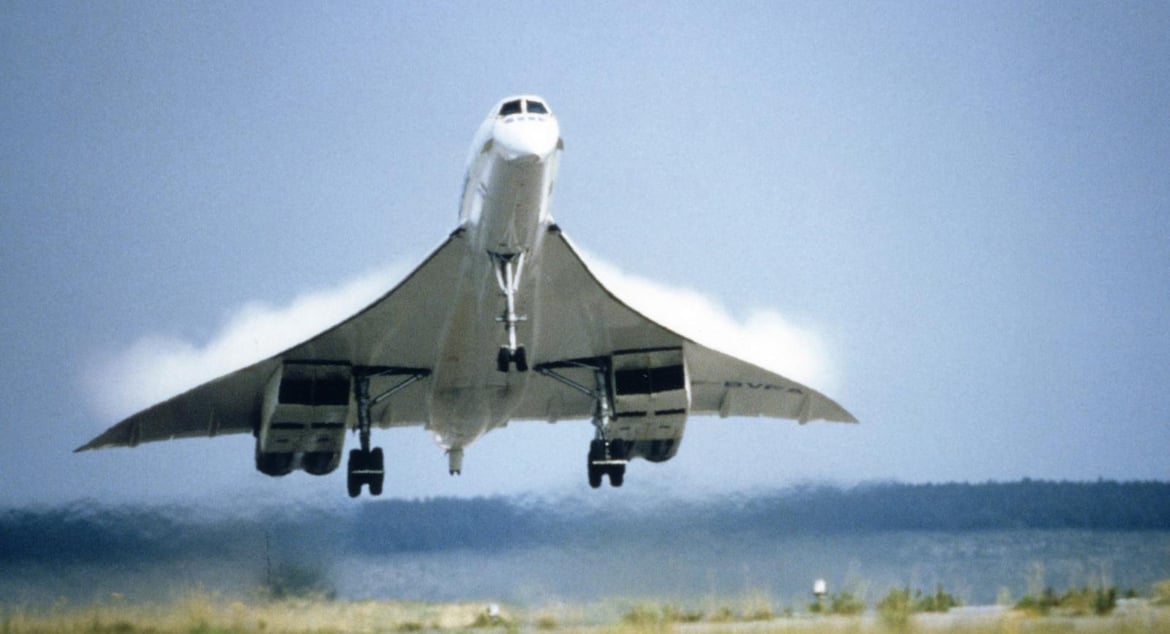
For years, the Concorde had been sold as the ultimate victory over time. It shrank oceans, embarrassed clocks, and turned intercontinental travel into a four-hour stunt. Passengers waited months, sometimes years, for the chance to feel that surge as the needle crept past Mach 2 and Europe fell away behind them. Speed was the point. Speed was the product. However, on New Year’s Eve 1976, a group of wealthy Americans paid a small fortune for the opposite experience. They did not want the Concorde to go faster. They wanted it to slow down. Ideally, they wanted it to slow down so perfectly that time itself would appear to stop. But, as reported by the Washington Post, regulations got in their way.

The scheme was curated by a New York based marketing company. The itinerary was theatrical by design. Midnight in Paris. Midnight again over the Atlantic. Midnight once more at the French Embassy in Washington. Three New Years in three places, stitched together by supersonic travel and champagne.

But the agency wanted something more. Their original plan was for the aircraft to adjust its speed at midnight so that its westward movement would cancel out the Earth’s rotation. For a brief moment, local clock time would appear frozen. Midnight would hover. The calendar would hesitate. Guests would be able to sip their champagne while technically going nowhere in time.

In marketing terms, it was brilliant. Concorde was no longer just outrunning time. It was supposedly controlling it. The aircraft became a stage prop in a carefully choreographed illusion. You were not merely flying fast. You were holding midnight in place, suspended over the Atlantic like a crystal glass.

The physics behind the fantasy was simple enough. At cruising altitude, Concorde flew at around Mach 2, roughly 2,180 km/h. Heading west, it already chased the sun and crossed time zones at absurd speed. By fine-tuning ground speed for a short window, the illusion of a paused clock could be created. Not a miracle, not science fiction, just clever timing wrapped in luxury packaging. However, the problem was not engineering. It was Washington.

According to Ghosts of DC, when the United States reluctantly allowed Concorde to operate into Dulles in 1976, it did so under strict political conditions. Flights were limited to daytime and early evening hours. Landings had to occur before 10 PM. Noise abatement rules were rigid, and supersonic flight over land was forbidden. Every arrival was part of a fragile compromise with environmental activists and local residents.
The “time stands still” moment required loitering. It not only required flexibility, but it also needed the freedom to linger in the sky and arrive when the show was over. That freedom did not exist. Miss the curfew, and the entire operation collapsed. So, the grand illusion was quietly abandoned. Midnight would pass as usual.

What remained was still extravagantly staged. Guests paid $3,235 each, roughly $18,400 in today’s money. In return, they received Concorde tickets, Paris hotels, limousine transfers, curated meals, and a closing reception hosted by the French ambassador. The brochure promised “an enjoyable time” for about one hundred carefully selected travelers. A fully loaded supersonic theater.

The irony is that Concorde had been built to humiliate time, justified by governments as a strategic necessity, revered by engineers as a triumph of precision and ambition, and marketed by airlines as the ultimate proof that distance and delay could be conquered by money and machinery, and yet, in one of its most elaborate civilian performances, its richest passengers quietly asked it to hesitate and soften its defining purpose.

They had paid extraordinary sums for speed and supremacy over geography, but what they truly wanted in return was not merely to arrive early, but to inhabit a story in which time itself appeared to pause on command, long enough for them to raise a glass and believe, if only briefly, that the clock answered to their schedules.