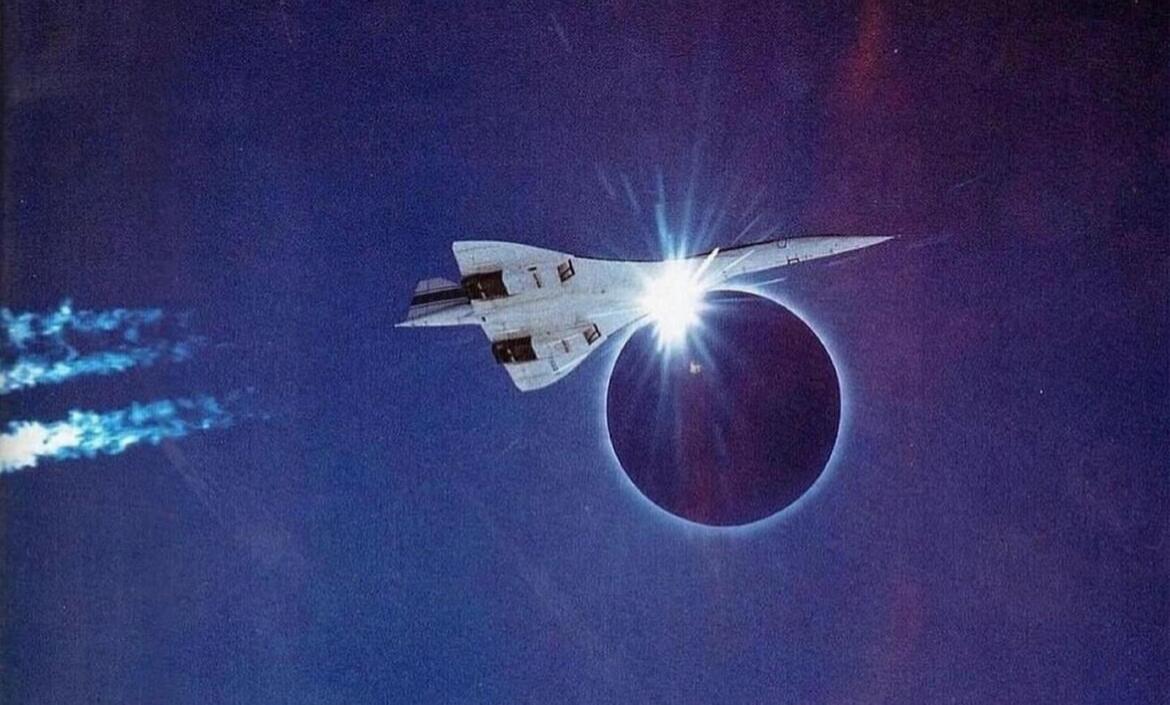
On June 30, 1973, a supersonic jet screamed across the African sky at 58,000 feet, chasing darkness at 1,450 miles per hour. Inside Concorde 001, seven scientists peer through holes cut in the roof, watching the longest solar eclipse in human history unfold.

This wasn’t supposed to be possible. Total solar eclipses last seven minutes, maybe eight from the perfect spot on Earth. But test pilot André Turcat and mission leader Pierre Léna had a radical idea: What if you didn’t stay on the ground? What if you raced the Moon’s shadow across an entire continent?

The plan was audacious. Concorde 001 would take off from the Canary Islands, intercept the eclipse over Mauritania, and chase the Moon’s umbra across the Sahara for 2,500 miles before landing in Chad. The aircraft had to match the shadow’s speed of 2,100 kilometers per hour while flying a precise path down the eclipse centerline. One mistake, one navigation error, and they’d miss their cosmic rendezvous entirely. Mauritania cleared its entire airspace. The margin for error was seconds.

A flying observatory in the sky
The Concorde prototype barely resembled the luxury airliner it would become. Engineers had stripped out the elegant interior and cut quartz windows into the roof. Scientific instruments hung from anti-vibration frames throughout the cramped, sweltering cabin. Eclipse veteran Donald Liebenberg squeezed alongside French and British scientists, all crammed around equipment worth millions.

The payload read like a wish list for solar astronomers. A Queen Mary College interferometer tracked the Sun through the roof windows. Michelson interferometers captured sub-millimeter wavelengths.

Photometers hunted for infrared emissions from cosmic dust near the Sun. Side-mounted instruments monitored oxygen in the upper atmosphere. Every sensor required perfect timing and navigation to work at supersonic speeds.

At exactly the planned moment, the Moon’s shadow engulfed the aircraft. For 74 minutes, Concorde flew in artificial night while the Sahara Desert passed below in twilight. The scientists detected five-minute oscillations in the solar corona, measured thermal emissions from dust particles near the Sun, and captured brightness spikes impossible to observe from the ground.

The mission proved that high-altitude, mobile platforms could revolutionize eclipse science, directly inspiring NASA’s later airborne programs.

Why only the Concorde could do this
The physics were brutal and beautiful. Over Africa, the Moon’s shadow raced across Earth at over 1,300 miles per hour. Ground observers got seven minutes before the shadow moved on. But Concorde at Mach 2.2 could actually outrun the shadow, staying locked in totality for as long as fuel lasted.

Height mattered as much as speed. At 58,000 feet, the aircraft flew above weather, water vapor, and atmospheric turbulence that would blur ground observations. The combination of speed, altitude, and precise navigation created a stable observatory hurtling through space faster than a rifle bullet.

The same capabilities that made Concorde a marvel of passenger aviation enabled impossible scientific feats. In 1985, Phil Collins used Concorde’s speed to perform at Live Aid concerts in London and Philadelphia on the same day, helicopter-hopping between continents faster than the sun could set. Wall Street executives routinely ate breakfast in London and lunch in New York three hours later.

Modern attempts have tried to match the 1973 achievement. NASA’s WB-57F jets extended the 2017 Great American Eclipse to 7.5 minutes using coordinated aircraft. Tourist Concordes in 1999 gave passengers 4-5 minutes over Europe. Boeing 787s and research Gulfstreams have pushed totality to 8-9 minutes. But none have approached 74 minutes.

The record stands unbroken because Concorde itself is gone. The last supersonic passenger jet made its final flight in 2003, grounded by costs, environmental concerns, and the 2000 Air France crash. New companies like Boom Supersonic promise to revive supersonic travel, but until then, that June day in 1973 remains unique in human experience.

For 74 minutes, a handful of scientists flew through the solar system’s most perfect shadow, watching the Sun’s corona dance in ways no ground observer could see. They didn’t just break records. They redefined what was possible when human ambition met the raw physics of speed, altitude, and celestial mechanics.The longest eclipse in history happened not because the Moon lingered, but because humans refused to stand still.