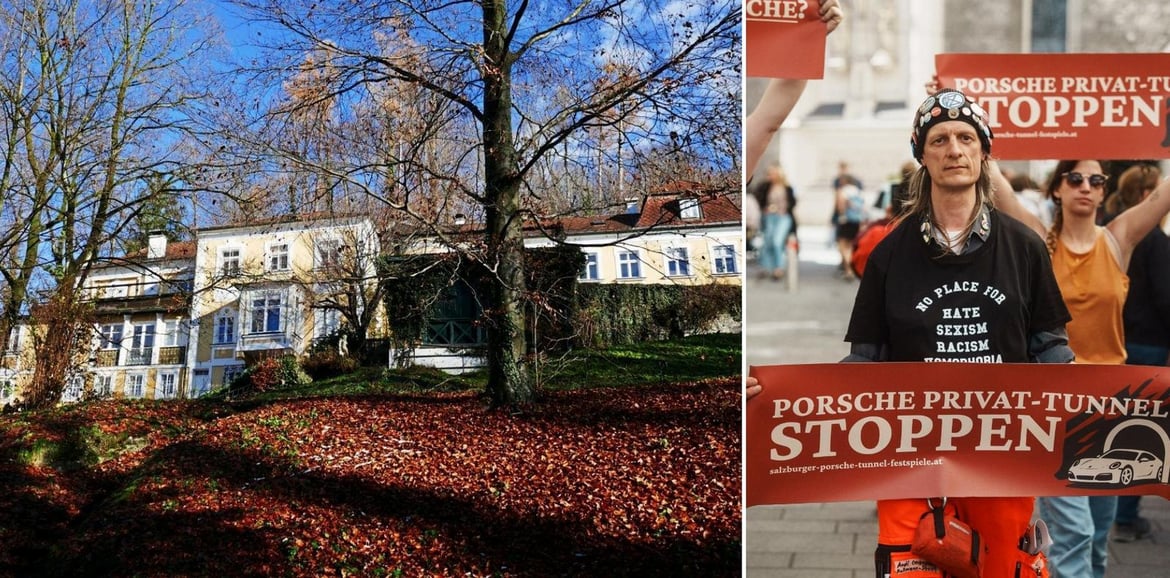
Twenty thousand Salzburg residents have now signed a petition protesting a plan by billionaire Wolfgang Porsche to carve a 500-meter private road tunnel through Kapuzinerberg, accusing city officials of giving public land to private luxury. The dispute has evolved into one of Salzburg’s most polarizing civic debates, touching questions of privilege, heritage, and public accountability.

At the heart of the controversy stands a deep irony. The Paschinger Schlössl, a 17th-century villa once owned by author Stefan Zweig, was long admired for being “car-free.” Zweig famously praised its remoteness from noise and traffic, saying that its inaccessibility made it a haven for creativity. Now, that very isolation has become the justification for a 500-meter tunnel connecting the villa to the city’s Linzer Gasse parking garage. Critics say a billionaire’s “car-free” literary shrine is being turned into a car tunnel.

The petition began in mid-May with around 16,000 signatures, climbed to 19,000 in early September, and soon reached 20,000, as reported by LaStampa. Its steady rise became a symbol of mounting local frustration. Residents argued that the project gives special treatment to the ultra-rich, allowing a private individual to reshape a protected hill for convenience.

One of the strongest complaints centers on how the city granted Porsche the right to build under public land. Reports initially cited a one-off fee of €40,000 (about $47,000), later corrected in committee records to €48,000 (roughly $56,000). That payment, covering an easement of about 1,500 square meters, was widely criticized as a token sum for a project expected to cost around €10 million (nearly $11.7 million). Opponents describe it as “public land for private benefit,” saying it represents a bargain few ordinary citizens could ever secure.

Officials defending the project argue that it serves the public interest by reducing surface traffic along Linzer Gasse and the steep Stefan-Zweig-Weg, both of which are pedestrian or partially restricted roads. They say fewer vehicles on those routes will improve safety and air quality. Critics counter that such reasoning only masks a privilege problem, describing the decision as a vivid symbol of social inequality.
The political maneuvering behind the project added to public anger. Salzburg’s planning committee approved an “individual planning exemption” with votes from the Social Democrats (SPÖ), the conservative People’s Party (ÖVP), and the right-wing Freedom Party (FPÖ). The Greens and Communists opposed it. The mayor, who previously worked for Porsche, publicly stated that he is “no friend of Wolfgang Porsche,” yet opponents argue that the city’s handling of the land deal suggests otherwise.
Years earlier, the city, the province, and the local university had considered purchasing the villa to create a Stefan Zweig museum or cultural space. Access was the main obstacle. Ironically, that very issue is now being resolved through a private tunnel for one man rather than a public solution for many.

Protesters have responded with creativity and humor. Under the banner of the “Salzburger Porsche-Tunnel Festspiele,” activists staged mock performances, satire, and even symbolic street renamings to honor Zweig and highlight inequality. Their blend of art and activism has kept the story alive across Austria.

Engineering details reveal an elaborate plan. The tunnel would branch off from the Linzer Gasse public garage and pass through the mountain to an underground garage below the villa. The latest records list eight parking spaces, though earlier plans suggested up to twelve. The design also includes a smoke-exhaust adit to meet safety regulations.
The project’s high cost, the symbolic clash between public and private interest, and the cultural weight of Stefan Zweig’s legacy have made this more than a zoning dispute. For many Salzburgers, it has become a moral test of fairness. The city’s planning committee has approved, but the state authority of Land Salzburg still needs to review it before construction can begin. Whether the tunnel is ever built or not, it has already carved a divide through Salzburg’s civic life.