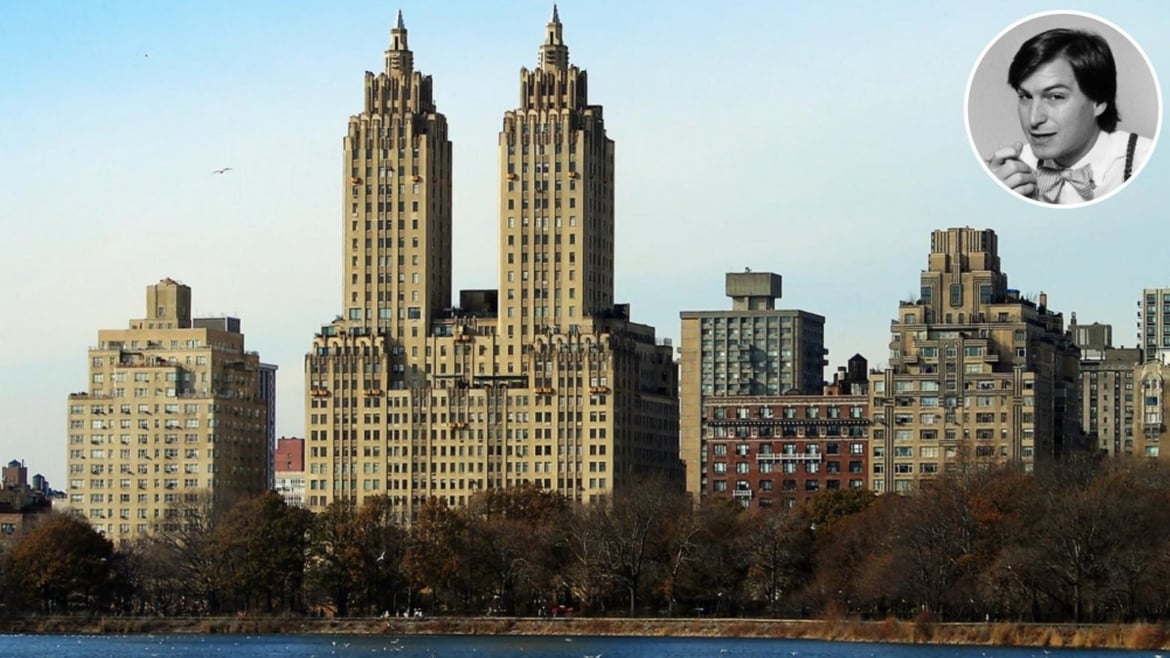
In the early 1980s, Steve Jobs quietly acquired a penthouse apartment in Manhattan’s The San Remo, one of the most storied addresses on Central Park West. The purchase did not immediately attract the mythology that would later surround it, yet the facts themselves were unusual. Jobs would go on to spend years and significant resources reshaping the residence, only to never truly live there.

At the time, he was in his twenties, newly wealthy, and beginning to understand the cultural weight of design beyond Silicon Valley. Walter Isaacson, Jobs’s biographer, notes that his explanation for buying in New York was simple and revealing. He loved the city and saw it as a way to educate himself, to absorb a level of sophistication that California did not yet offer him.

A penthouse as a design experiment
This was never a casual real estate move. The San Remo already carried architectural prestige, designed by Emery Roth and long associated with old New York status. By buying there, Jobs was stepping into a world defined by culture, legacy, and aesthetic authority. The apartment itself reflected that ambition. Reported details describe roughly 3,500 square feet of interior space, expansive terraces measuring over 1,200 square feet, soaring 16-foot ceilings, and two wood-burning fireplaces overlooking Central Park.

Jobs did not preserve the apartment as he found it. He embarked on a prolonged redesign that merged two upper floors into a single duplex penthouse, turning the space into something more conceptual than residential. To execute this vision, he hired James Freed of I. M. Pei’s firm, tapping into the world of the master architect whose cool, exacting modernism produced icons like the Louvre Pyramid and reshaped skylines across the world. Jobs even paid to have the building’s foundation reinforced, a decision driven by his insistence on extensive marble throughout the interiors.

The process stretched across nearly a decade, finally reaching completion in 1994 after nine years of obsessive detail work. What emerged was not a typical luxury home. Descriptions from those who saw it suggest a space stripped to its essence, dominated by pale gray tones, stone surfaces, and a level of control that bordered on austere. One broker would later remark that the apartment felt like an iPod before the product even existed, while another described it as cold, monolithic, and almost mausoleum-like.

Finished to perfection, then left behind
Despite the time, money, and attention invested, Jobs never truly moved in. The reasons remain diffuse rather than definitive. The renovation timeline stretched across a period when his life was in flux, and California continued to anchor his work and daily routine. New York, for all its allure, remained more of an aspiration than a home base.

The result is a peculiar kind of artifact. The apartment functioned as a trophy, an education, and a design laboratory, but not as a lived-in space. It was Jobs attempting to construct an environment that reflected his evolving sensibilities, a physical expression of control, minimalism, and material precision.

In 2003, he sold the penthouse to Bono for around $15 million. The transfer felt almost narrative in its symmetry, passing from a defining figure in technology to one in music. By then, the apartment had already accumulated a biography of its own, shaped less by habitation and more by intent.
The San Remo penthouse stands as an unusual chapter in Jobs’ life, a place designed with extraordinary rigor yet never inhabited. It reflects a moment when he was not just building products, but attempting to design a version of himself, using architecture as the medium and New York as the stage.