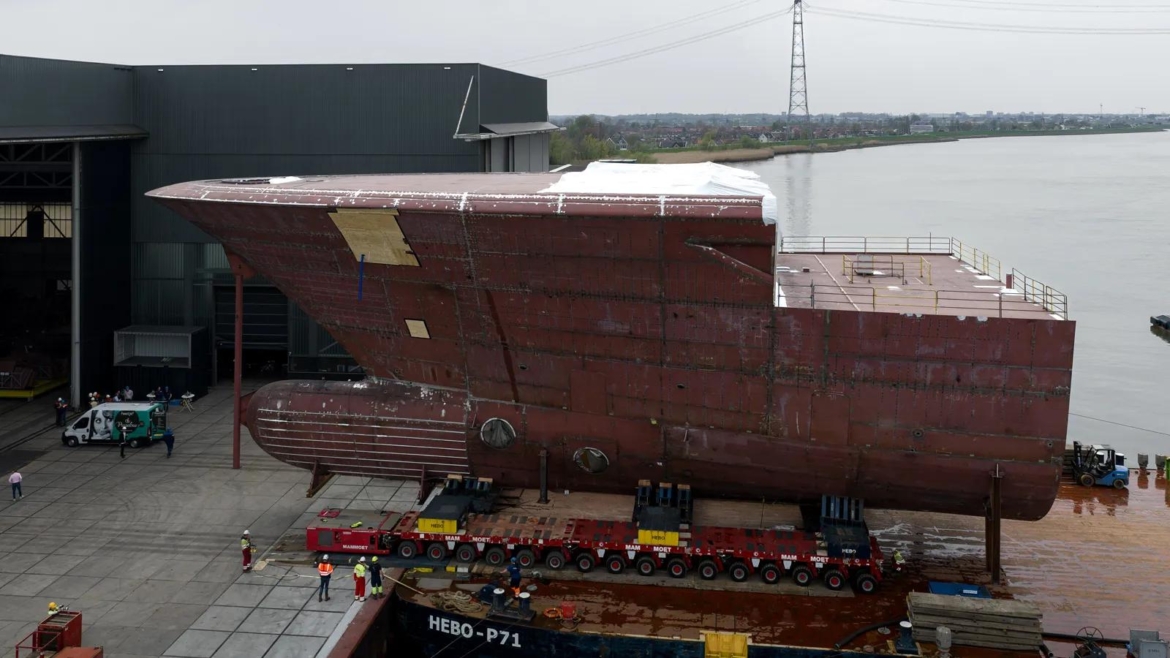
The first visible section of a secretive 140-meter (about 470 feet) Feadship flagship, widely believed to be commissioned by French billionaire Bernard Arnault, has emerged from a construction shed in the Netherlands, offering the clearest signal yet that one of the most closely guarded superyacht projects in Europe is well underway. The exposed bow, captured during its rollout from a fabrication facility, is expected to move to Rotterdam for further assembly, as the vessel quietly advances toward a projected 2029 delivery.

What makes the moment striking is not simply the scale on paper but the way the bow distorts reality around it. The structure rises like a piece of industrial architecture rather than part of a yacht, overwhelming everything in its vicinity. People standing nearby appear reduced to the proportions of scale figures used in design studios, while a van parked alongside, something that would typically dominate a marina setting, looks almost toy-like. Even the heavy transport platform supporting the section seems visually diminished, as if the sheer mass of the steel has recalibrated the scene.

If completed as expected, the yacht will become the largest ever built in the Netherlands, surpassing even Breakthrough and redefining what Feadship considers its flagship. With an estimated value of around $650 million and a projected volume that pushes into the upper tier of global yacht construction, the project places itself in a category typically reserved for the most discreet and powerful clients.

Arnault, the man believed to be behind the commission, has built a reputation for staying firmly outside the spectacle that often surrounds extreme wealth. As the CEO of LVMH, he oversees an empire of brands that define modern luxury, yet his personal life remains tightly controlled and rarely broadcast. His existing yacht, Symphony, already reflects that philosophy with its restrained elegance and absence from the social circuits that define the Mediterranean season.

That instinct for privacy appears to have carried over into this new project. The vessel has effectively disappeared from public tracking systems, with its AIS signals carefully managed to avoid detection on widely used maritime platforms. In an era where even mid-sized yachts broadcast their movements in real time, the deliberate opacity surrounding this build signals a different approach, one that prioritizes invisibility as much as engineering.

For now, the bow is the only tangible evidence of a yacht that has otherwise existed in whispers. Yet even in isolation, it tells a complete story. This is not just another large build progressing through a Dutch yard. It is a statement of scale, discretion, and intent, one that suggests that when the full vessel finally takes shape, it will not just dominate the waterline but quietly redefine the boundaries of private maritime ambition
.