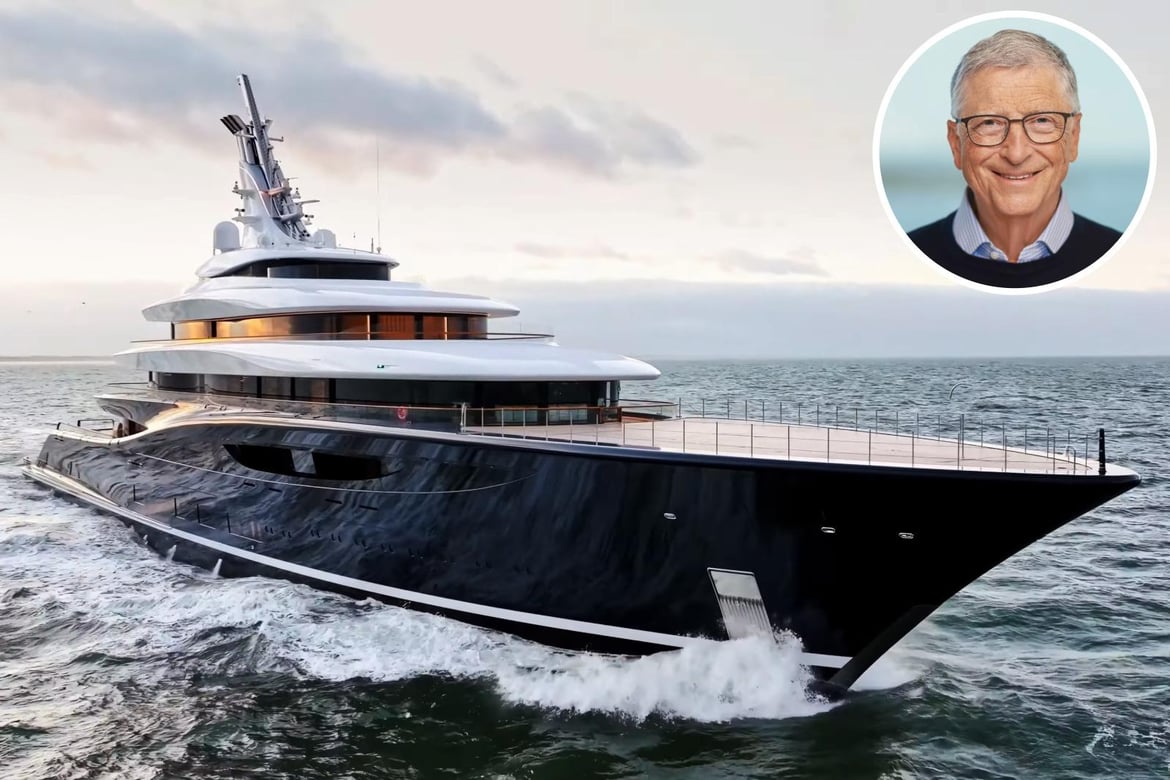
Bill Gates’ superyacht Breakthrough is not just another billionaire’s indulgence gliding across the seas. It is a technological statement, equipped with a 3-megawatt hydrogen fuel cell system that represents one of the most ambitious clean-energy integrations in marine history. Built by Feadship and designed by RWD, the 118.8-meter vessel uses ABB’s Onboard DC Grid platform, dual 3.2-megawatt Azipod propulsion units, and advanced power management systems to deliver silent, emission-free operation. At anchor, it can run entirely on hydrogen for up to a week, and when departing or entering sensitive marine zones, it can cruise at 10 knots without burning a single drop of diesel.

To put the yacht’s energy capacity in perspective, the hydrogen plant produces enough continuous power to operate more than thirty replicas of Gates’ own mammoth 66,000-square-foot mansion at once. That is a staggering amount of energy for a single private vessel and demonstrates how far marine clean technology has progressed in recent years.

Inside Xanadu 2.0
Gates’ $130 million Pacific Lodge-inspired estate on the shores of Lake Washington is known as Xanadu 2.0. This 66,000-square-foot home is an architectural and technological showcase. It contains seven bedrooms, twenty-four bathrooms, six kitchens, a massive library with a $30.8 million Leonardo da Vinci manuscript, and a 60-foot swimming pool equipped with an underwater music system. The reception hall can host two hundred guests and features a massive video wall and limestone fireplace.

Xanadu 2.0 is also one of the most advanced smart homes in the world. Climate, lighting, and even the artwork on the walls are controlled by an array of sensors that respond to each guest’s preferences. The property includes multiple garages for Gates’ Porsche collection, a sprawling gym, a steam room, a sauna, and a shoreline topped up annually with sand shipped from St. Lucia. Every feature is meticulously designed to combine comfort, automation, and luxury.

While Xanadu 2.0 is a power-hungry residence by any standard, its demand still pales in comparison to Breakthrough’s hydrogen system. ABB rates the yacht’s fuel cell at three thousand kilowatts of continuous output. If you compare that to the average American home usage of 0.49 kilowatt-hours per square foot per month, the mansion’s load comes to about forty-five kilowatts. That means Breakthrough’s system could run roughly sixty-eight Xanadus at once. Using a hotel-style benchmark of 18.6 kilowatt-hours per square foot per year brings the figure to about twenty-two. A fair, rounded middle ground is to say the yacht could comfortably power thirty of them.

In broader terms, the same output could keep around 2,500 average American homes running at the same time. And unlike diesel generators, this would be done with no exhaust fumes, no low-frequency noise, and no greenhouse gas emissions when using hydrogen.

This comparison is more than a playful calculation. It underscores the scale of innovation at work on Breakthrough.

Integrating a multi-megawatt fuel cell into a luxury yacht required new regulatory frameworks, custom engineering, and collaboration between Feadship, ABB, and fuel cell specialists. The success of the project is already influencing other maritime applications, with similar systems being adapted for ferries and potentially for commercial shipping.

Gates has long invested in sustainable technologies, and Breakthrough extends that vision into the maritime world. Just as Xanadu 2.0 redefined what a high-tech home could be, this yacht shows that sustainability and luxury can operate in perfect harmony. One is anchored on the shores of Lake Washington while the other can explore the farthest oceans, but both stand as proof that with enough ambition, technology can deliver extraordinary results.