You might not believe it, but there exists a Ferrari motorcycle. Not a tribute, not an aftermarket fantasy, but a hand-built machine that carries the Cavallino emblem with full permission from the Ferrari family. It is called the Ferrari 900, and it occupies a space so unusual that even lifelong enthusiasts often question whether it is real. Yet its story is as authentic as any chapter in Italian engineering history. It began in 1990, when MV Agusta specialist David Kay received something that would be almost impossible today. Piero Ferrari signed a letter granting him the right to place the prancing horse on a motorcycle he planned to build, giving Kay’s vision an endorsement no other two-wheeled project has ever been granted.

From there, Kay spent four years and more than 3,000 hours shaping the Ferrari 900 into a tribute worthy of Enzo Ferrari’s legacy. With decades of experience working on Italian machines through MV Meccanica Verghera, he approached the bike with the same principles that guided Maranello’s road and racing cars.

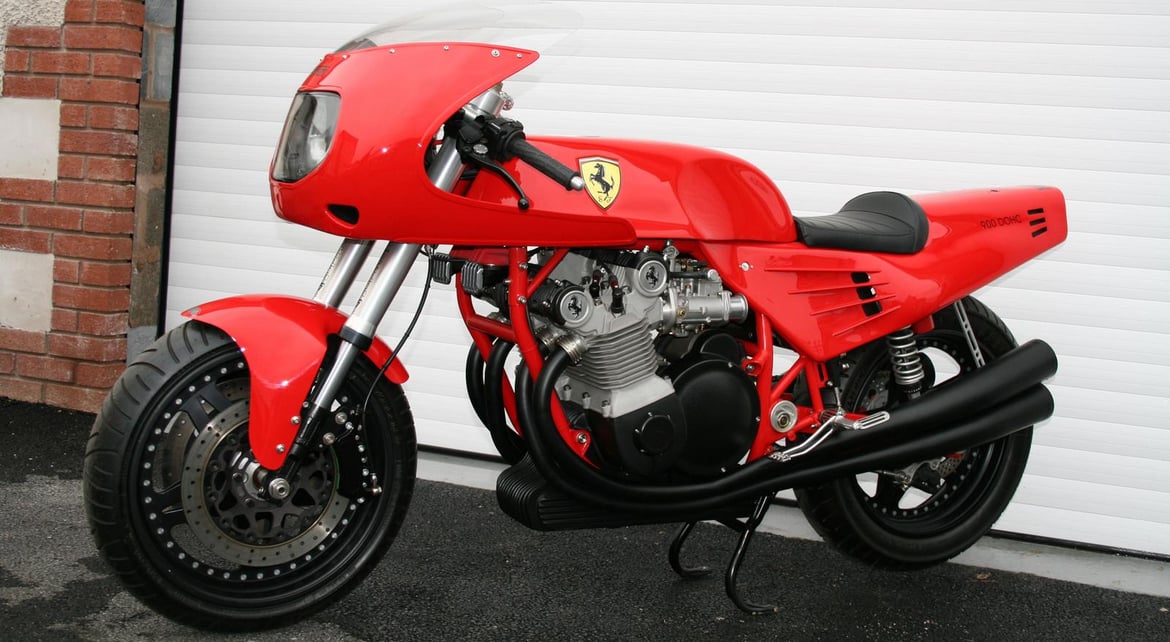
At its core sat a scratch-built air-cooled 900 cc DOHC four-cylinder engine with magnesium and alloy casings, paired with a five-speed transmission. It produced 105 hp at 8,800 rpm and pushed the 172 kg machine toward an estimated top speed of 165 mph. Every element was engineered from scratch, from the tubular manganese–molybdenum steel frame to the hand-formed aluminum body crafted by Terry Hall.

The design drew heavily from Ferrari’s visual language. The swept-back front fairing flowed into a long, sculpted fuel tank, while the tail flicked up sharply to create a dramatic silhouette. Testarossa-style side vents tied it to the brand’s past. The rear lights were neatly recessed in a style reminiscent of classic Ferrari road cars. Even the brake master cylinder was integrated into a custom digital instrument panel, one of many details that showed Kay’s obsessive approach. The twin reverse-cone megaphones, also built by Hall, produced a sound Kay once likened to a Messerschmitt chasing a Spitfire.

Mechanical components were sourced from the best suppliers of the era. Forcelle Italia built the upside-down front forks, Brembo supplied disc brakes with six-pot front and four-pot rear calipers, WPS provided twin rear shocks, and 17-inch hand-spun Astralite wheels completed the chassis. The Ferrari 900 was not just rare. It was uncompromising.

When Kay unveiled the motorcycle in 1995, it captured global attention, yet the market never quite knew how to value it. In 2008, it appeared at auction with an estimate of around 300,000 euros but failed to sell. Four years late,r it finally changed hands for about £85,500, a price far below the significance of what it represented. Today, its value would be dramatically higher, if only because it remains the only motorcycle ever allowed to wear the prancing horse.

Whether or not it surfaces at auction again, the Ferrari 900 stands as a singular expression of passion, craftsmanship, and imagination. It may not have rolled out of Maranello, but it carries the spirit of Ferrari as faithfully as any machine on four wheels.