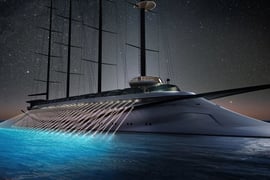
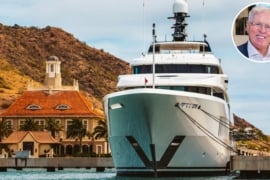
For decades, the world’s richest people have competed to own larger yachts, faster private jets, more extravagant homes, and lately, even rockets built to reach space, and perhaps even Mars. Gabe Newell appears to be playing a different game. The billionaire co-founder of Valve, the company behind Steam, is looking in the opposite direction, not toward the stars, but into the deepest corners of the ocean. Through marine research organization Inkfish, Newell is backing a project that looks less like a luxury purchase and more like a floating scientific moonshot, one that may become the most capable civilian deep-sea research vessel ever constructed.

That ambition became official when Norwegian shipbuilder VARD signed a contract worth nearly €700 million, or roughly $815 million, to design and build the vessel known as RV11000. The contract is the largest single-vessel order in VARD’s history and the largest order of its kind ever secured by a Norwegian shipyard, as per NTB Kommunikasjon. Scheduled for delivery in the first quarter of 2030, the vessel will measure 162 meters, or 531 feet, in length with a beam of 28 meters, making it dramatically larger and more capable than Inkfish’s previously announced RV6000 research vessel.
A floating research campus built for the deepest parts of Earth
The easiest way to understand RV11000 is to stop thinking of it as a ship. It is closer to a floating ocean exploration headquarters. Designed by VARD in collaboration with Inkfish and supported by Italian shipbuilding giant Fincantieri, RV11000 is being built to operate at depths of up to 11,000 meters. That places it in the extremely rare category of full-ocean-depth capable platforms, giving it the ability to support missions virtually anywhere in the world’s oceans, including the deepest trenches on Earth.

Its mission profile is remarkably broad. The vessel is designed for high-resolution seafloor mapping, ultra-deep coring operations, submarine deployment and recovery, remotely operated vehicle missions, and scientific sampling campaigns. Instead of specializing in a single task, RV11000 attempts to combine several of the world’s most advanced oceanographic platforms into one hull.

The hardware list explains why VARD has described it as the world’s most capable deep-sea research vessel. The ship will feature a stern-mounted A-frame for launching and recovering submarines, a large hangar capable of housing two submarines, a dedicated ROV hangar, a 12,000-meter umbilical system, a 40-meter corer for sediment sampling, and a fiber-rope lifting system with a staggering 15,000-meter capacity. An active-heave-compensated offshore crane will support operations at depths of up to 2,500 meters.

The vessel itself is being engineered as a scientific instrument. Its hull has been optimized specifically for seabed mapping performance, while four active stabilizers and advanced station-keeping systems will help maintain precise positioning during complex operations involving long cables, sensitive sensors, and crewed submersibles.

The ship that reveals Inkfish’s larger ambitions
One of the most remarkable features aboard RV11000 may not be visible at all. VARD says the vessel will carry the largest battery installation ever fitted to a ship, enabling up to 12 hours of silent scientific operations. That capability is crucial for reducing vibration and underwater noise during sensitive mapping, sonar, and research missions.

The vessel is also being built to the latest cybersecurity standards with DNV’s Cyber Security notation, a reminder that modern research ships now function as highly connected platforms operating sophisticated digital systems, autonomous vehicles, and vast scientific data networks.

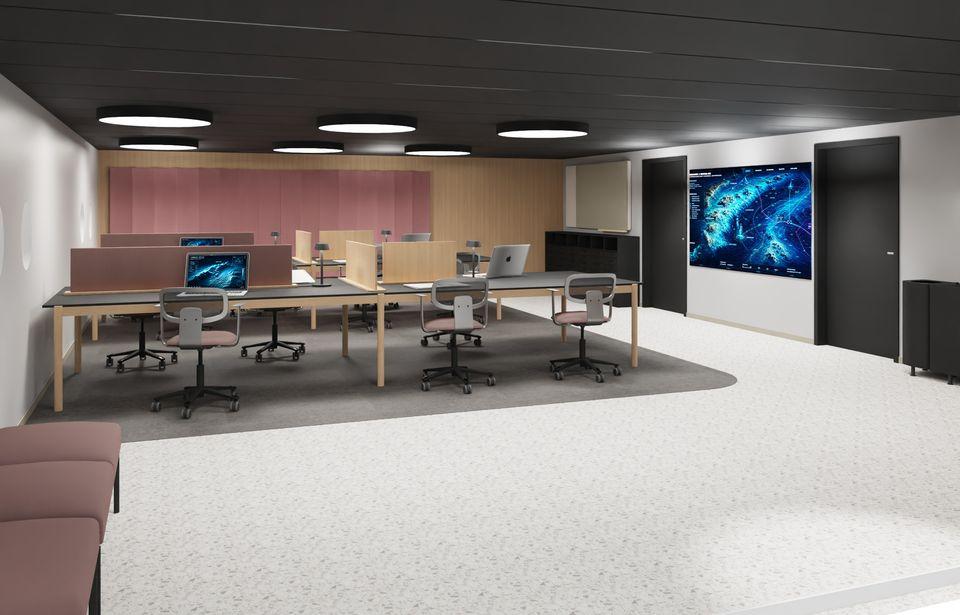
Accommodation tells another important story. RV11000 will support up to 130 crew members and scientists, nearly double the complement of RV6000. Most personnel will have single cabins, while laboratories, workshops, offices, and dedicated data-processing facilities will transform the vessel into what is effectively a floating research campus. VARD is even developing a new bridge concept that integrates research and safety functions alongside traditional navigation, turning the command center into something closer to mission control.

There is also an unusual human element to the project. The interiors emphasize premium materials, high indoor air quality, 100% fresh-air ventilation, and comfort-focused living spaces. The philosophy appears straightforward. Better living conditions help researchers perform better during long and demanding expeditions.

RV11000 is only one piece of a larger strategy. Inkfish already operates research vessels including RV Hydra and RV Dagon, while RV6000 is expected to join the fleet in 2028. Together, they form an expanding ocean research network designed to generate and share open scientific data around the globe.

That broader vision helps explain why Newell’s name keeps appearing in discussions about advanced marine technology. The billionaire has quietly built a reputation for treating ships as platforms for exploration rather than status symbols. His involvement in the acquisition of Dutch yacht builder Oceanco raised eyebrows in the luxury world. RV11000 suggests his real interest may lie much deeper beneath the surface. When the vessel enters service in early 2030, it will represent not just a new ship, but one of the most ambitious private investments ever made in ocean science.