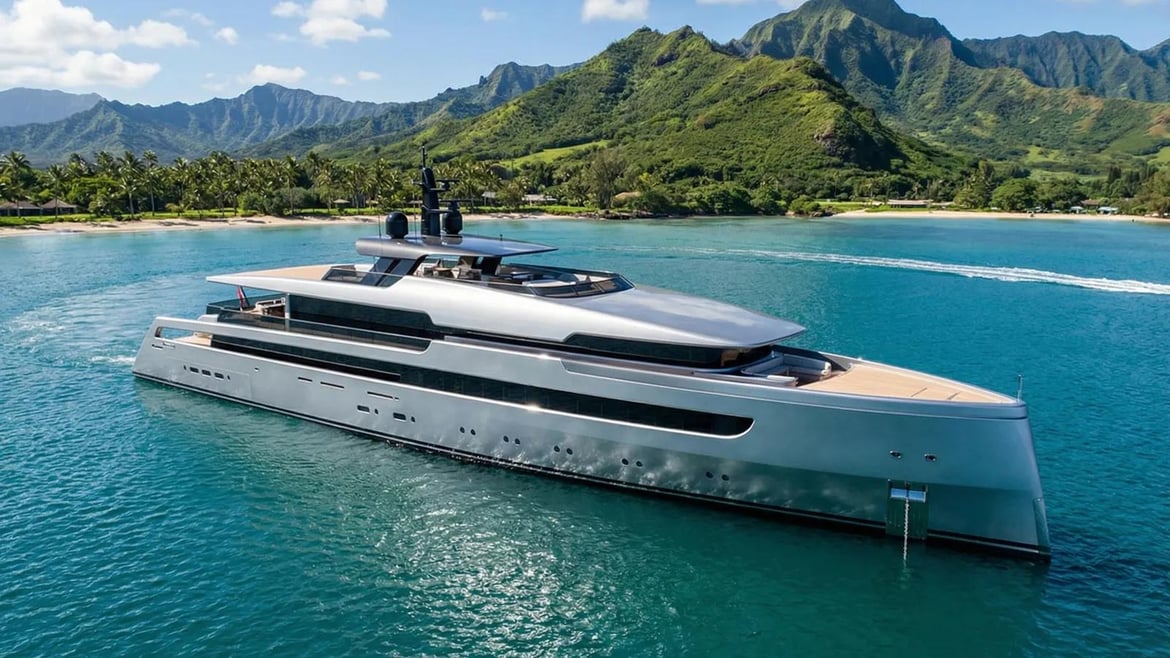
British studio ThirtyC’s 180-foot (55-meter) concept ION does not present itself as another sustainability exercise wrapped in futuristic language. It opens with a far more disruptive proposition by presenting a superyacht designed around a sealed nuclear power system instead of diesel engines and fuel tanks. Everything else, from its vertical bow to its dramatic two-level saloon, flows from that decision. ION is not merely a yacht that happens to use advanced energy. It is a vessel whose entire spatial and visual logic has been reorganized around a radically different idea of propulsion.

At the heart of the concept is NOxFree’s Unity nuclear module, a one-megawatt-class micro-reactor packaged as a container-sized “nuclear battery.” It is designed to operate for years without refueling, producing no onboard greenhouse emissions and eliminating most of the machinery normally required in a yacht of its size. With no large fuel reserves, exhaust systems, or multiple generator rooms to accommodate, ThirtyC is free to redistribute volume in ways that would be almost impossible under conventional layouts. In ION, energy becomes compact, centralized, and largely invisible, while space becomes the primary luxury.

Architecture Before Ornament
Visually, ION reflects this reorganization. Its profile is defined by a vertical bow and an upright stance that projects what the studio describes as “modern strength,” as pointed out by Boat International. The extended waterline improves efficiency and seakeeping without resorting to exaggerated length, while the metallic grey finish reinforces an industrial, architectural character.

Rather than masking its volume with soft curves and layered decks, ION embraces clarity. The studio’s creative director, Rob Armstrong, emphasizes “presence through proportion,” which translates into clean surfaces, restrained geometry, and a silhouette that reads more like a contemporary building than a traditional leisure vessel. In a market crowded with sculpted superstructures and decorative complexity, this lean, almost urban posture feels deliberately contrarian.

The yacht’s most striking spatial feature is the duplex-style aft saloon. Split across two levels and enclosed in expansive glazing, it functions as a two-story loft suspended over the stern. From the dock, it becomes a transparent stage, with guests visible across stacked floors behind a glass facade. From inside, it offers layered sightlines to the wake, allowing occupants to shift between water-level intimacy and elevated perspective without leaving the same space.
This is not simply a stylistic gesture. A double-height saloon of this scale is rarely feasible on a 55-meter platform without sacrificing accommodation or storage. On ION, it becomes possible because the nuclear system removes the need for large machinery zones. The saloon is the spatial dividend of abandoning diesel.

A sealed power core and practical autonomy
Beneath the architectural restraint sits the technical engine of the project. The Unity module uses low-enriched uranium and is designed as a factory-built, sealed unit. Two modules can replace main engines, generators, and fuel systems, feeding electric propulsion and hotel loads through integrated power electronics.

At full output, a module could operate for six to ten years before replacement. In yacht service, where power demands are intermittent, the effective lifespan could extend far longer. At the end of life, the container is removed through a dedicated access point, with most materials and much of the fuel recoverable.

Safety is addressed through passive shutdown systems, modular construction, and regulatory integration with marine and nuclear authorities. Rather than replicating traditional reactor plants, Unity positions itself as a self-contained energy appliance, designed to be installed, operated, and eventually removed with minimal intervention.

NOxFree also proposes pairing the reactor with graphene-based supercapacitors, which absorb peak loads and provide instant-response energy storage without the fire risks associated with lithium batteries. The result is a compact nuclear core supported by robust, non-combustible buffering systems.
Operationally, ION reframes range. With fuel measured in years rather than miles, cruising becomes limited mainly by provisions and crew logistics. Emissions during operation fall to zero. Speed profiles naturally favor efficient passage making around 11 to 13 knots, aligning with the output of a one-megawatt plant and reinforcing the yacht’s long-range, low-drama character.
ION ultimately reads as more than a technical experiment. It is a demonstration of what happens when propulsion stops dictating layout. By shrinking the machinery footprint to a sealed nuclear heart, ThirtyC unlocks volume, light, and spatial freedom normally unavailable in this size class. The result is a yacht that treats energy as infrastructure and space as the true status symbol.