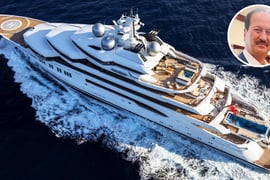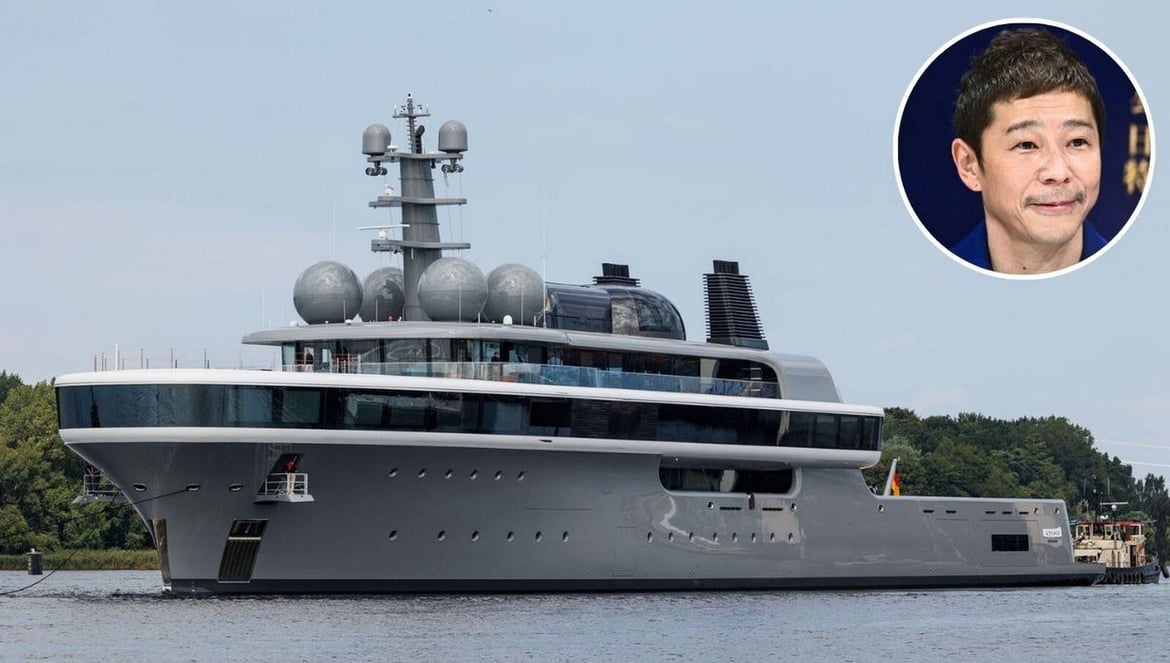
Japanese fashion billionaire Yusaku Maezawa, best known for founding the online fashion retail giant Zozotown, is all set to take delivery of a superyacht unlike any other on the water. The superyacht named Project Cosmos was recently launched from the Lürssen Rendsburg shipyard in Germany, as reported by Superyachttimes. At 375 feet (114.2 meters), the vessel is not just another Lürssen flagship.

It is the first from the German yard to be powered by a methanol-to-hydrogen fuel-cell system, developed with Freudenberg e-Power Systems. The setup can run at low speeds and power all onboard “hotel” functions in complete silence without the need for generators, making it more efficient in operation than Bill Gates’ pioneering hydrogen-powered yacht Breakthrough.

A billionaire with a taste for space and the sea
Maezawa’s connection to space exploration is part of his public identity. In 2021, he flew to the International Space Station aboard Soyuz MS-20 for a 12-day stay. His ambitious dearMoon circumlunar mission, which aimed to send artists around the Moon on SpaceX’s Starship, was canceled in 2024 due to uncertainty in the rocket’s schedule.

Naming his yacht Cosmos aligns naturally with that spacefaring persona. Japanese outlets have described the yacht as looking like a “space fortress,” citing both Maezawa’s PR office and his own social media posts. They have also repeatedly noted Marc Newson as the designer and Lürssen as the builder.

After a technical debut in March 2023, Cosmos is now in the final outfitting phase. Newson, the Australian industrial designer whose portfolio includes not only the Apple Watch but also the Riva Aquariva by Marc Newson and the 139-meter Solaris, is responsible for both her exterior and interior.

His influence on Cosmos is unmistakable, translating his Apple-grade minimalism into yacht scale. The forward-shifted superstructure, rounded observation pod, and seamless glazing create a fluid profile, while the interior promises uninterrupted sightlines and tactile detailing that blend high technology with understated luxury.

A fuel-cell system built for endurance and silence
At the heart of Cosmos is a proton-exchange membrane fuel-cell package by Freudenberg, integrated with Lürssen’s Innovation Lab concept. Instead of storing hydrogen directly, the yacht carries bio-methanol in structural tanks low in her double bottom. A reformer module converts methanol into hydrogen on demand, which is then fed into the PEM stacks to generate electricity. This powers propulsion for slow-speed cruising and covers all hotel loads such as air conditioning, lighting, galleys, and entertainment systems. The setup allows for zero-emission operation over approximately 1,000 nautical miles at low speed, or up to 15 nights of continuous silent hotel service delivering roughly one megawatt of power.

Methanol was chosen over stored hydrogen for its higher energy density, easier global bunkering, and simpler handling. It can be stored using conventional liquid-fuel infrastructure without cryogenic or high-pressure containment, freeing up guest space and removing the need for large explosion-proof zones. Locally, the system produces no nitrogen oxides, sulfur oxides, or soot, and when fueled with green e-methanol or biomethanol, the operational cycle can approach carbon neutrality.

Cosmos employs a hybrid powertrain where the fuel cells work alongside conventional generators and batteries. The fuel cells handle steady hotel demands and quiet low-speed passages, while engines and stored energy manage peak loads and higher-speed cruising. In practice, methanol flows from the tanks to the reformer, hydrogen is produced as needed, and the PEM stacks convert it into electricity and usable heat, feeding the yacht’s DC bus and onboard systems. This arrangement was proven in Lürssen’s lab before being implemented at full scale.

Safety and integration have been addressed through dedicated methanol supply lines, ventilation systems, and electrical infrastructure designed for continuous operation. Freudenberg’s methanol fuel-cell technology received RINA Type Approval in 2022, following earlier Approval-in-Principle from DNV GL, confirming readiness for class acceptance on large vessels. The system traces its roots to the Pa-X-ell research program, a collaboration between Lürssen, Meyer Werft, the German Aerospace Center, and other partners, which developed yacht-ready PEM systems with integrated reformers.

When Maezawa takes delivery, the $350 million+ Cosmos will stand as a symbol of his dual passions for technology and adventure, merging space-age ambition with advanced clean propulsion in a vessel that could mark the future direction of the superyacht industry.