

Business owners need a break every once in a while. In the case of billionaire tech boss Mark Zuckerberg, the break is simply bigger and better. Unlike mere mortals who may unwind with a staycation or a spa getaway, the Harvard graduate goes far grander. The world’s fifth-richest man is currently making the most of the serene Galápagos with his fleet, the $300 million superyacht Launchpad and the $100 million support vessel Wingman. This is not your average sunset-appreciating vacation in the Mediterranean. Instead, it fits Zuckerberg’s growing taste for destinations that go far beyond standard tourism. He did it last year with his visit to Svalbard, Norway, and now he seems to be treading into similarly delicate territory with the Galápagos.

It appears that the 387-foot Feadship superyacht and the 262-foot Damen Yachting support vessel (formerly U81) are sailing around the Ecuadorian Exclusive Economic Zone tied to the Galápagos. That distinction matters. Being in the broader Ecuadorian EEZ linked to the islands is not quite the same as being inside the Galápagos Marine Reserve itself, where protections and restrictions are even tighter.

Still, this is no St. Tropez, where a well-heeled individual can afford a casual drop-in with private vessels. The Galápagos government publicly lists authorizations for private national and foreign vessels, which means a yacht visit there falls within a permission-heavy regime. If Launchpad is in fact operating within or near those pristine waters, part of one of the world’s most carefully protected environments, then the vessel has to comply with some of the strictest maritime rules anywhere.

According to AIS data from MarineTraffic, the yacht departed from Puerto Ayora, placing Zuckerberg’s floating palace close to one of the world’s most tightly controlled eco-tourism zones. Under Ecuador’s Galápagos law, the Council of Government of the Special Regime of Galápagos sets rates and contributions for conservation and vessel entry. The Galápagos National Park also counts the entry of foreign vessels among its revenue sources. In 2022, the park authorized 24 foreign-flag private non-commercial vessels and collected $572,600, which works out to an average of about $24,000 per authorization.
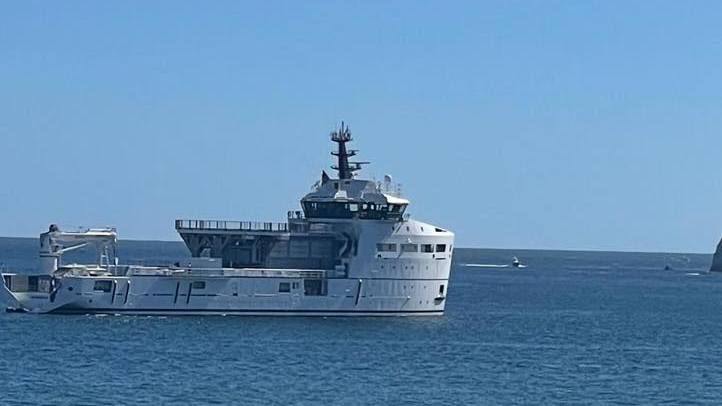
With Zuckerberg’s fleet, even the core authorization alone could push the bill past $50,000, before additional costs such as agent handling, biosecurity compliance, and protected-area entrance fees are added. In reality, the trip reads as a six-figure expedition even before fuel burn, crew logistics, and onboard luxury enter the picture. For Zuckerberg, the money is only a drop in the ocean.

The real story here is restraint. For an adventure-loving 41-year-old, the Galápagos is a place where even enormous wealth comes with limits. The park has strict rules designed to preserve its flawless environment, and those include technical requirements for visiting vessels. Private yachts are expected to have sewage-treatment systems, bilge-water treatment, and hydrocarbon-pollution controls in place.

The 387-foot Launchpad is more than sophisticated enough to meet those requirements, but in the Galápagos even a yacht of that scale may need to dial down the use of the many amenities, toys, and tenders carried aboard Wingman. Foreign private yachts are prohibited from indulging in a long list of onboard toys and activities, including jet skis, submarines, drones, sport fishing, spearfishing, and even underwater hull lights. So even if Wingman arrived with every toy imaginable, the Galápagos is not the place to deploy them freely. It seems Zuckerberg may not get to enjoy the view from a submersible on this trip after all.
Still, there is ample beauty to explore. And once outside the protected Galápagos zone, the $400 million fleet can become a private playground again. What happens on a six-figure expedition stays on a six-figure expedition, after all.