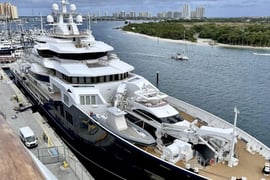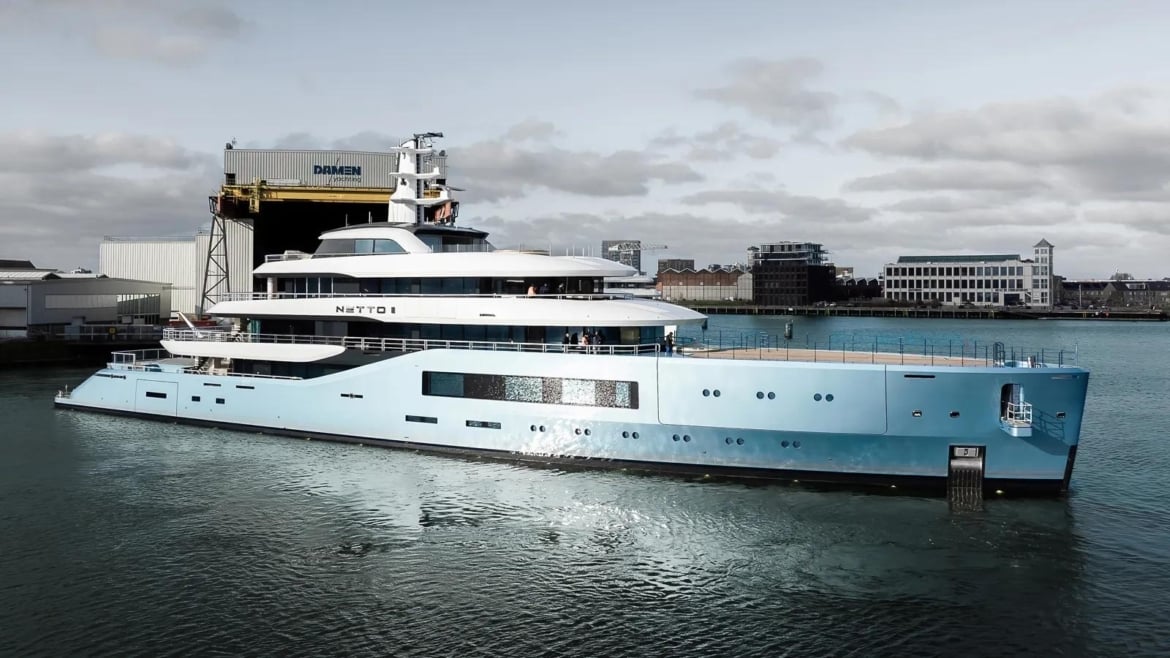
Netto II is a story of evolving passions. Her predecessor, Netto, was a Nordlund built for worldwide sportfishing, but this 262-foot superyacht is shaped around the lifestyle of her rumored American gaming tycoon owner. The second Amels 80, Netto II, has now embarked on sea trials in the North Sea ahead of delivery this summer. Built first at Damen Yachting’s yard in Galati, Romania, before moving to Vlissingen in the Netherlands for outfitting, the yacht represents a far grander expression of life on the water. Rumor mills have suggested that Netto II is intended for an adventurous young family drawn to ocean exploration, free-diving, spearfishing, and scuba diving, which explains many of the additions seen across the vessel.

The 2,175 GT yacht wears a striking dolphin-blue hull, echoing the color identity of her predecessor. According to Boat International, the ship designed by Espen Øino on the exterior, flaunts interiors by Sinot Yacht Architecture & Design. Inside, Netto II is conceived as a hub of activity, reflecting a brief centered on adventure and life on the water, with a sprawling beach club, unfolding sea terraces on three sides, a helipad, spa facilities, toys, and hybrid capability. She also features a speakeasy bar with a “60s casino vibe,” while accommodation is arranged for 14 guests in seven cabins, along with around 20 to 21 crew, including the captain.

Beyond her adventurous spirit, Netto II still delivers the indulgences expected of a modern superyacht, from an oversized Jacuzzi and a dedicated owner’s deck to a foredeck helipad that can also transform into a sports court. After a day built around action and exploration, Netto II shifts effortlessly into comfort. From the wellness area, which includes a gym, hammam, and sauna, to the serene glass-bottomed pool on the main deck aft, the yacht offers comfort on every level.

Damen Yachting project manager Stefan Regtvoort shared, “Sea trials are where the project comes together as a complete yacht. It is the first time we see how everything performs in real conditions at sea, not as separate elements but as one system. For the team, this phase is about verification, but also about fine-tuning performance in practice.”