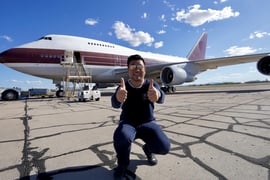
Qatar’s generosity with its Boeing 747 fleet has produced one of the more remarkable parallels in modern government aviation. A former Qatari royal jumbo jet donated to the United States has now entered service as the new Air Force One, giving the American leader a temporary 747-8i while the purpose-built VC-25B aircraft remain under development.

The luxurious aircraft, formerly registered A7-HBJ, was widely described as a $400 million gift to the United States. Remarkably, this was not the first time Qatar has given away one of its extraordinary royal jumbo jets to a foreign government.
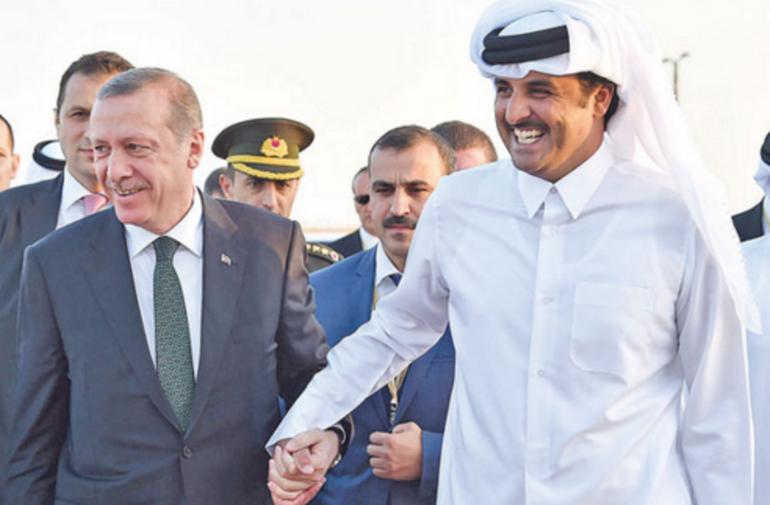
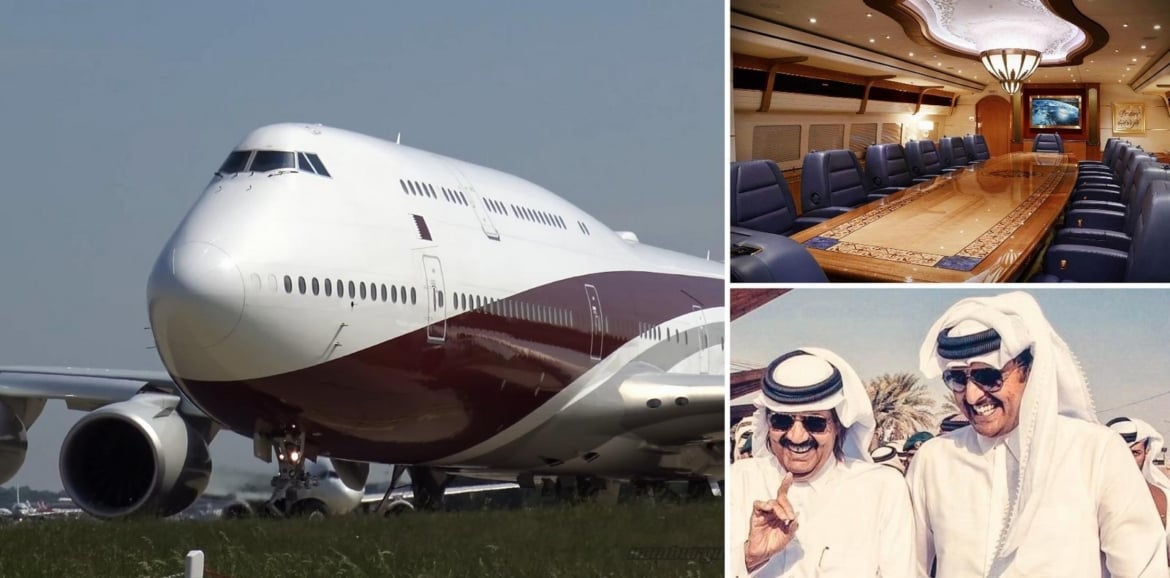
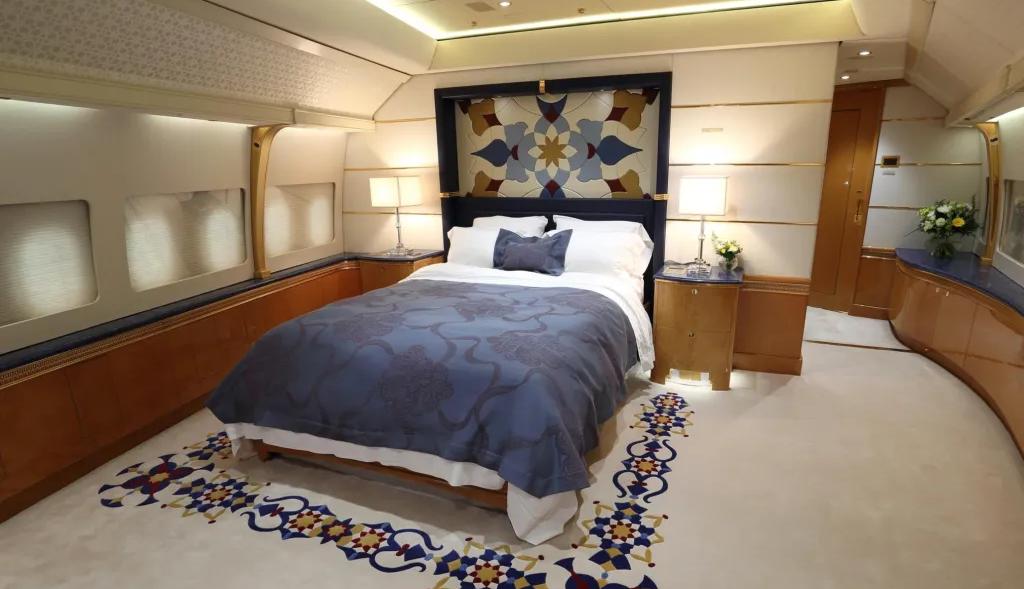
Seven years earlier, in September 2018, Qatar’s Emir Sheikh Tamim bin Hamad Al Thani gave one of his enormous private jumbos to Turkey after learning that the Turkish government was interested in buying it, as pointed out by the Sozcu. What’s interesting is that the aircraft, formerly registered VQ-BSK and now flying as TC-TRK, carried a higher estimated value of $500 million and was arguably even more extravagant inside, with gold-leaf finishes, gemstone-style surfaces, lavish lounges, private bedrooms and even a fully equipped hospital.
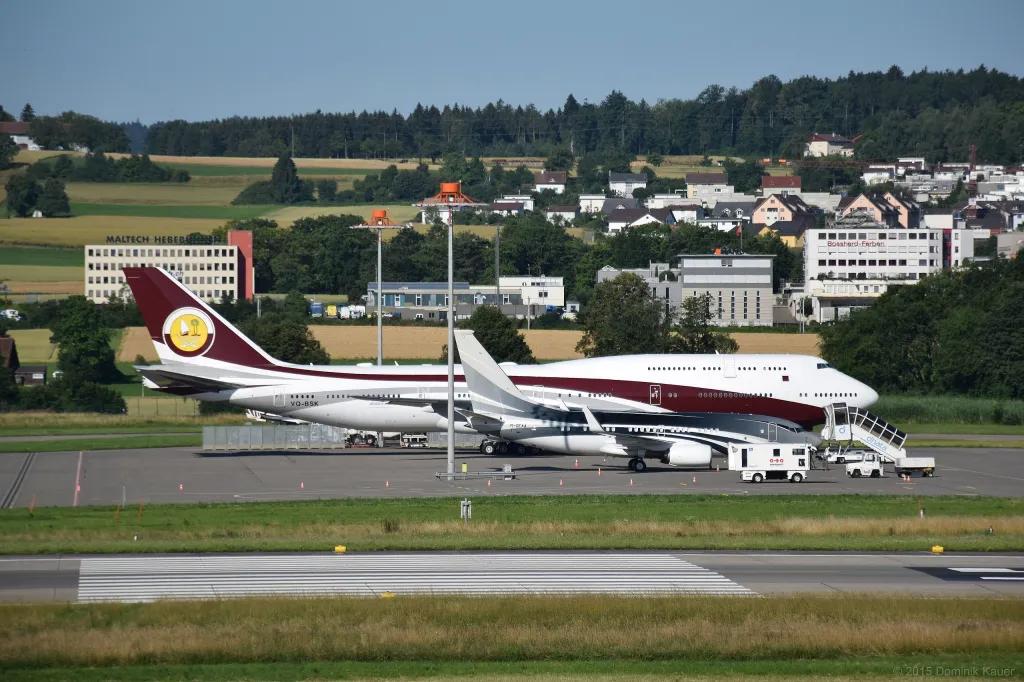
Turkey received a barely flown $500 million flying palace
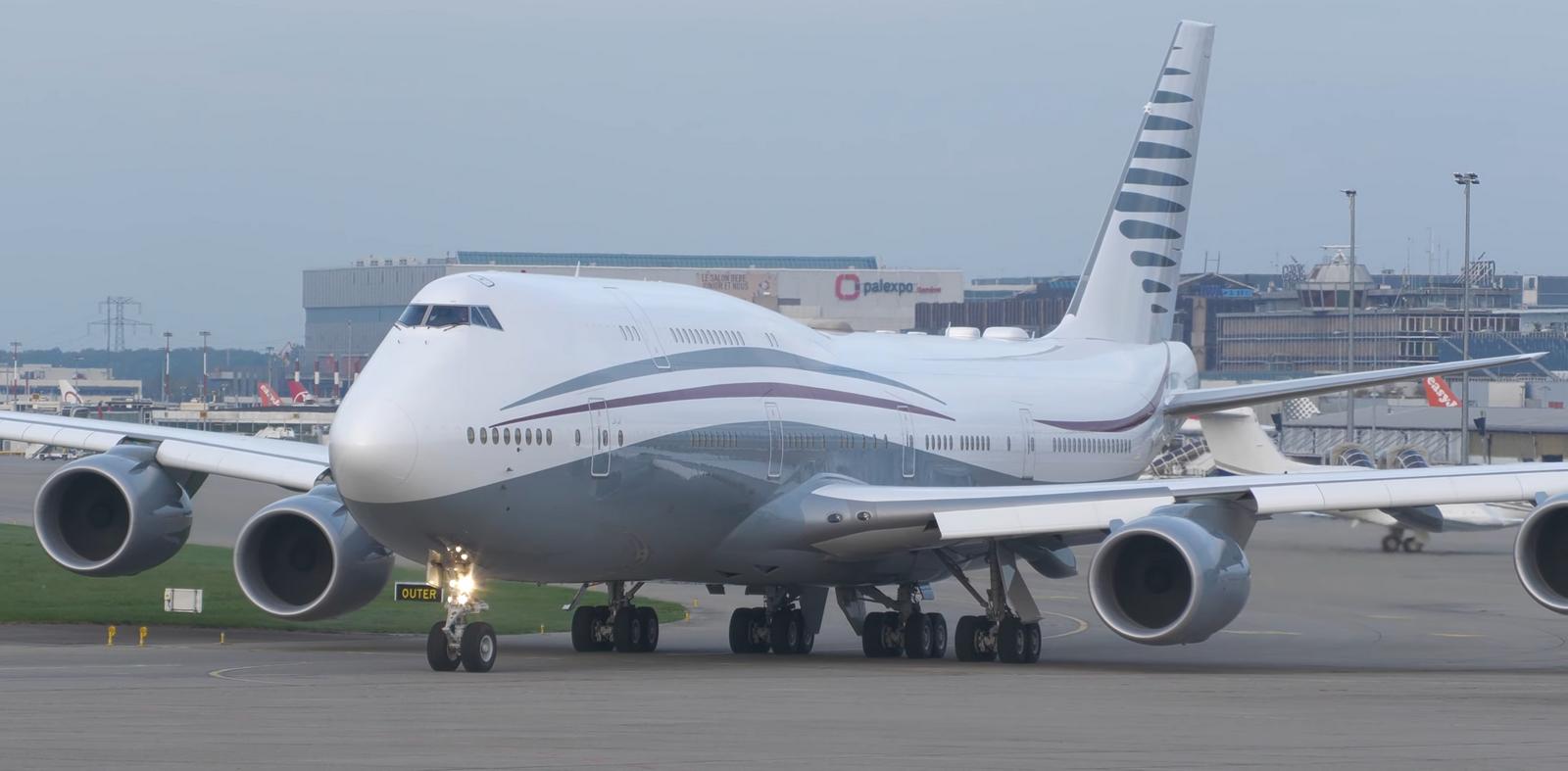
The Boeing 747-8i BBJ gifted to Turkey was effectively a sister aircraft to the one that would later make its way to the United States. VQ-BSK rolled off Boeing’s Everett production line in late 2012 before spending more than two years at Boeing’s San Antonio service center, where it was transformed from a green airframe into a bespoke VVIP aircraft. It finally entered service with Qatar’s Amiri Flight in 2015.
By the time it was offered for sale in 2018, the giant four-engine aircraft had accumulated just 436 flight hours and 200 cycles. For a six-year-old Boeing 747, that was astonishingly little use, effectively making it a delivery-mileage jumbo jet. A conventional airline 747 could accumulate a comparable number of hours in a matter of months.
Its exclusivity was perhaps best demonstrated by the number of people it carried. A standard three-class Boeing 747-8i can accommodate more than 400 passengers, but Qatar’s flying palace was configured for only 76 passengers and 18 crew. That meant just 94 people had an entire 76.3-meter-long jumbo jet at their disposal.
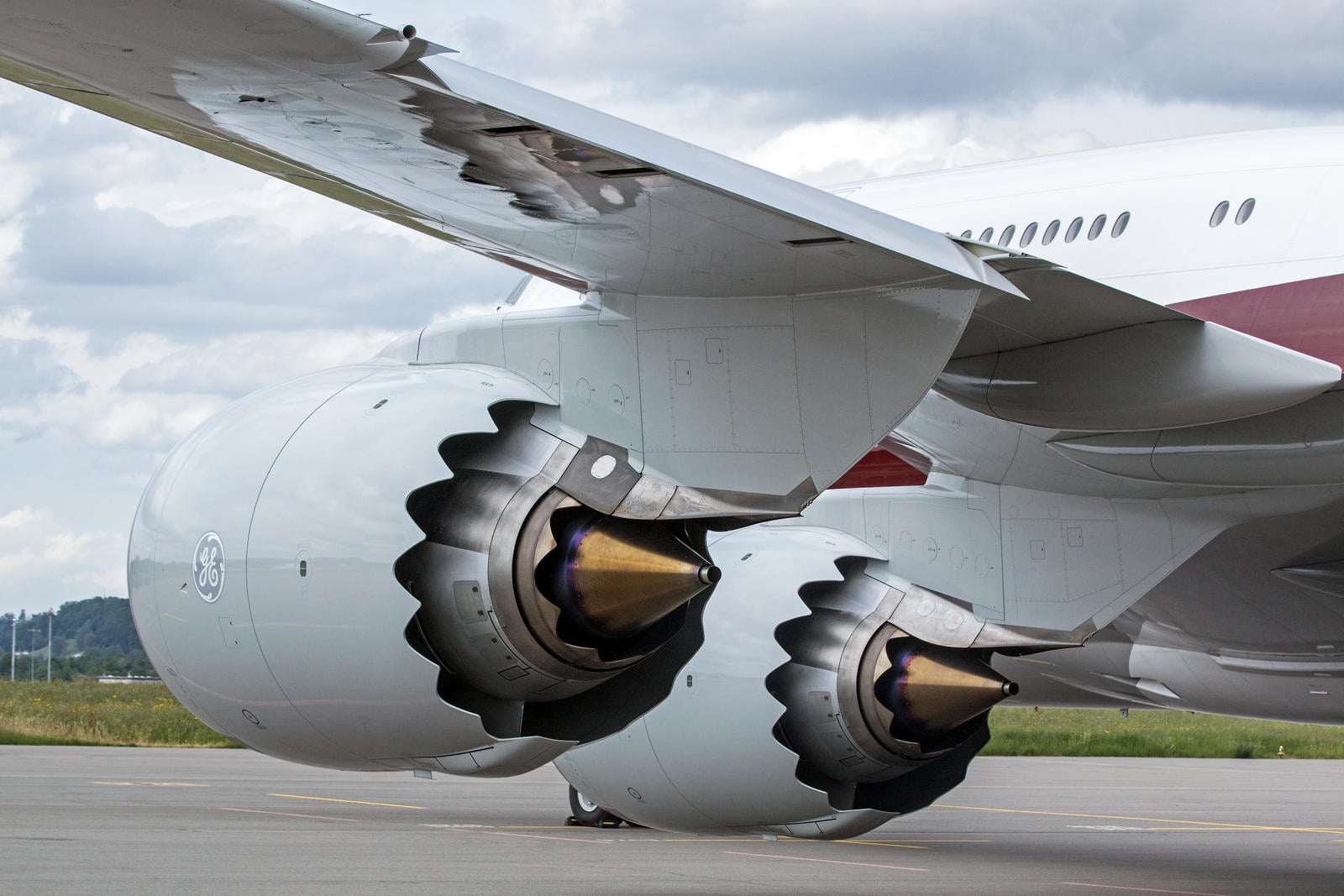
The aircraft was also immensely capable. Powered by four GE GEnx-2B67 turbofan engines, the 747-8i offered a range of roughly 14,800 kilometers, making nonstop intercontinental journeys possible. A new, unfitted 747-8i alone cost around $370 million at the time, before the addition of a bespoke interior that could itself cost tens of millions of dollars. Estimates of the finished aircraft’s value ranged from roughly $367 million to $500 million.
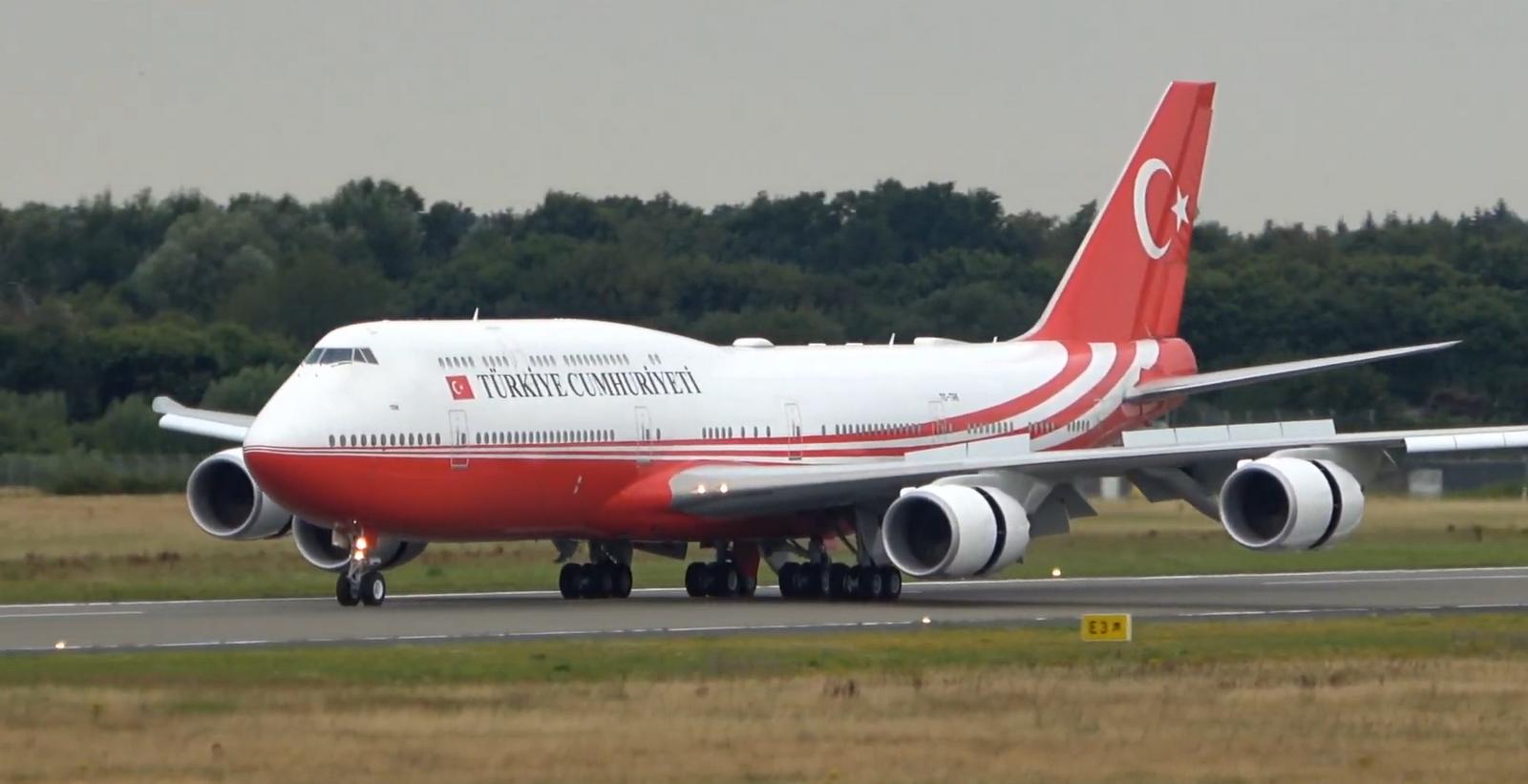
The transfer initially sparked controversy in Turkey, where opposition lawmakers questioned whether taxpayer money had been used to buy such an extravagant aircraft during a period of severe economic pressure. President Recep Tayyip Erdogan subsequently said the Emir of Qatar had refused payment after hearing of Turkey’s interest in the jet, instead giving it to the Turkish state as a gift.
Gold leaf, royal-blue leather and a hospital at 40,000 feet
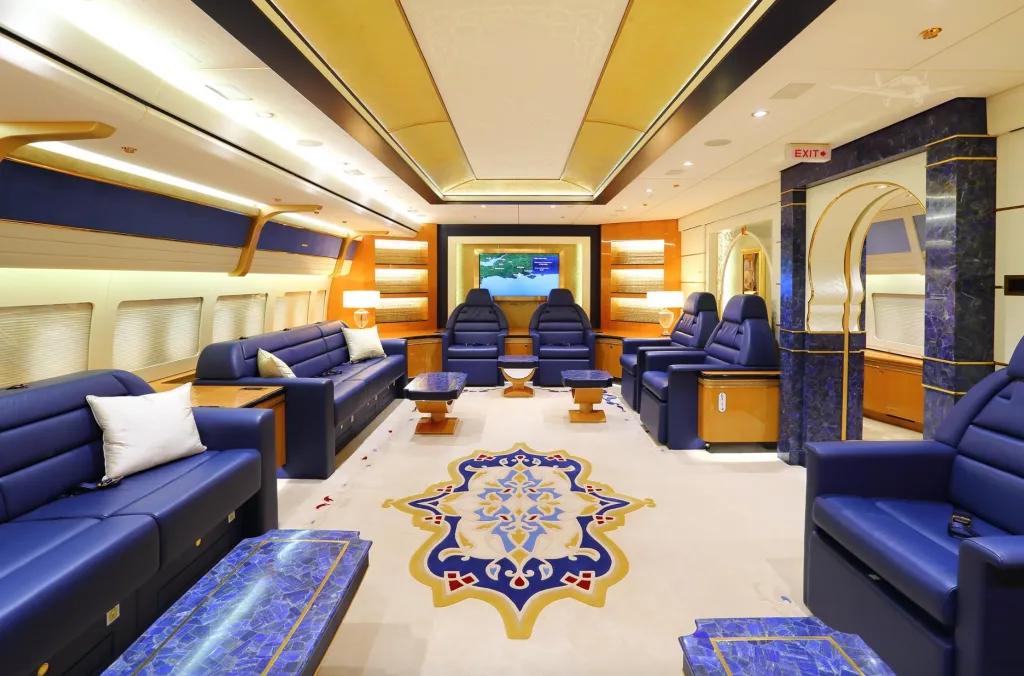
Calling TC-TRK a private jet hardly does justice to what Qatar created inside the enormous fuselage. Its floor plan was closer to that of a boutique hotel or a Gulf palace, incorporating a master stateroom, guest bedroom, multiple lounges, first-class seating cabins, numerous bathrooms, a dedicated conference and dining room and a 14-seat main-deck lounge.
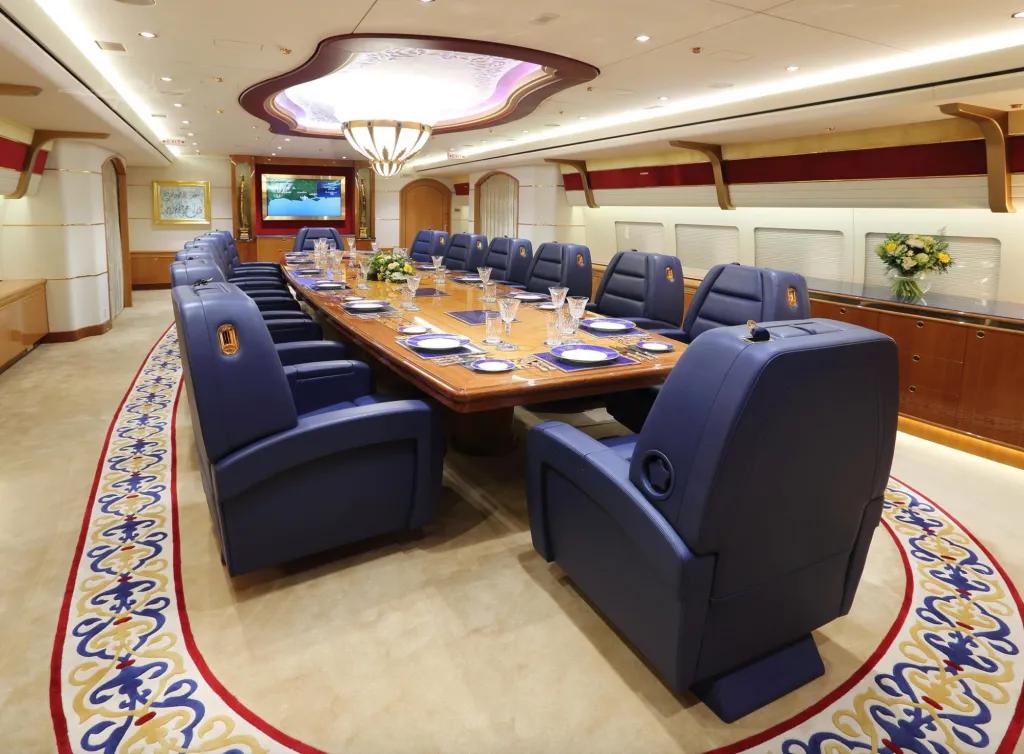
The formal dining and boardroom were among the most spectacular spaces aboard. A long, polished timber table was surrounded by high-backed navy leather chairs and set beneath an elaborate sculpted ceiling dome with a chandelier-style light fixture. It was a room designed to host meetings or formal meals while crossing continents, with little visual suggestion that it existed inside a Boeing 747 flying several miles above the earth.
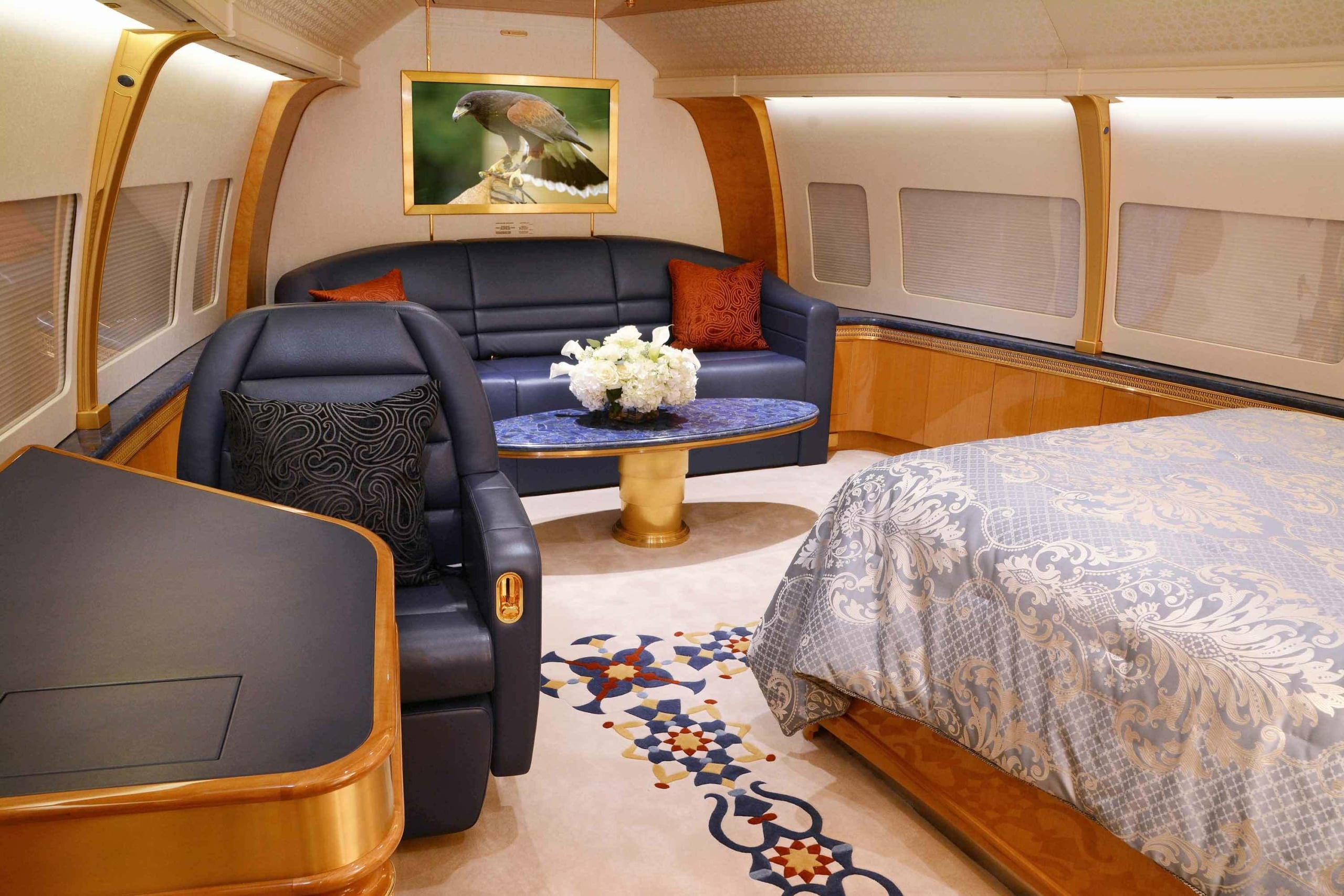
Elsewhere, the cabin embraced a distinctly palatial aesthetic. Royal-blue leather sofas and armchairs contrasted with cream carpets decorated with large Islamic geometric medallion patterns in shades of blue, gold and red. Gold leaf appeared across ceiling coves and archways, while some countertops and side tables featured striking lapis-style blue gemstone surfaces.
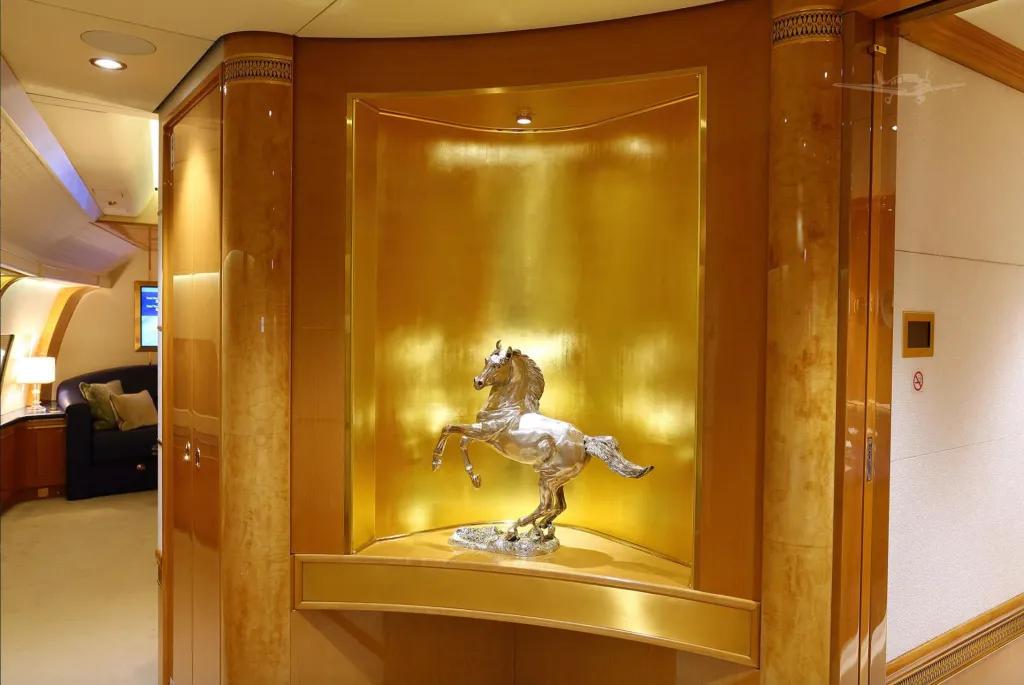
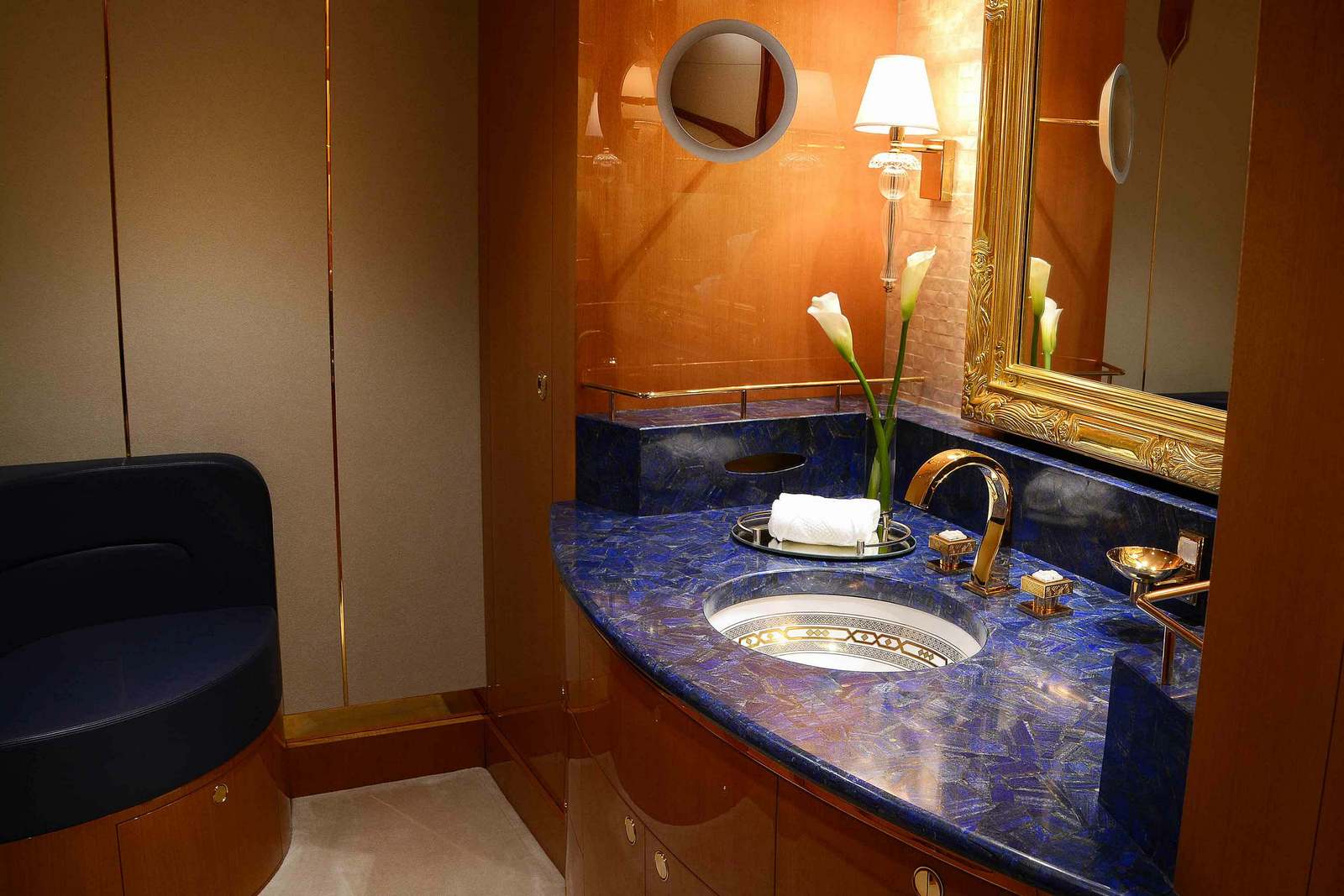
The master bathroom took the extravagance even further, pairing a rich blue vanity with a gilt-framed mirror and gold-colored fittings. One corridor reportedly featured an entire display niche clad in gold leaf, created to showcase a silver sculpture of a rearing horse. It served no practical purpose beyond turning a passageway aboard a jumbo jet into something resembling a private gallery inside a royal residence.
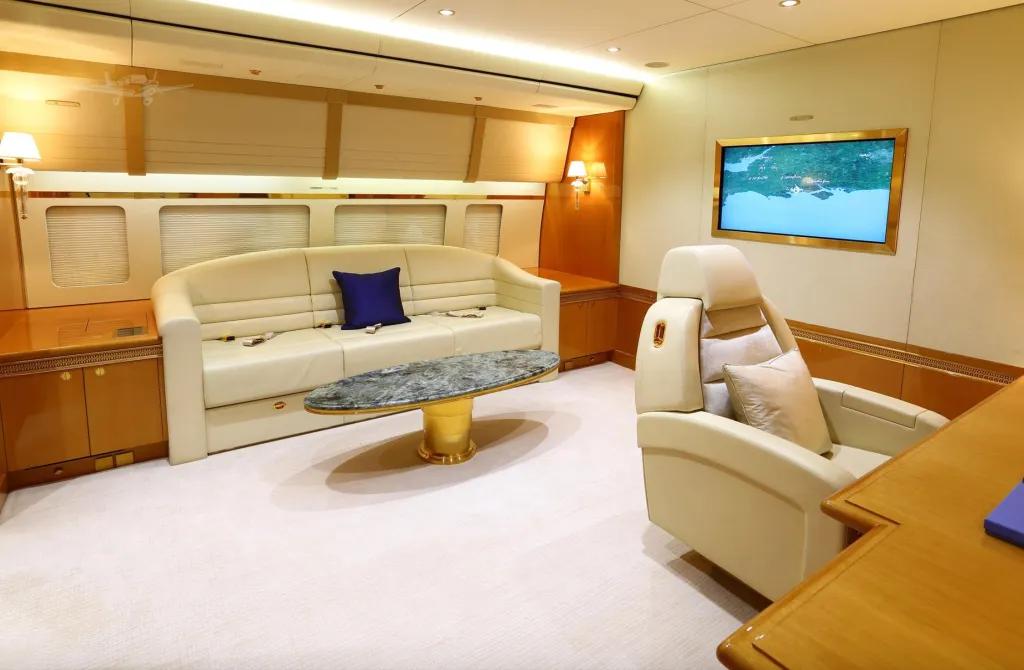
Yet the interior was not uniformly ostentatious. Some of the forward lounges used softer creams and caramel tones, giving the cabin a more restrained atmosphere and demonstrating how the design shifted between ceremonial grandeur and quieter luxury.
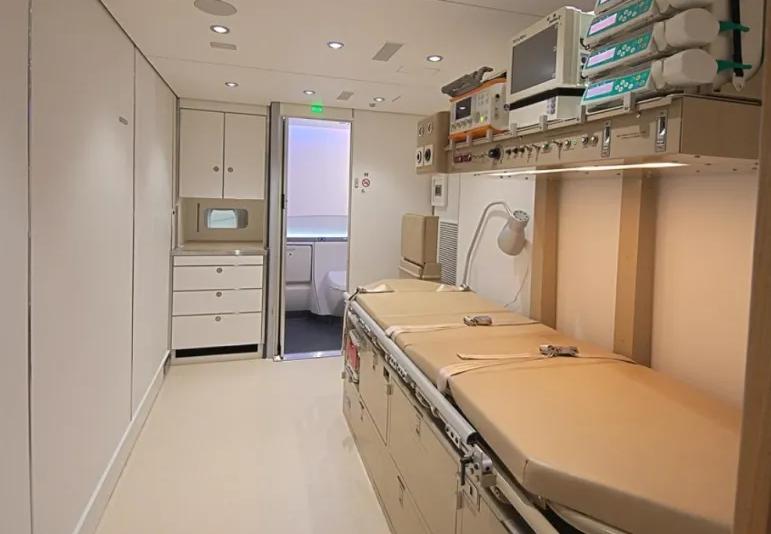
Perhaps the most extraordinary feature was the aircraft’s onboard hospital, equipped with medical monitors, infusion equipment, and a patient bed. Reports also described a gyro-stabilized surgical bed intended to remain steady through aircraft movement and turbulence. An elaborate Panasonic entertainment system served the cabin, while a camera and security suite from Otonomy Aviation gave occupants exterior views around the aircraft. Even then, the original sales listing indicated that certain spaces and features were deliberately excluded from public photographs and specifications.
Two Qatari 747s, two presidential careers
The similarities between Turkey’s TC-TRK and the former A7-HBJ donated to the United States are remarkable. Both were Boeing 747-8i BBJs built in 2012, both underwent lengthy VVIP conversions, and both entered service with Qatar’s Amiri Flight in 2015. Yet Turkey received the more lightly used aircraft. Its jet had flown only 436 hours and 200 cycles when listed in 2018, while A7-HBJ had accumulated fewer than 1,100 hours and fewer than 300 cycles when it was listed for sale in 2020.
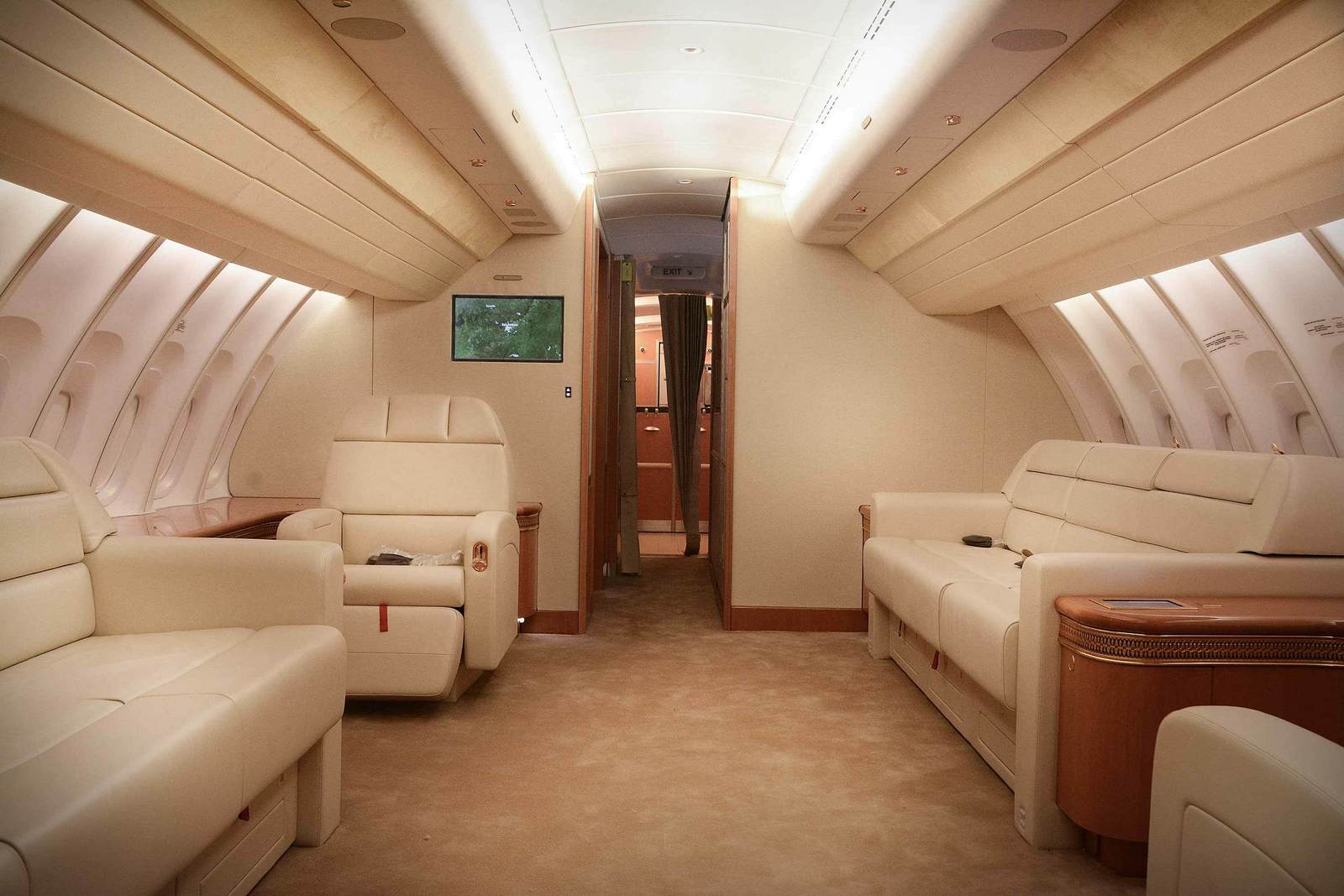
Their cabin configurations were also slightly different. Turkey’s aircraft was designed for 76 passengers and 18 crew, while the American aircraft reportedly accommodated approximately 89 passengers and 18 crew in its original Qatari configuration. A7-HBJ had spent four years undergoing an elaborate VVIP completion designed by Cabinet Alberto Pinto before entering royal service.
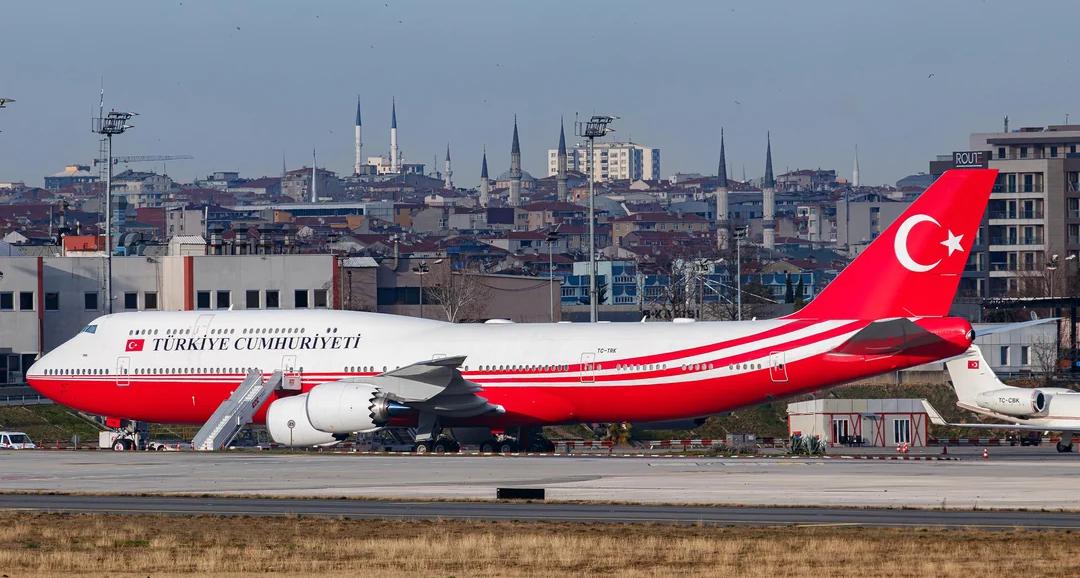
The two aircraft also carried similar headline valuations. Turkey’s 747 was valued at up to $500 million, while the aircraft donated to the United States was widely characterized as a roughly $400 million gift. Unlike TC-TRK, which retained its role as a lavish government aircraft, the American jumbo underwent major modifications to prepare it for presidential duties, replacing its Qatari royal role with specialized communications, security and mission systems.
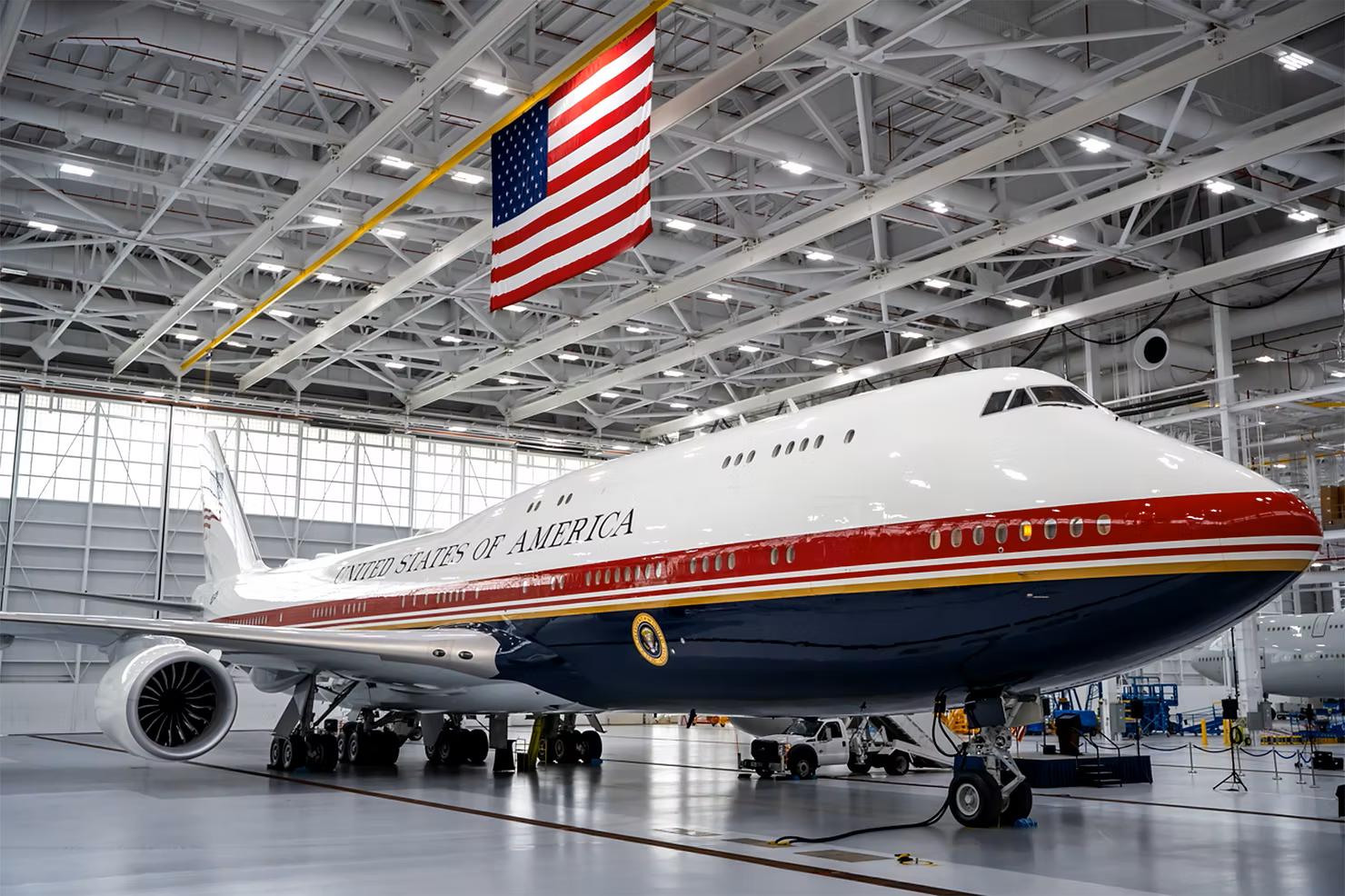
The result is an extraordinary coincidence in aviation. Within seven years, Qatar gave away two closely related, barely used Boeing 747-8i flying palaces. One went to Turkey with its gold-clad lounges, royal bedrooms, boardroom and airborne hospital intact. The other crossed the Atlantic and was transformed into the new Air Force One, placing two of the most extravagant private jumbos ever built at the service of two very different presidencies.