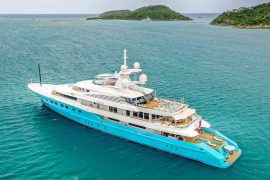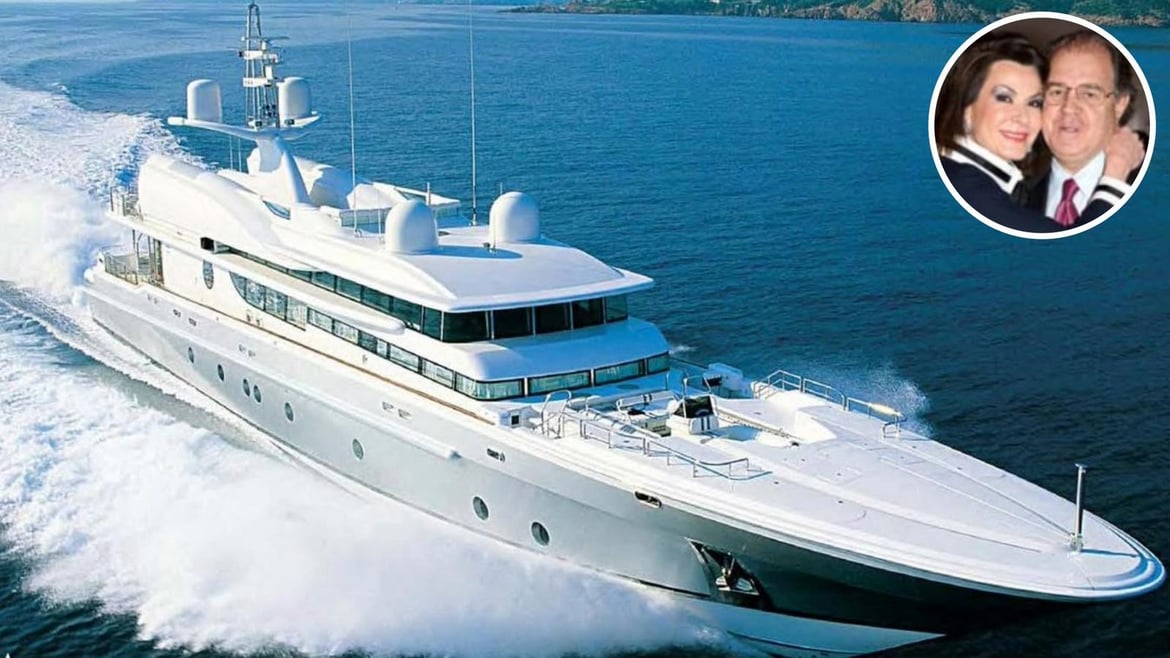
In the 1990s, when the world’s most elite travelers were boarding Concorde to have breakfast in London and lunch in New York, one billionaire took the same idea to sea. Theodore P. Angelopoulos, the Greek shipping and steel magnate, wanted to enjoy breakfast in Saint-Tropez, lunch in Monaco, and dinner in Portofino without ever leaving the water. His solution was to commission a yacht so fast, so advanced, and so outrageous that it would become a legend of modern naval design. That yacht was Thunder.

Commissioned in 1995 and delivered in 1998 by Oceanfast in Western Australia, Thunder was no ordinary luxury vessel. At 49.8 meters (about 163 feet) in length with a beam of 8.1 meters and an ultra-shoal draft of about 1.6 meters, she was built for extreme performance between the glittering towns of the Riviera. Where most yachts were built for leisure, Thunder was engineered for velocity. Her creator wanted a dayboat capable of darting across the Mediterranean like a jet streaking across the Atlantic.

The design brief, famously described as “breakfast in Saint-Tropez, lunch in Monaco, dinner in Portofino,” pushed boundaries never seen in yacht construction, as pointed out by Boat International. Angelopoulos turned to Australian-English designer Jon Bannenberg, a visionary whose radical approach to superyacht design redefined luxury at sea. For naval architecture, he enlisted Phil Curran, who was known for his performance-oriented hulls. Together, they conceived a vessel that combined aerodynamic beauty with aerospace-inspired engineering.

Thunder’s hull was built using advanced composites, including carbon fiber and Kevlar, materials more commonly found in fighter jets than pleasure boats. The goal was strength without weight, and the results were astonishing. Her propulsion system was a rare CODAG setup: twin MTU V16 diesel engines producing about 5,900 horsepower combined, paired with a centrally mounted Textron Lycoming gas turbine generating an additional 4,600 horsepower. All that power was channeled through three KaMeWa waterjets, giving Thunder a staggering 10,500 horsepower and a top speed of around 40 knots. Later modifications reduced the top speed to roughly 34 knots, but the intent remained clear — this was a superyacht built to race time itself.

To keep passengers comfortable while slicing through the sea at such speeds, Thunder featured ride and control systems that bordered on military technology. A trim system by Maritime Dynamics, originally developed to stabilize missile launchers, kept the decks steady. Her rapid emergency steering mechanism could swing the vessel from port to starboard in under four seconds, a feat that even many naval ships would envy.

Despite her performance credentials, Thunder was more than just an engineering marvel. She was a social statement. Her distinctive foredeck featured a seven-meter pool with counter-flow jets that could double as a tender bay when drained. Concealed lockers for watercraft and a hidden crane gave the space versatility, transforming it into an open-air social hub. Below deck, the accommodations balanced opulence with audacity. Typically configured for 10 guests across five cabins, including a full-beam master suite amidships, Thunder carried a crew of seven or eight to maintain her intricate systems.

Over the years, her interior has seen as many transformations as her ownership. Bannenberg’s original scheme was a study in flowing forms and futuristic minimalism. It was later replaced by a radical baroque refit around 2015. Executed by a Ukrainian designer in collaboration with Roberto Cavalli’s Visionnaire studio, the refit introduced stingray skins, high-gloss veneers, and mirrors that reflected light like liquid metal. Reports suggest the refit cost several million euros, turning Thunder into an extravagant work of marine art.

Angelopoulos, born in 1943 and educated in Zurich, came from a family steeped in steel and shipping. Through his company Metrostar Management, he became one of Greece’s most influential maritime figures. Yet it was Thunder that revealed another side of his ambition. It was a desire to fuse industrial might with artistic daring.

The Concorde, the icon of high-speed air travel, represented more than just aviation brilliance. It was a statement of human ambition and elegance, a machine that turned the impossible into the routine. Cruising at Mach 2, twice the speed of sound, it could cross the Atlantic in just three and a half hours. Its sharply pointed nose, delta wings, and slender fuselage became synonymous with power and prestige. Only a few thousand passengers could ever afford to fly it, yet for those who did, Concorde was not just transportation but transformation

While the Concorde symbolized humanity’s race to conquer distance through the skies, Thunder embodied the same spirit on the water. She was a private Concorde of the sea, a 50-meter streak of carbon and Kevlar that turned the Mediterranean into her own personal runway. Even decades later, Thunder remains a reminder that for some, speed was not just a luxury. It was a way of life.