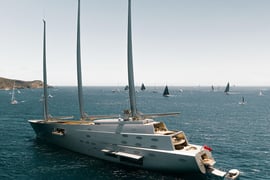
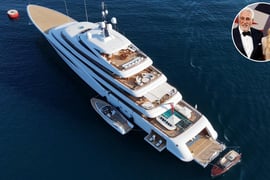
There was a phase when the world went nuts over padel and pickleball, and while that craze has not completely fizzled out yet, there is a new fascination on the block: mahjong. There is an undeniable global mahjong renaissance happening right now, and it has evolved far beyond a quiet parlor game for the older generation. It would not be entirely wrong to call it the new, more comfortable pickleball. But what may be a fad for the world was a constant fixture aboard the 275-foot trimaran of late Singaporean paint billionaire Goh Cheng Liang, who owned the world’s largest trimaran. Liang had the Echo Yachts-built White Rabbit since 2018, and yes, it featured a dedicated mahjong room.

While most billionaires like Jeff Bezos and Joe Lewis have made space for padel on their luxury vessels, Liang had made room for mahjong from the very beginning. It was not just a game for the tycoon who built a global empire through Nippon Paint, but a way of bringing all his people together. The businessman, whose story began in 1927 in a one-room tenement in Singapore, could host 22 guests and 30 crew aboard this remarkable vessel. Interestingly, the diesel-electric trimaran was centered around family time across generations.

Tying this thought together were two lounges on the main deck, one informal to port and a more formal seating area to starboard for older generations. The dedicated mahjong room was complemented by another games area on the sundeck, designed as a more informal space for younger generations to enjoy. The karaoke and piano lounge is another strong Asian family-entertainment detail that sits beautifully beside the mahjong room, adding to the sense that this trimaran was designed less as a floating showpiece and more as a social home on the water.

To foster this congeniality at sea, the owner ensured there were no televisions in the guest cabins, gently pushing younger generations into communal areas instead. The four-deck trimaran also traveled with a 51-meter support vessel, which carried most of the toys and tenders.

White Rabbit was designed around stability for mahjong and familial merriment
Sam Sorgiovanni designed the vessel after taking in the opinions of every family member, and for that he flew to Singapore specifically to meet the billionaire clan. The family had already enjoyed a 200-foot trimaran, and for the larger version requested the intimacy of the smaller vessel, only with more space to enjoy together.

In fact, according to a BOAT interview, the family specifically requested less wardrobe space. They told Sorgiovanni that since they spent all their time in the social areas, they did not need massive walk-in closets, only a bench to lay out their things.

That thinking makes the trimaran configuration especially important to the mahjong angle. A trimaran offers incredible stability, which makes long, seated games at sea far more practical and comfortable. It also allows for meals, conversation, and gatherings to continue even in the middle of a swell, without the sort of motion that could easily disrupt a game like mahjong. At 20 meters wide, it is about the width of two standard superyachts. Liang, believed to have been worth $15 billion at the time of his passing, is said to have owned at least five yachts carrying the White Rabbit name over the decades. He favored trimarans for their stability, and getting the biggest one in the world made this feel like a full-circle moment.

The trimaran breathed new life into the Australian superyacht industry
White Rabbit was built by Echo Yachts at its Henderson shipyard. It took four years to complete the vision of Fremantle-based yacht designer Sam Sorgiovanni, who was responsible for both the exterior and interior styling. But this was not just the world’s largest trimaran. It was also a project that created 300 local jobs and contributed to the training of 45 new apprentices.

Some of the workers even had to be pulled out of retirement because they possessed the expertise required for a build of this scale. It is safe to say that with White Rabbit, the billionaire who passed away at 98 last year gave the superyacht industry in Australia a real shot in the arm. “There’s a lot of knowledge that would have been lost through retirement if this project had not come around,” reported The West Australian. It also added, “I do believe the client is quite a philanthropist in the way that he has a lot of passion for the industry and a lot of respect for the WA builders.”