
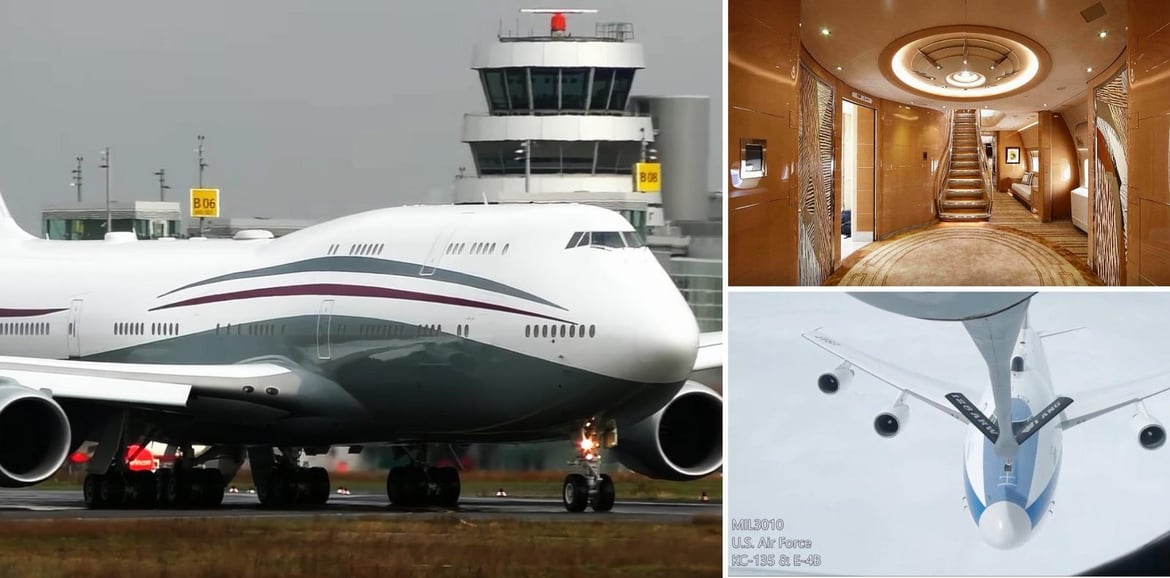
The $300 million Boeing 747-8 gifted by Qatar and now being converted in Texas into a stopgap Air Force One is unlikely to receive one of the most iconic features associated with the modern presidential fleet. We are talking about the mid-air refueling system. The aircraft is being fast-tracked for delivery by summer, and that compressed timeline is shaping what will and will not make it onto the jet. In practical terms, the bridge aircraft is being built for speed and sufficiency rather than for the full spectrum of Cold War-era survivability.

According to Air and Space Forces magazine, the aircraft is unlikely to get an in-flight refueling system as part of its rapid modification. That omission is not a technical impossibility. It is a reflection of schedule, scope, cost, and risk, all of which are tightly constrained on an airframe that was officially accepted in May 2025 and publicly acknowledged as undergoing work in September, with anticipated delivery no later than summer 2026. Less than a year for modification is an aggressive runway for any large jet. For something as complex as aerial refueling integration on a 747-8, it is fundamentally misaligned with reality.

The same time pressure shaping the refueling decision is also preserving the cabin. With less than a few months available for modification, most of the Qatari VVIP interior is expected to remain in place, which will make this the most luxurious Air Force One in history. The aircraft was designed as a flying palace, complete with private bedroom suites, marble-clad bathrooms with full showers, expansive lounges, wood paneling, tailored carpets, and even a grand staircase linking the decks.

Why in-flight refueling does not fit the timeline
The timeline alone makes the case. Developing and certifying an aerial refueling capability for a widebody aircraft is not a matter of cutting a hatch and adding plumbing. It is a multi-year engineering and flight-test campaign that can consume thousands of test hours. Structural reinforcement is required around the refueling receptacle, which on earlier presidential 747s sits atop the nose ahead of the cockpit. That area must absorb boom loads, turbulence-induced misalignments, and potential contact events. High-capacity fuel lines must then be routed safely into multiple tanks with redundancy and fire protection. Every change triggers analysis for crashworthiness, lightning protection, and electromagnetic shielding.

The 747’s aerodynamics add another layer of complexity. The bulbous nose generates disturbed airflow that interacts with a tanker’s boom in subtle and sometimes violent ways. The E-4B, also based on a 747-200, required a unique pop-up spoiler panel ahead of its refueling receptacle to stabilize pitch oscillations during contact. Engineering, validating, and certifying a similar solution on a passenger-configured 747-8 would demand a dedicated test program across the full weight and altitude envelope. That effort alone conflicts with a one-year schedule.

Scope is the second constraint. L3Harris, widely reported as the modifier, is already tasked with installing secure communications, mission systems, hardened power and cooling, presidential accommodations, and defensive measures. Adding aerial refueling would represent major scope creep for a bridge airframe that is not intended to serve beyond a single presidential term. The Pentagon previously cut refueling from the new VC-25B program to save roughly $1 billion. Reintroducing that feature on a one-off interim jet would be a difficult sell.

Capability versus practical necessity
Risk and optics also matter. Mid-air refueling is among the most demanding maneuvers a large aircraft can perform, requiring precise formation flying in turbulence just meters behind a tanker. For a presidential platform, acceptable risk thresholds are even lower. Test campaigns are high-visibility and inherently hazardous periods. There is limited strategic upside in assuming that risk for an aircraft with ample intercontinental range that will almost never need to remain aloft for days.

Historically, not every presidential jet has carried this capability. The Kennedy-era VC-137C fleet did not feature in-flight refueling. The capability entered the presidential fleet with the 747-based VC-25A aircraft that began service in 1990 and 1991. If the Qatar 747-8 flies without it, the precedent would not be entirely new.

Operationally, the absence of refueling changes less than critics suggest. The 747-8’s range of upto 8,500 nautical miles (15,742 km) comfortably covers most presidential missions with, at most, a planned technical stop. In crisis scenarios where airborne endurance would matter most, the aircraft’s loiter time will be limited to its fuel load and crew duty cycles. That trade-off reflects the bridge jet’s intended role. It is being configured as a highly capable executive airlift platform rather than a permanent doomsday command node.

Inside, much of the Qatari VVIP interior will also remain largely unchanged, making it the most lavish presidential aircraft ever fielded. Interestingly, it will also be the first presidential platform to carry the new color scheme.

The result is a paradoxical hybrid that pairs visible opulence with carefully bounded capability. Technically feasible does not mean strategically sensible, and on this schedule, aerial refueling falls squarely into that distinction.