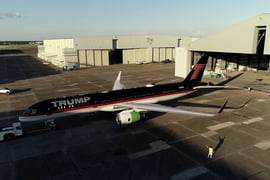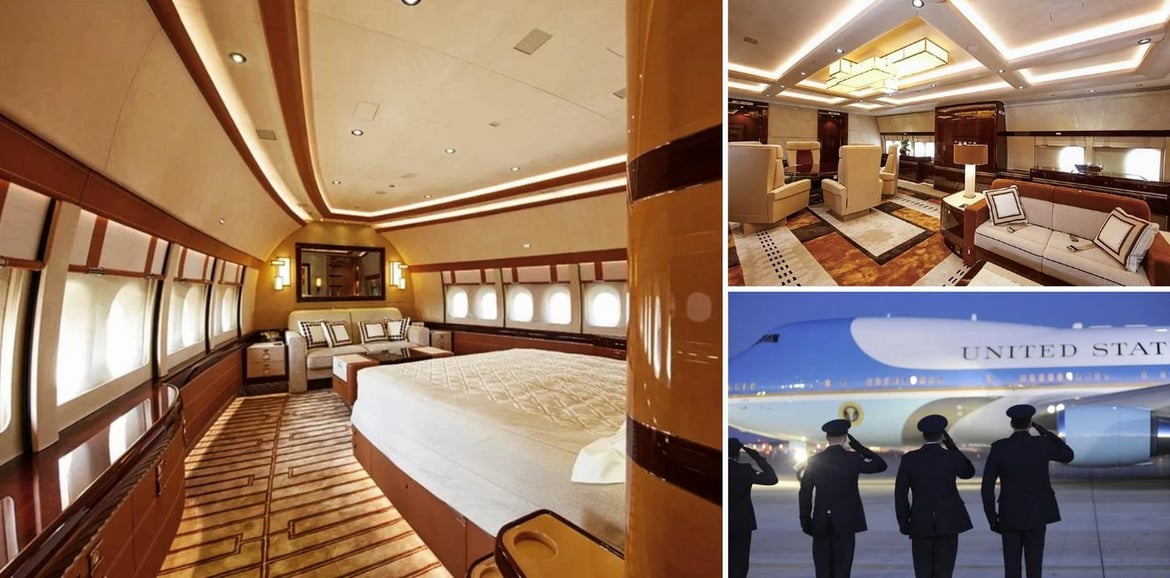
Washington appears determined to rush its interim Air Force One into operational use. To place the $300 million VVIP Boeing 747-8 gifted by Qatar into presidential service by summer, the Air Force is choosing not to dismantle the aircraft in the way a traditional Air Force One program would demand. Instead of stripping it down to bare structure and rebuilding it as a hardened flying command bunker, planners are working around what is already inside the fuselage, preserving most of the royal architecture that defined its previous life.

According to Aviation Week, the aircraft will largely remain the same, with the Air Force seeking to limit changes to the interior in order to accelerate entry into service. That single decision reshapes the story. Rather than engineering a conventional successor to Air Force One, Washington is adapting a fully formed flying palace.

Preserving the Palace in the Sky
This 747-8 Intercontinental was delivered in VVIP configuration for Qatar’s ruling family and conceived as an airborne residence rather than a military nerve center. It offers roughly 420 square meters of cabin space across the main and upper decks, yet accommodates only about 89 passengers.

A commercial airline would install between 360 and 460 seats in the same footprint. The contrast reveals the intent. Space here was designed for privacy, ceremony, and comfort.

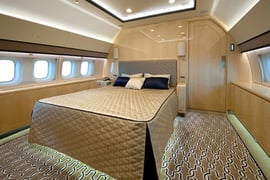
Inside are bedroom suites, marble-clad bathrooms with full showers, multiple lounges, a grand staircase linking the decks, a private office, and a dedicated business class section in the tail. In the quiet nose sits a full presidential-style apartment with a master bedroom, guest suite, living room, and high-end en-suite bathroom accessed by its own stairway.

Five galleys and eleven lavatories support fewer than one hundred occupants. Gold accents, mirrored surfaces, wood paneling, and tailored carpets create an atmosphere closer to a superyacht or Gulf palace than to a government transport aircraft.

The current Air Force One fleet, derived from the 747-200B, tells a different story. Its interiors are comfortable but utilitarian, carved into staff work areas, press seating, a medical suite, communications bays, and a main conference and dining room.

The presidential bedroom is modest, the private office functional, and the aesthetic restrained. Passenger counts on typical trips sit around seventy, but with far less personal space and none of the theatrical material richness found in the Qatari jet. In terms of visible luxury, the comparison is stark.

Several months ago, the Air Force asked to expedite the modification process for the Qatar 747. Thanks to the fast-tracking of the process, the original layout will remain mostly intact, and the changes will be selective. A more secure presidential office and conference area will be created.

Certain doors and stairways may be adjusted to meet Secret Service requirements. A modest medical treatment space could be added. What is unlikely is a complete interior overhaul. The visual identity of the aircraft is expected to remain unmistakably royal, even as American systems are threaded through its walls.

A presidential office in a royal shell
Limiting interior changes does not mean ignoring mission capability. The aircraft will receive secure voice and data links, classified satellite communications, upgraded internal networks, and modern cryptographic equipment that allow the President and senior staff to conduct secure calls and manage routine national business. In operational terms, it will function as a highly capable executive command jet housed inside a 747-8.

What it is unlikely to become on this compressed timeline is a fully nuclear-hardened National Command Authority platform. Achieving that standard would require validating every cable and component while integrating extensive electromagnetic pulse resistance and the most sensitive defensive systems.

That level of reconstruction conflicts with a one-year schedule and a mandate to limit changes. Modular defensive aids such as infrared missile warning sensors and directional infrared countermeasures are plausible additions. Full aircraft-wide hardening and the deepest layers of survivability associated with extreme war scenarios are far less compatible with the deadline.

The result is a remarkable hybrid. It will be secure enough for executive airlift and crisis management, yet materially more opulent than any presidential aircraft before it. It will also be the first presidential platform to get the new paint scheme, featuring red, white, blue, and gold. By choosing speed over structural reinvention, the United States may soon field an Air Force One that makes the aging VC-25A feel like a well-equipped motel with excellent WiFi parked beside a marble and gold palace.