The long-promised new Air Force One has slipped again. Boeing’s VC-25B program, intended to deliver the next-generation presidential aircraft, is now years behind schedule, pushing meaningful availability dangerously close to the end of the decade. With each delay, the gap between what the United States needs and what Boeing can deliver has widened. The consequence is no longer theoretical. It is already reshaping how the president will travel in the near term.

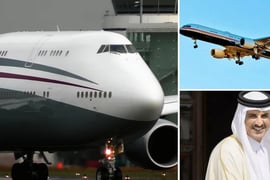
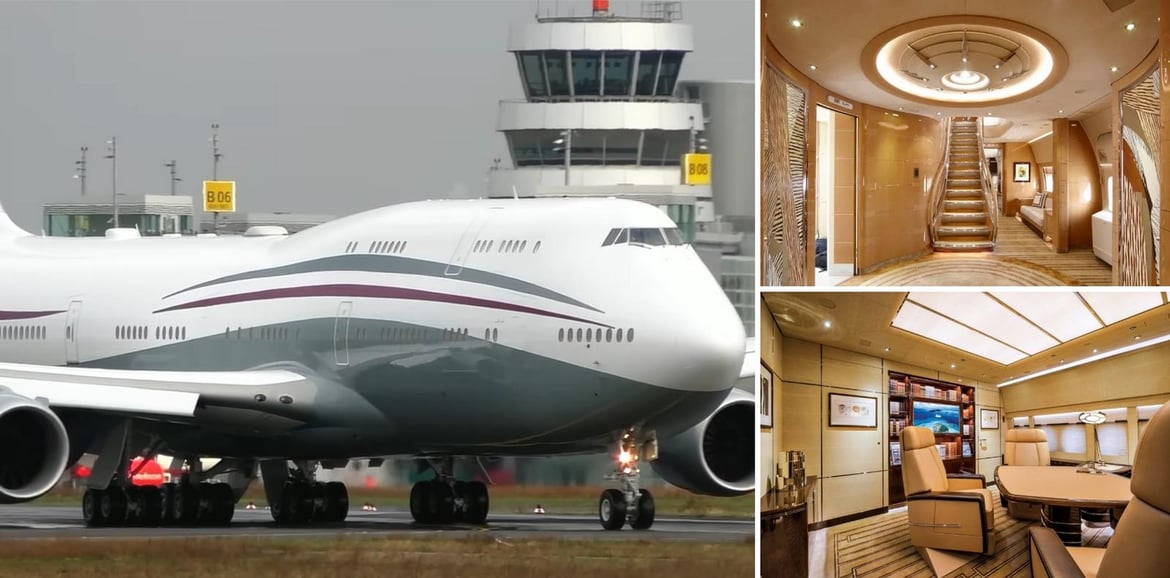
Rather than waiting until mid 2028 for the VC-25B as reported by Bloomberg, the US Air Force has moved forward with an extraordinary stopgap solution. The luxury Boeing 747-8 donated by Qatar is now being converted to serve as the primary presidential transport until the new jets are finally ready. Thanks to the delay the conversion work on the jet gifted by the Emir of Qatar has now been expedited. What began as a backup plan has quietly become central to presidential airlift planning.

What the next Air Force One is supposed to be
At a high level, the VC-25B is designed to be far more than a modified commercial airliner. Publicly described requirements frame it as a flying White House, capable of supporting presidential decision-making even during national emergencies. That means secure communications, survivability, and independence far beyond any civilian aircraft.

Official acquisition reporting outlines the scale of modification. The aircraft requires a major electrical power upgrade, dual auxiliary power units usable in flight, a full mission communications system, military-grade avionics, and an integrated self-defense suite. Beyond the hardware, the program includes aircraft integration, exhaustive testing, evaluation, certification, paint, and final delivery preparation. Each of these elements must function not in isolation, but as part of a single, tightly integrated system.

This is where complexity explodes. Unlike a normal 747, the presidential aircraft is effectively an aircraft-as-a-system. Power, communications, security, avionics, and mission equipment are interdependent. A change in one area can ripple across dozens of others. Nothing flies until everything works together, repeatedly, and under extreme conditions. That level of integration is one reason timelines on paper rarely survive contact with reality.

Why the new Air Force One keeps getting delayed
Government oversight and credible aerospace reporting point to a convergence of problems rather than a single failure. One major constraint has been the workforce and security clearance bottlenecks. The work is highly sensitive, and hiring mechanics and engineers who can obtain and retain clearances has proven difficult. When cleared labor is scarce, throughput slows, no matter how many aircraft are waiting in the hangar.

Design maturity has also been an issue. As systems are installed, conflicts and shortcomings have emerged, forcing rework. Tasks already completed have had to be undone and redone as designs evolve. Wiring, the nervous system of the aircraft, has been particularly disruptive. Delays in wiring design cascade into installation problems and block other work that depends on finished routing.

Environmental and cabin issues have added further drag. Oversight reporting has cited decompression and environmental control system challenges, including excess cabin noise, which can trigger redesigns and retesting. Structural findings have not helped either. Stress-corrosion cracking repairs that were expected earlier in the program slipped, introducing heavy maintenance-style work into what was supposed to be a conversion effort.

Supplier instability compounded these technical problems. Earlier acquisition reporting documented how a key interiors supplier fell behind schedule and showed signs of financial distress, forcing Boeing to terminate the subcontract and shift work elsewhere. That kind of disruption typically resets schedules on complex VIP aircraft.
All of this has unfolded under a contract structure that leaves little room for recovery. The deal has long been characterized as fixed-price in nature, exposing Boeing to billions in losses as costs rose and timelines stretched. The result has been ongoing tension between scope, cost control, and speed, none of which bend easily in a program this sensitive.

The Qatar 747 steps into the spotlight
Against this backdrop, the donated Qatari 747-8 has moved from curiosity to necessity. The US accepted the aircraft and directed the Air Force to rapidly upgrade it for presidential transport. Reporting places the jet in Texas during early phases of the work, with defense contractor L3Harris tapped to handle the conversion.

There is active disagreement over cost. The program leader has suggested the retrofit could be completed for under $400 million, while critics argue that, depending on requirements, the bill could approach $1 billion. The Air Force has said contract details are classified, which is consistent with presidential mission systems and makes outside verification impossible.

What can be described credibly is the nature of the work. Secure communications and command-and-control are foundational. The aircraft must carry encrypted voice and data links, hardened communications pathways, and the antenna and radome ecosystem needed for global, multi-band connectivity. Survivability upgrades are equally central, integrating defensive countermeasures and coordinating them with sensors, avionics, power, and cooling.

Power generation and thermal management are often underestimated. High-end communications and defense systems demand far more electricity and cooling than a luxury jet was ever designed to provide. This alone drives deep changes to generators, distribution, and environmental systems, underscoring why a free airplane does not translate into a cheap conversion.

Cybersecurity and supply-chain assurance loom large as well. A foreign-operated VIP jet triggers intense scrutiny of equipment provenance, wiring integrity, and maintenance history. That typically means inspections and, in some cases, wholesale replacement of components to meet U.S. security standards.

Even the cabin, despite its opulence, cannot be left untouched. Royal interiors are not automatically compatible with presidential mission needs. Significant sections may be removed or reworked to route wiring, integrate secure spaces, and support communications and staff operations.

The hardest part, however, is integration testing. Installing systems is only the beginning. Proving that everything works together reliably, under mission conditions, takes time. How quickly the interim jet enters service will depend on how closely it is pushed toward full Air Force One standards versus a more limited executive airlift configuration.

For now, the reality is clear. The next Air Force One remains delayed, and the Qatar 747 is no longer just an interim solution on paper. It is becoming the aircraft that carries presidential authority through the skies while Boeing’s long-awaited replacement continues to slip further into the future.