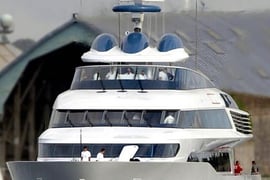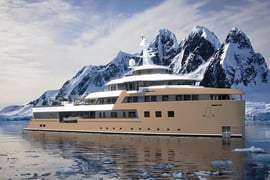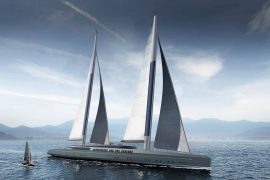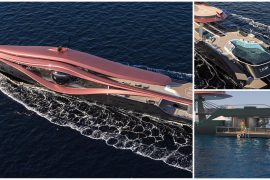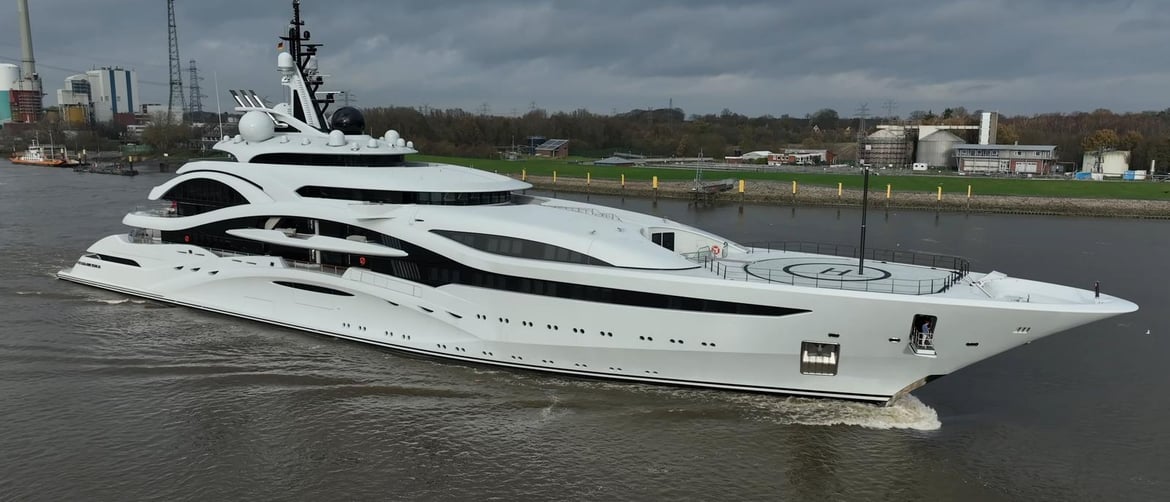
Superyacht watchers perked up in late November when ship-spotter DrDuu shared fresh footage and photos of the 404-foot superyacht Al Lusail arriving at Lürssen, accompanied by a caption that said it all: the giant was “back at home.” Posted on 25 November 2025, the images showed the $500 million vessel settling into the same yard that built her, instantly sparking talk of a new service or refit. Moments like this always excite enthusiasts, because yachts of this scale rarely return to their birthplace without purpose. Her last documented visit was in October 2021 at Blohm+Voss Hamburg’s Dock 16 for a cosmetic and technical tune-up, and at eight years old, Al Lusail is right at the stage where a serious mid-cycle inspection becomes inevitable.

A service or refit on a yacht of this scale typically revolves around class and flag compliance. Al Lusail is kept in Lloyd’s Register class and sails under the Qatar flag, so intermediate or extended surveys of the hull, machinery, and safety systems are standard practice. Mechanical overhauls are also highly likely. Her twin MTU 20V 1163 M84 engines and multiple generators have pushed through several Mediterranean and Middle Eastern seasons, and these powerplants require deep inspections, new parts, fluid analyses, and recalibrations.

Yachts in the 120-meter range often schedule stabilizer servicing, steering checks, and bow thruster maintenance during the same period, and earlier Blohm+Voss references to overhauls and beauty treatments fit exactly that pattern. It is the quiet, unglamorous work that keeps a yacht operating at the near-silent, vibration-free standard expected by a royal household.

Systems upgrades often accompany these mid-cycle visits. Navigation suites, satellite communications, IT backbones, security networks, and AV systems tend to be refreshed every five to eight years. A vessel launched in 2017 sits right in that window, and the pace of technological improvement means that owners who want seamless connectivity and updated security tend to approve these upgrades without hesitation. In parallel, cosmetic work becomes inevitable. Al Lusail received a major repaint early in her life and later emerged from warranty work in Genoa, showing off a darker blue-grey hull. In 2025, a full repaint is unlikely, but partial resprays, fairing touch-ups, underwater coating renewals, and boot-top refinishing are common. Teak deck refurbishment is almost guaranteed. After eight years of heavy summer usage, sanding or replacing sections of the deck is a routine but substantial job that can take weeks.

Her pool, glazing, and beach-club areas also demand periodic attention. Al Lusail is known for her sweeping glass façades, and large private pool, and glass sealants, pool filtration systems, and water-treatment hardware require periodic inspection and renewal. Even if the work is not visible to casual observers, refinishing these parts ensures the yacht continues to present the sharp, modern silhouette that made her so recognizable from day one.

Interior work will never be disclosed, but standard seven- to ten-year tasks on a royal-grade yacht usually include soft-goods refreshes, selective furniture changes, quieter HVAC systems, and lighting improvements. Owners also sometimes make subtle layout adjustments to refine how the yacht functions for family, security, or workflow reasons. None of this is confirmed, but the timeline fits the usual behavior of yachts in the 100-meter class.

A refit of this nature typically lasts three to six months if driven mainly by surveys, paint work, and mechanical overhauls. If deeper interior changes or complex system retrofits are involved, the period may stretch to nine or even twelve months, but Al Lusail’s previous 2019 and 2021 visits were described as overhauls rather than rebuilds. That points toward another mid-length stay rather than a year-long transformation. Costs scale quickly at this level. Industry guidance suggests that a major cycle on a yacht like this can easily absorb five to ten percent of new-build cost, and large refits commonly reach into eight-figure territory. For a vessel originally priced around $500 million, a realistic range for the 2025 visit sits somewhere in the $20 million to $40 million bracket. This is not a reported number, only an informed estimate based on comparable projects and her technical profile.

The technical scale of Al Lusail justifies that investment. With 8,489 gross tons, a 19-knot top speed, long-range cruising ability, and roughly 500,000 liters of fuel capacity, she is closer to a compact cruise ship than a private yacht. She was built by Lürssen with a steel hull, an aluminum superstructure, and teak decks, and designed externally by H2 Yacht Design. Her interiors, crafted by March & White, remain one of yachting’s most closely guarded secrets. She offers multiple pools, a wellness center, a movie theater, a gym, a vast beach club, extensive glass balconies, a central atrium, and enough volume to host 36 guests with a crew of 56. Her tender garage holds a D-RIB and two limousine tenders, and the helipad ensures discreet VIP arrivals. Every few years, she returns to northern Germany for her equivalent of a state-level inspection, something German media once described as taking a royal limousine in for its TÜV.

Her owner, Sheikh Tamim bin Hamad Al Thani, the Emir of Qatar, has been at the helm of the country since 2013. British-educated and known for his passion for sports and high-end technology, he oversees the Qatar Investment Authority and holds stakes in major global institutions. His lifestyle spans a $247 million London mansion and a $200 million Boeing 747 flying palace, and Al Lusail serves as his statement on the water. A yacht of this stature demands meticulous care, and her quiet return to Lürssen in 2025 signals that the Emir intends to keep her operating at the highest level for many years to come.