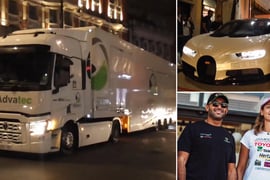
The story around the Bugatti La Voiture Noire has always read like a guessing game designed for the ultra-rich, the kind where every answer says more about fantasy than fact. For years, the internet insisted the owner had to be a football icon or a Gulf royal, with Cristiano Ronaldo leading a rotating cast of billionaires who seemed to fit the price tag more than the evidence. Bugatti, for its part, said very little, and that silence turned speculation into mythology.

The truth, however, is far more interesting than any celebrity guess. Priced at around $18.5 million, the most expensive new Bugatti ever sold was not snapped up by an outsider chasing status, but by someone whose fingerprints are already all over the brand’s modern identity. The car never really left the orbit of the empire that rebuilt Bugatti in the first place, which makes its story feel less like a purchase and more like a full-circle moment.

The car that was never just a car
La Voiture Noire exists in a category that barely overlaps with the rest of the hypercar world. Bugatti did not present it as an expensive variant or a limited edition, but as a piece of coachbuilt automotive couture created to mark 110 years of the marque. Its form is unmistakable, with a long, stretched nose, a visor-like glasshouse, and a dorsal spine that runs down the centerline as if the car were carved rather than assembled. The deep-black exposed carbon gives it a liquid quality, while six exhaust outlets punctuate the rear with theatrical intent.

Beneath that sculpture sits the familiar brutality of Bugatti engineering, an 8.0-liter quad turbo W16 producing 1,500 horsepower and 1,180 pound-feet of torque, the same mechanical heart that turned the Bugatti Veyron into a record-breaking machine. Yet the numbers are almost beside the point here. What elevates the car is the story it carries, a deliberate homage to the Bugatti Type 57 SC Atlantic, and more specifically to the missing black Atlantic that vanished during the chaos of war. That unresolved disappearance gives the modern car a sense of narrative gravity that no specification sheet can replicate.

Bugatti did not allow that narrative to trap the car in a museum-like existence. It spent years engineering, testing, and homologating the one-off as if it were a production model, and later confirmed it was driven extensively, including a thousand-kilometer appearance in Croatia. That decision quietly separates it from the usual garage-bound trophies that define this segment.

The secret that was designed to last
The reason the ownership mystery endured for so long has as much to do with Bugatti as it does with the buyer. When La Voiture Noire debuted in 2019, the company confirmed the sale but withheld the name, describing the client only as an enthusiast. That single choice created a vacuum that the rumor mill eagerly filled, attaching familiar wealthy figures to a car that demanded a headline-worthy owner.
Timing played its own role in sustaining the illusion. The public saw the concept in Geneva, but the finished, road-legal car did not arrive until 2021, and early sightings offered little more than registration clues. Even as it quietly appeared in Switzerland, there was still no definitive confirmation tying it to a specific individual.

What emerges now is a more controlled and revealing picture. The buyer is widely linked to Ferdinand Piëch, the architect behind Volkswagen Group’s transformation and the driving force who brought Bugatti back from irrelevance. His influence shaped the very engine that powers the car, and his legacy defines the era that made such a machine possible. Sadly, Ferdinand Piëch passed away in 2019, two years before the one-off was delivered. The hypercar is believed to have moved within the family, with his son, Anton Piëch, now connected to its future.

That future now comes with an unexpected turn. Anton Piëch is reportedly preparing to part ways with the car, offering it through a discreet process at a valuation that circles around 25 million euros (about $29 million), according to a report by Xataka. The motivation appears practical rather than sentimental, tied to funding ambitions around his electric vehicle venture, which has yet to deliver a production car. It is a decision that subtly reframes La Voiture Noire once again, shifting it from a symbol of legacy into a financial lever, and reminding everyone that even the most myth-laden machines can eventually be drawn back into the realities of business.