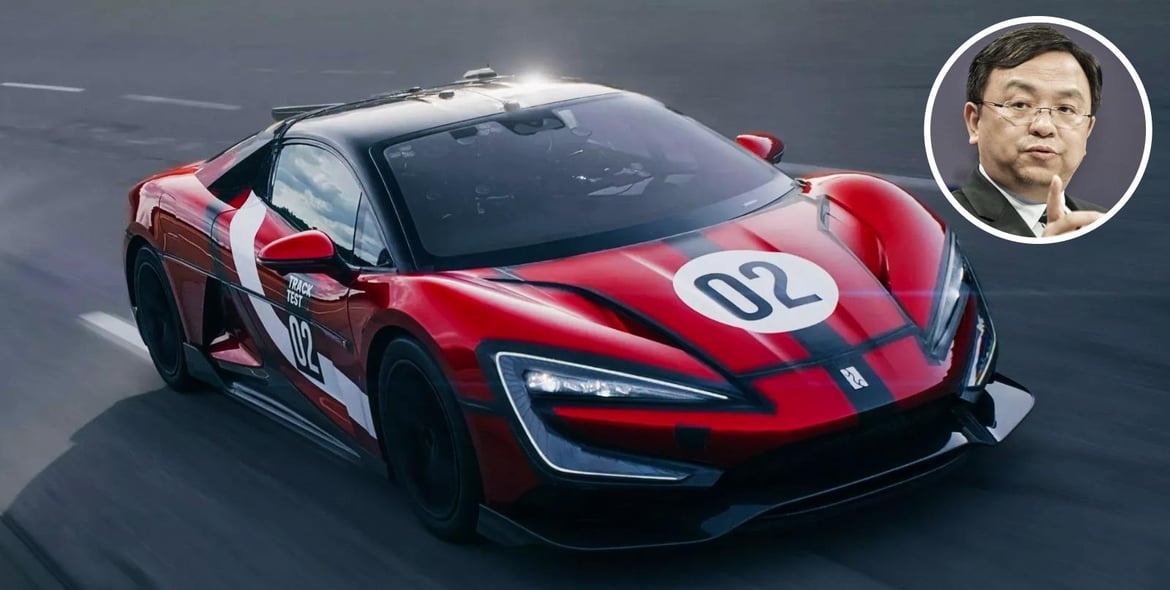
At a windswept oval in northern Germany, a Chinese-built electric hypercar has shaken up the order of the automotive world. The YangWang U9 Xtreme, a track-focused evolution of BYD’s U9, has been touted as the fastest production car on the planet after hitting 308.4 mph (496.22 km/h) at ATP Automotive Testing Papenburg. The venue, with its two vast banked straights, has long been the industry’s proving ground for v-max runs, but this time it was a Chinese EV, not a European titan, that captured the spotlight.

Behind the wheel was Marc Basseng, a seasoned German racer with a Nürburgring 24 Hours victory to his name. Basseng is no stranger to speed records, having guided Aspark’s SP600 prototype to 272.6 mph (438.7 km/h) just last year at the same venue. His calm professionalism gave weight to BYD’s claim, further underlined by onboard clips that showed Racelogic VBOX instrumentation recording the figures. Social media posts citing ATP verification amplified the result, giving the U9 Xtreme legitimacy even if some observers remain cautious.
This isn’t BYD’s first headline. Weeks earlier, the company had trumpeted an EV-only record when the YangWang U9 Track Edition hit 293.5 mph (472.41 km/h), also with Basseng at Papenburg. The Xtreme took that effort and went further, not only eclipsing Bugatti’s 304.77 mph (490.48 km/h) Chiron Super Sport 300+ from 2019 but also proving that a nearly 3,000 hp electric hypercar can sustain outrageous speeds. For context, 308.4 mph means covering a football field in just 0.80 seconds, about 452 feet every second.

The car’s technical arsenal is formidable. Four independent motors, delivering almost 3,000 horsepower, sit within BYD’s e⁴ platform, providing individual-wheel torque vectoring. Its Blade battery architecture runs on a 1,200V system and can charge from 30 to 80 percent in around ten minutes using dual DC inputs. Even the suspension borders on the theatrical: the DiSus-X active body control can make the car “dance,” jump, or drive on three wheels, but at maximum velocity it stabilizes vertical body motion to keep the U9 flat and planted. Semi-slick tires co-developed with Giti and carefully tailored aero packages were also key to the record-setting run.

Of course, the record comes with an asterisk. Like Bugatti’s famous 2019 blast, the YangWang’s achievement was a single-direction sprint rather than a two-way average. On that stricter measure, Koenigsegg’s Agera RS still reigns supreme with a 277.87 mph (446.97 km/h) verified average on a public Nevada highway in 2017. Yet in the more popular “one-way” bragging-rights category, BYD has clearly edged ahead, and with just 30 U9 Xtremes slated for production, it is following Bugatti’s formula of rarity and exclusivity.

The U9 Xtreme is not just about straight-line numbers. YangWang has also announced a Nürburgring lap of 6:59.157, which, if confirmed, would make it the first EV to dip under the seven-minute barrier. That puts it in rare company, even if gasoline rivals like Koenigsegg’s Jesko Absolut still loom with promises of speeds beyond 310 mph (500 km/h).

For BYD’s founder Wang Chuanfu, the moment is a validation of decades of persistence. Charlie Munger once described him as a mix of Thomas Edison and Jack Welch, a man with both technical brilliance and executional drive. With the U9 Xtreme’s run at Papenburg, that description feels prophetic. A Chinese EV has just outrun Bugatti, and the automotive world is going to have to take notice. It’ll be interesting to see if Bugatti responds with an attempt to take back the title with its new Tourbillon hypercar.