The world had seen presidents fly in and out of summits countless times before, but nothing quite like what unfolded on the Caribbean island of Saint Martin, also known as Sint Maarten, when two heads of state arrived for a meeting in December 1989. It was supposed to be a routine diplomatic event featuring George H. W. Bush of the United States and Francois Mitterrand of France. Everyone expected Air Force One to command the spotlight, as it always did. Instead, the island’s sky was claimed by something sleeker, louder, and infinitely rarer. The Concorde had arrived, and for once, the American president’s aircraft became a supporting act.
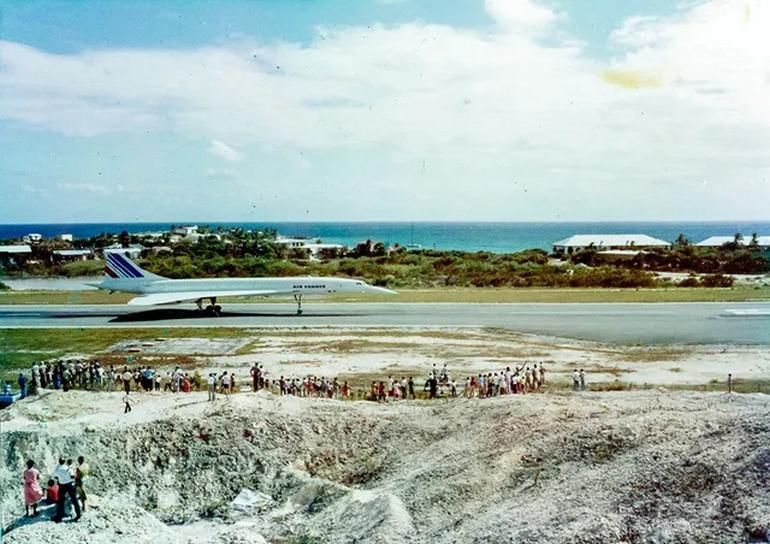
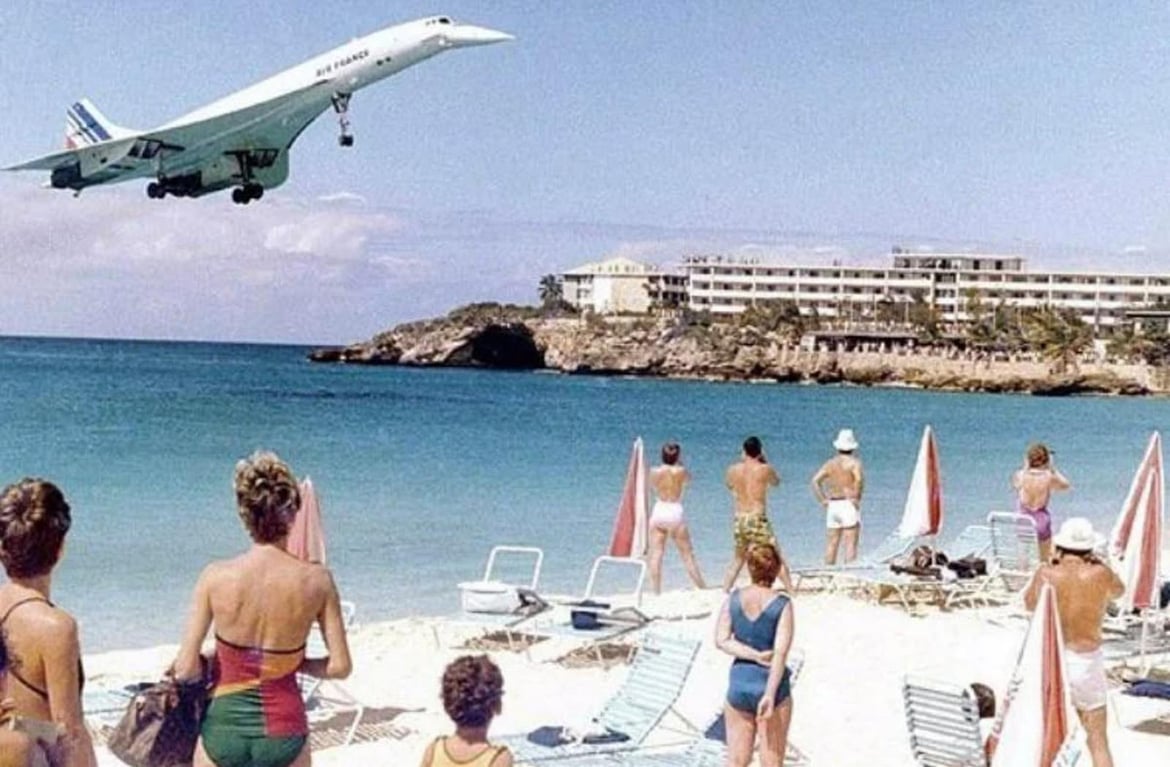
When Concorde came to Saint Martin, the island didn’t treat it like a closed, heavily guarded presidential operation. It felt more like a festival. Locals and tourists turned the famous Maho Beach into an open-air amphitheater, as pointed out by The Friendly Books. People filled the sand, climbed fences near the runway threshold, and even positioned boats in line with the approach, “in the axis of the track, in front of Maho Beach,” to feel the sonic spectacle overhead.

Air France had dispatched the jet on a special one-off mission, flight AF100F, carrying Mitterrand himself. It was not a scheduled crossing but a dedicated head-of-state flight. The island’s tourism board later confirmed that the Concorde had only ever landed at Princess Juliana Airport twice in total, one of those being this visit. That alone made it a once-in-a-lifetime sight.

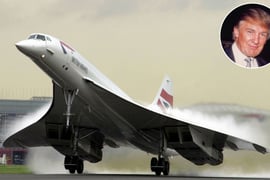
The crowd that day was ecstatic. When the white delta shape appeared over the horizon, the entire beach seemed to hold its breath. Seconds later, hundreds of onlookers were pointing cameras to the sky, capturing what looked like a flying arrow balancing in the air. Then the sound arrived, a wave of deep roar and hot jet exhaust that rattled everything in its path. People screamed, laughed, and instinctively ducked as the Concorde passed only a few dozen meters overhead.

The supersonic arrival and the presidential contrast
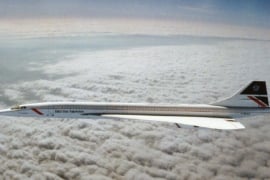
The Concorde was never built to be ordinary. It was a pure delta-wing jet that cruised at Mach 2 and flew at 60,000 feet, a height where passengers could see the curvature of the Earth. Landing such an aircraft was an art in itself. Because its wings required high angles of attack at low speeds, the entire fuselage had to pitch upward dramatically as it approached. Pilots dropped the iconic “droop nose” to see the runway ahead. To those standing on the beach, it looked like the jet was defying physics, gliding almost vertically and impossibly slow.
Its approach speed was around 160 to 170 knots, roughly 185 to 195 mph, which is very fast for a landing. The four Olympus 593 turbojet engines were deafening, producing around 116 EPNdB of noise, comparable to standing near industrial machinery during a thunderstorm. Sand and debris blasted across the beach. The sheer volume of sound and heat made it feel like the sky was tearing apart. It was both terrifying and mesmerizing, and it left the crowd in awe.

Moments later, the American president made his own entrance. George H. W. Bush was still using the Boeing VC-137C, call sign SAM 27000, a customized version of the Boeing 707 that had served every US president from Nixon to Reagan. The aircraft carried deep historical weight but lacked the futuristic allure of its French counterpart. Bush would be the last to use the 707 before the arrival of the jumbo 747-based VC-25A in 1990. Against the sleek, needle-nosed Concorde, Air Force One suddenly looked conservative, a relic from a slower age of flight.

Usually, it is Air Force One that turns heads wherever it lands. The aircraft has long symbolized American prestige and presidential authority. But on this Caribbean afternoon, that narrative quietly flipped. The images that circulated afterward were not of Bush’s landing but of the Concorde slicing low over Maho Beach, its engines roaring and fuselage gleaming in the tropical light. For perhaps the only time in modern history, the world’s most famous airplane was upstaged by another.

The host and the guest
Mitterrand’s arrival carried symbolic weight beyond the spectacle. He landed on French territory, aboard France’s most celebrated technological triumph. The Concorde embodied the nation’s pride in engineering and progress. Bush, by contrast, arrived as a visitor in a jet that represented tradition rather than innovation. The dynamic of power shifted slightly. Mitterrand welcomed Bush on home soil, setting the tone for the meeting as the confident host. Bush, usually the global figure commanding the stage, appeared for once as the guest.

That day, Saint Martin became the setting for a quiet reversal of roles. The Concorde stole the world’s attention not just through speed and noise but through symbolism. It represented a moment when aviation, artistry, and diplomacy converged in a single breathtaking performance. On that runway framed by sea and sand, France’s supersonic marvel reminded the world that beauty and innovation can speak louder than politics.