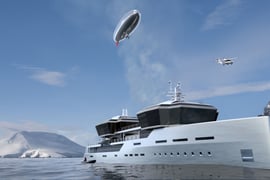
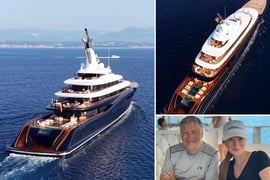
The fourth hull in Damen Yachting’s Yacht Support 53 series has entered sea trials, and with it comes a clearer picture of where modern superyachting is heading. This 53-meter platform, built not as a centerpiece but as an enabler, belongs to an experienced American owner who already operates within a broader fleet and now wants something far more capable than a traditional chase boat. The brief is not subtle. It is about fishing, high-energy watersports, and the kind of long-range operational flexibility that turns a yacht itinerary into something closer to an expedition plan.

At 175 feet and just under 500 gross tons, the YS53 sits in an unusual space. It is large enough to command presence, yet lean enough to remain purpose-driven. A top speed of 19 knots and a range of roughly 5,000 nautical miles at 12 knots position it as a serious long-distance companion, capable of crossing oceans without constant logistical dependence. The standard arrangement of 8 guests and a crew of 10 plus a captain reinforces the point that this is not designed for crowded social calendars but for controlled, capable operations at sea.

What defines this particular hull is its deck logic, which Damen treats less like a finished design and more like a blank canvas. Across roughly 310 square meters of usable space on the main and bridge decks, the yacht becomes whatever the owner needs it to be. Tenders, submersibles, vehicles, mobile workshops, and even scientific setups can be accommodated without compromising the vessel’s core function. The presence of a 15-ton crane is not a headline feature in isolation, but in practice, it transforms the entire platform into a working machine that can launch, recover, and reposition serious equipment without hesitation.

The most revealing detail, however, is not in the brochure specifications but in what this owner reportedly intends to carry. A 31-foot sportfisher sits alongside a 36-foot folding trimaran, a 31-foot walkaround or RIB, and a 23-foot wake boat. This is not abstract language about toys. It is a mobile marina, an adventure locker, and an operational overflow deck condensed into a single hull. It explains why vessels like this exist at all. The mothership remains clean, composed, and guest-focused, while everything that creates action and complexity lives here.

Sea trials, now underway, are where this philosophy is tested against reality. Like any large yacht, the program will validate propulsion, maneuverability, stability, and safety systems, but a support vessel is judged by a different standard. The crane and its lifting systems will be pushed through repeated cycles. Launch and recovery workflows for tenders and heavy equipment will be scrutinized. Deck operations, load handling, and the way the yacht behaves under shifting weight will be observed closely. The axe bow hull form, a signature of Damen’s commercial DNA, will be evaluated for how it manages rougher conditions and protects exposed equipment from spray.

There is also the question of endurance. Helicopter deck readiness, the practicality of day-to-day deck use, and the reliability of systems over extended operations matter as much as outright speed. A conventional superyacht sea trial proves luxury performance, but a support vessel has to prove that it can work, repeatedly and without compromise, in environments where the itinerary is only loosely defined.
As this fourth YS53 moves through its trials, it becomes clear that the real story is not about a single delivery but about a shift in mindset. Owners are no longer building a yacht. They are assembling a fleet, and vessels like this are the backbone that allow everything else to function.