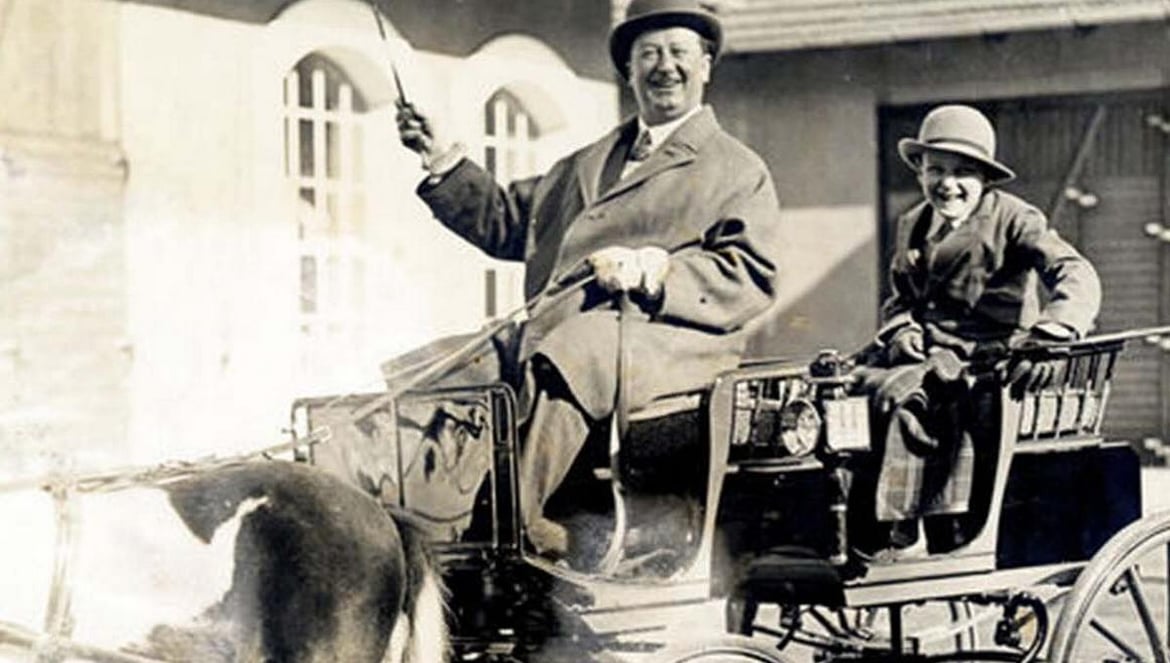
There are few things more dangerous in the world of luxury than a perfectionist with a pencil, and Ettore Bugatti carried one everywhere. In Molsheim, dissatisfaction was not debated, it was redesigned. If something failed to meet his standard, he did not argue, he redrew it. Long before Bugatti and Hermès collaborated in 2008 to create the Veyron Fbg par Hermès, there was a moment when the iconic marque’s founder looked at the work of Hermès and decided he could do better himself.
Today, the partnership between Bugatti and Hermès feels like a natural alliance between two houses obsessed with material, proportion, and finish. Yet buried in Bugatti lore is a remark that complicates the symmetry of that story. According to a first-hand account from 1928, Ettore once declared that his men had managed to do better than Hermès.

The origin of “better than Hermès”
The line traces back to French journalist Frédéric Loiseau, whose 1928 visit to Molsheim is preserved in the monograph Horseman Bugatti. He left with more than impressions of racing cars. In the 1920s and ‘30s, Bugatti’s stables were as obsessively detailed as his automobiles. Stall doors carried polished metal plates and finely finished wood, composed with the restraint of a drawing room rather than a barn. Order was architectural. Even the horses appeared curated.

Loiseau was led into the harness room, a space he described with near-religious reverence. The atmosphere carried the scent of rare woods and flawless leather, with steel fittings arranged like ceremonial armor. It was there that he noticed something unexpected. He saw harnesses stamped in an oval with the words “Sellerie Bugatti.”

Surprised, he asked whether Bugatti had entered the tack business. Ettore’s reply was disarmingly direct. Hermès, he said, could not deliver exactly what he wanted. So, he made a drawing, handed it to his workers, and they managed to do better than Hermès.

The anecdote was later documented by historian Andres Furger in his monograph Horseman Bugatti, grounding the quote in a first-hand narrative rather than drifting hearsay. What makes the line endure is not bravado but context. It was delivered inside a room that looked and felt like a temple to craft.

Sellerie Bugatti and the cult of precision
Behind the remark stood a functioning in-house saddlery. Sellerie Bugatti was not a decorative indulgence but an operational atelier embedded within the Molsheim estate. L’Ebé Bugatti, in her 1966 biography, recalled that one could encounter saddlers sewing harnesses or suitcases on site, confirming that leatherwork was part of the estate’s daily production alongside engines and coachwork.

Furger’s reconstruction suggests that roughly two dozen sets of harnesses were made or used for the family stable, which housed around 30 horse-drawn vehicles. This was a serious workshop serving a demanding patron who happened to sign the paychecks. The oval “Sellerie Bugatti” stamp signified authorship in the same way the horseshoe grille did on his cars.

To understand the weight of the “better than Hermès” claim, one has to understand Ettore’s temperament. He treated tolerances as moral commitments. If a supplier fell short of his exact curvature, stitch density, or hardware finish, compromise was not an option. The idea that a Parisian maison, however prestigious, could not execute his precise vision would not have offended him. It would have compelled him.

The stables at Molsheim were an extension of the factory floor. The same eye that calibrated a front axle or specified a casting finish evaluated leather thickness and strap geometry against a horse’s flank. In that environment, surpassing Hermès was not an act of rivalry but a byproduct of total control.

A century later, the modern partnership between the two houses reads like a reconciliation between parallel philosophies. Yet the story of Sellerie Bugatti remains a reminder that for Ettore, perfection was personal. In a harness room that smelled of rare wood and polished steel, he sketched his own solution and instructed his craftsmen to execute it. The result carried his stamp and a statement that still resonates: when standards are absolute, even Hermès becomes a benchmark to exceed.