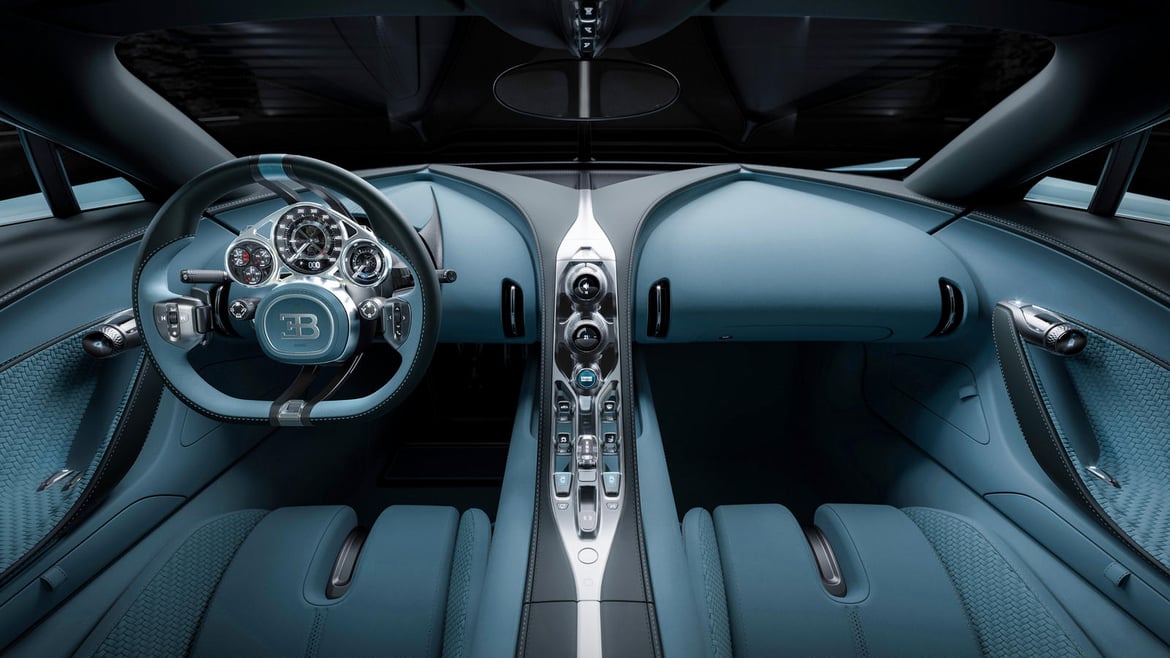
Bugatti did not design the Tourbillon’s interior to impress you in the first ten seconds. It was designed to make sense in ten years, and still feel relevant in fifty. In a hypercar world increasingly dominated by screens, software layers, and visual noise, the Tourbillon cabin feels almost contrarian. It is quieter, more deliberate, and far more confident than anything else at this level. The French hypercar manufacturer recently released a video on YouTube explaining the design philosophy shaping the interior design of the Bugatti Tourbillon.

That confidence comes from a simple premise. The interior is not a tech product. It is a mechanical object, closer in spirit to a high complication watch than a modern digital cockpit. Watching the interior tour video, it becomes immediately clear that every surface, control, and mechanism has been designed to age rather than update. This is not a cabin meant to be refreshed with software. It is meant to endure.

The first thing that defines the space is the architecture. Bugatti’s iconic center line and C-line do not stop at the exterior. Inside the Tourbillon, they physically divide the cabin into two distinct worlds. The driver and passenger are separated by a strong central spine, reinforced by a horizontal color split. This is not symmetry for the sake of aesthetics. It reinforces that the Tourbillon remains a driver-first machine, with the passenger positioned as an observer rather than a co-pilot. It is old-school hypercar thinking, executed with modern precision.

Materials are where the interior begins to feel personal. Bugatti has moved beyond the predictable leather and carbon formula, introducing newly developed fabrics alongside supple hides. These fabrics are not decorative. They are meant to wear, soften, and develop character over time. Bugatti calls this approach car couture, borrowing directly from haute couture logic. The idea is tailoring, not trends. The interior is dressed, not decorated.

Then there is the steering wheel, which immediately signals that this is not a normal cockpit. The fixed-hub design allows the rim to rotate freely around a stationary center that houses the airbag and controls. The effect is subtle but powerful. The driver’s reference point never moves. It feels anchored, mechanical, and intentional. This layout keeps the instrument cluster perfectly aligned at all times, reinforcing the idea that the car revolves around the driver’s interaction with the machine.

The analogue instrument cluster is the emotional core of the cabin. Developed with Swiss master watchmakers, it is fully mechanical, skeletonized, and housed in milled aluminum casings topped with crystal displays. Gears, linkages, and mechanical logic are proudly visible. There is no attempt to hide complexity. Instead, Bugatti celebrates it, much like a high-end timepiece that invites you to admire its movement rather than obscure it behind a screen.

Digital technology exists, but it knows its place. The central display is hidden behind the dashboard and only deploys when needed. Most of the time, it simply disappears. This digital restraint is intentional. Bugatti understands that screens age poorly. By minimizing their presence, the cabin avoids visual obsolescence and preserves its mechanical character. Most of the controls are rotary dials with knurled texture, with tiny displays housed inside them. The console is covered with a single piece of sapphire crystal, adding to the hypercar’s horological connection.

One of the most unexpected highlights appears on the doors. The door-mounted controls are inspired directly by horology and feel like jewelry rather than switches. On the driver’s side, a beautifully machined rotary knob adjusts both the steering wheel and pedal positions. The entire unit looks like something lifted from a Jacob & Co. timepiece, complete with intricate detailing and a tactile, mechanical feel. It is a functional sculpture that turns ergonomics into an event.

Throughout the design process, Bugatti never lost sight of reality. Safety systems, airbags, seat belts, and crash behavior were all integrated without compromising the concept. As Chief Interior Designer Ignacio Martinez puts it, “The role of an interior designer is to, of course, design a full vehicle cabin from the first sketches all the way to production. But we need to consider many aspects in this journey, not only Bugatti’s DNA, and making sure we honor all of the marque’s stylistic cues, but also develop a theme; a user sequence that is understandable.”

Ultimately, the Tourbillon interior is not chasing the future. It is opting out of it. By grounding the cabin in mechanics, materials, and watchmaking logic, Bugatti has created an interior that does not need to keep up. It simply needs to last.