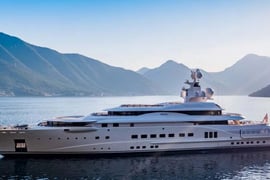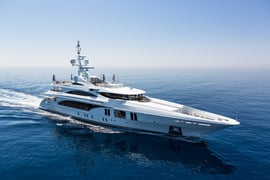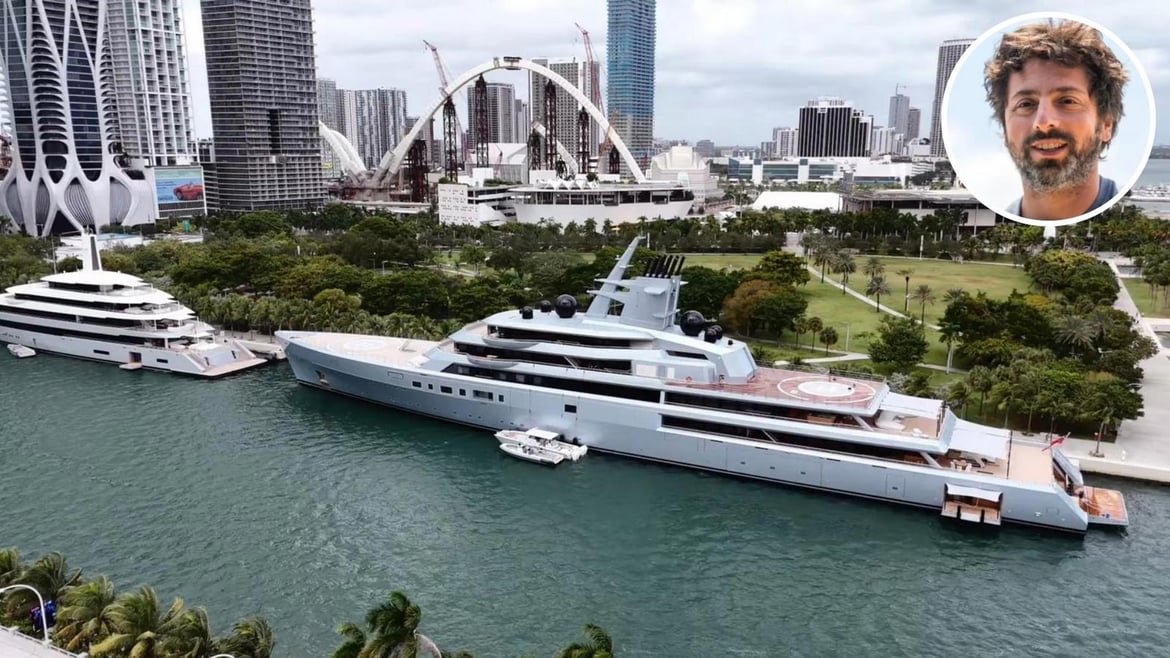
Sergey Brin arrived in Miami for Art Basel 2025 the long way around. Not by Gulfstream, not by motorcade, but aboard a floating object so large it temporarily rewrote the city’s visual hierarchy. Dragonfly, the Google co-founder’s $450 million megayacht, slid into Biscayne Bay and immediately became the most dominant structure on the water that week, a moving piece of infrastructure parked for art shopping.

Docked along Museum Park by Maurice A. Ferré Park, the location gives it away instantly. The Miami skyline rises behind it, punctuated by the unmistakable white exoskeleton of Zaha Hadid’s One Thousand Museum. This is downtown Miami’s most photogenic stretch of waterfront, and during Art Basel, it turns into a public runway for wealth.

This year’s Art Basel was no different, with the VIP preview thronged by the world’s ultra-rich before the public ever got a glimpse, as pointed out by Vanity Fair. Dragonfly’s berth is practical and theatrical at the same time. It is a short car hop to the Design District and Wynwood, easy water access toward Miami Beach, and a front-row seat for thousands of passersby who suddenly realize they are standing next to something closer to a floating skyscraper than a yacht.

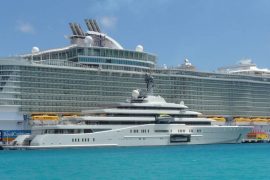
At 466 feet long, Dragonfly is almost absurd in scale. For context, it was docked next to Moonrise, the 331-foot superyacht owned by WhatsApp founder Jan Koum, which can be seen in a YouTube video posted by a user named Alejandro Jose Farias. Moonrise is itself a leviathan by any reasonable definition, yet beside Dragonfly it looks almost restrained. The comparison does not flatter Moonrise. Dragonfly overwhelms it, visually and spatially, like a luxury hotel parked beside a boutique resort.

When Brin stepped ashore to browse installations and private previews at Art Basel, Dragonfly did not power down. Quite the opposite. While her owner walked through galleries and temporary pavilions, the yacht remained fully alive, consuming electricity at a rate that would make a utility executive pause.

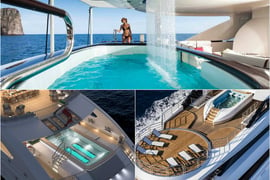
The biggest energy appetite comes from HVAC, which is the true monster aboard any megayacht of this size. Dragonfly is essentially thousands of square feet of climate-controlled interior spread across multiple decks, all of it fighting Miami heat and humidity that never lets up. Cooling alone is not enough. The air must be constantly dehumidified. Redundant chillers, air handlers, and ventilation systems run in parallel, so a single failure never becomes a guest-facing problem. Comfort is non-negotiable.

Then there is hot water and laundry, which operate more like a high-end resort than a private vessel. Multiple galleys run simultaneously. Crew laundry never stops. Guest laundry spikes during event weeks when outfit turnover accelerates. Towels, linens, table settings, dishwashers, steam ovens, warming drawers, and dozens of showers all demand heat and flow. Art Basel is not a quiet cruising week. It is operationally intense.

Lighting and electronics add another permanent draw. Whole-yacht lighting systems stay active, including mood lighting and exterior deck lighting. Security systems, satellite communications, networking racks, and IT infrastructure remain on around the clock. Even when no one is aboard, the yacht is very much awake.

Pumps and hotel services hum in the background. Freshwater pressure systems, sewage treatment, greywater processing, bilge systems, ventilation fans, kitchen extraction systems, and elevators all draw power. If tanks are being topped up or heavy cleaning is underway, pump usage climbs sharply. Stabilization and maintenance loads matter too. While at-dock stabilizers may be reduced, maintenance equipment, compressors, tools, and workshop systems often run during port stays. Dockside checks, system testing, and preventive maintenance can spike demand unexpectedly.

Overlay all of that with a redundancy culture. Even with shore power available, yachts like Dragonfly often keep generators online or in hot standby. The idea is simple. No flicker, no interruption, no excuses. The ship must ride through any shore-power issue without guests ever noticing. It is less like plugging in a boat and more like powering a boutique hotel that just happens to float.

According to experts Luxurylaunches spoke to, on a heavy operational day, Dragonfly can consume an estimated 28,800 kilowatt-hours in 24 hours. To understand what that means, consider that the average Florida household uses about 1,104 kilowatt-hours per month. That works out to roughly 36 kilowatt-hours per day. Dragonfly’s single day at the dock equals the daily electricity use of roughly 780 to 800 Florida households. Look at it another way, and it is about 26 Florida households’ entire monthly consumption, burned through in 24 hours. On a per-person basis, it becomes even starker. Florida averages about 2.51 people per household, or roughly 14 to 15 kilowatt-hours per person per day. Dragonfly’s heavy day equals the daily home electricity use of about 2,000 Floridians.

At an estimated $0.30 per kilowatt-hour, the electricity bill alone comes to roughly $8,640 per day. Docking fees in Miami, at around $9 per foot, put Dragonfly’s berth at about $4,194 per day. During peak weeks like Art Basel, when waterfront space is at its most coveted, dockage can climb well above standard per-foot rates, pushing the daily tab higher still. For someone with an estimated net worth of $242 billion, these numbers are rounding errors.

For everyone else standing along Museum Park, phones out, staring up at 466 feet of floating excess, Dragonfly is something else entirely. It is a reminder that during Art Basel, Miami does not just host art. It hosts the infrastructure of extreme wealth itself, humming quietly while its owner goes gallery hopping.