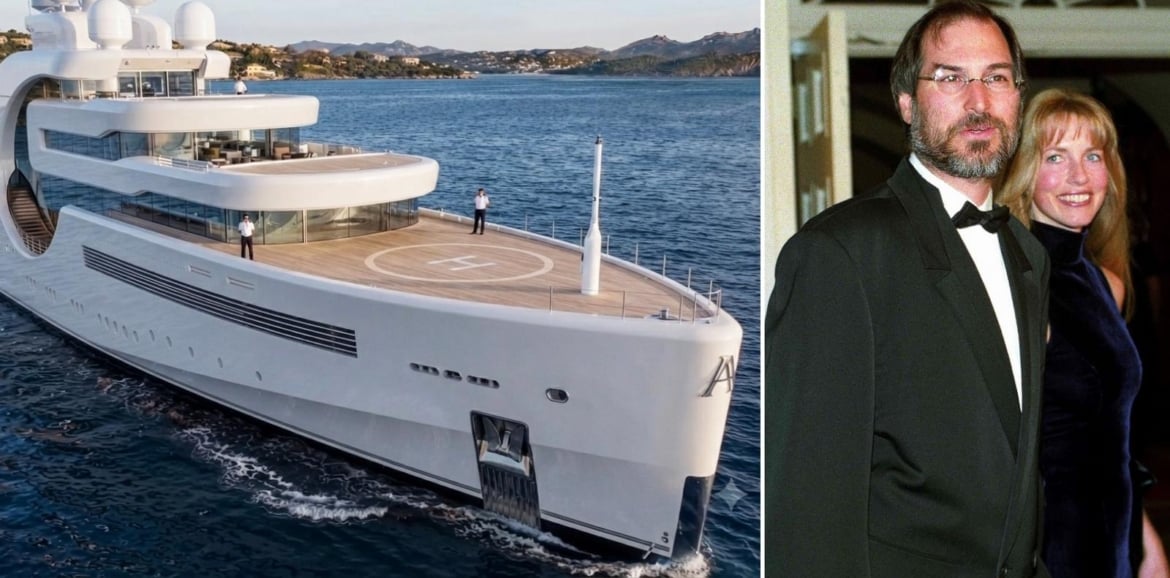
If Laurene Powell Jobs ever decided to upgrade the superyacht she inherited from Steve Jobs, Project Atom would make for a remarkably fitting successor. At 344 feet, the concept is substantially larger than Venus, yet it shares the same fascination with clean lines, expansive glass, and architecture that feels more like a modern home than a conventional yacht.

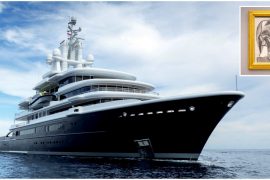
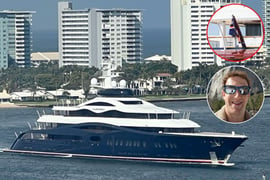
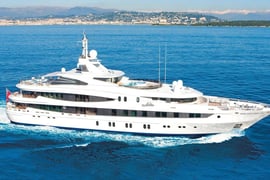
That connection is particularly interesting because Venus itself was an unusually radical superyacht for its time. Built by Feadship and designed by Philippe Starck with Steve Jobs, the 257-foot vessel was the world’s first mastless motor yacht, with its antennas and domes concealed inside a composite casing. It also featured huge windows running along the main-deck staterooms and an all-glass pavilion deck. Project Atom takes that love of glass and minimalism in a much more dramatic direction, as pointed out by the Superyacht Times.
A giant window becomes the yacht’s signature
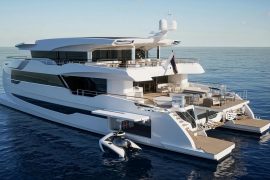
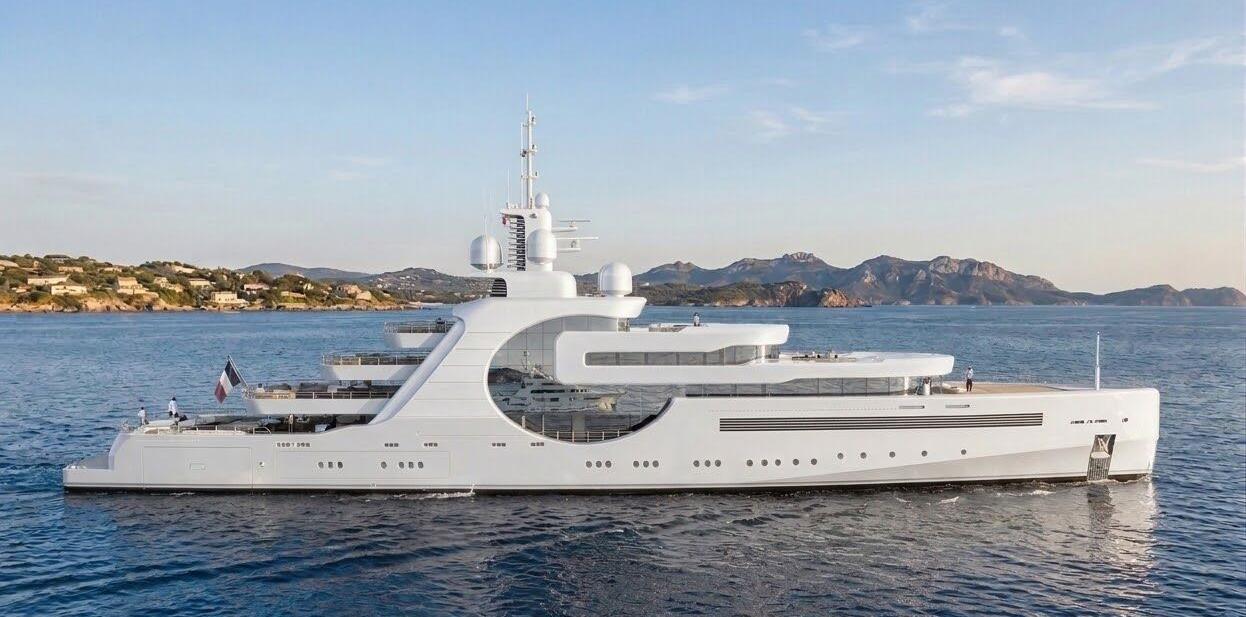
Designed by French yacht designer and former Oceanco designer Arnaud Anseeuw, Project Atom is built around one feature that is difficult to overlook. It’s an enormous C-shaped arch cut directly into the superstructure.

It is not simply a decorative feature. The opening doubles as a giant picture window, frames sweeping ocean views and creates a double-height main saloon behind it. Anseeuw says the shape was inspired by the famous C associated with Bugatti, which he sees as a symbol of exceptional craftsmanship.

That makes the feature particularly appropriate for a yacht that appears to blur the line between naval architecture and contemporary coastal architecture. Sweeping curves, extensive glazing and cantilevered decks give Atom a sculptural quality, while the enormous opening gives the vessel an unmistakable identity. The name is just as deliberate. Anseeuw says Atom refers to the “atomic age of the modern world” and humanity’s ability to transform matter into increasingly sophisticated creations. In practice, the concept certainly looks like an exercise in turning an enormous volume of steel, aluminum and glass into something that feels surprisingly light.
The exterior is organized around terraces designed for outdoor living. A substantial helipad occupies the foredeck, while the stern is imagined as a private resort, complete with a swimming pool, sunpads and broad staircases connecting the different levels. Fold-down platforms at the stern would allow guests to step directly into the water.

Bigger than Venus, but familiar in spirit
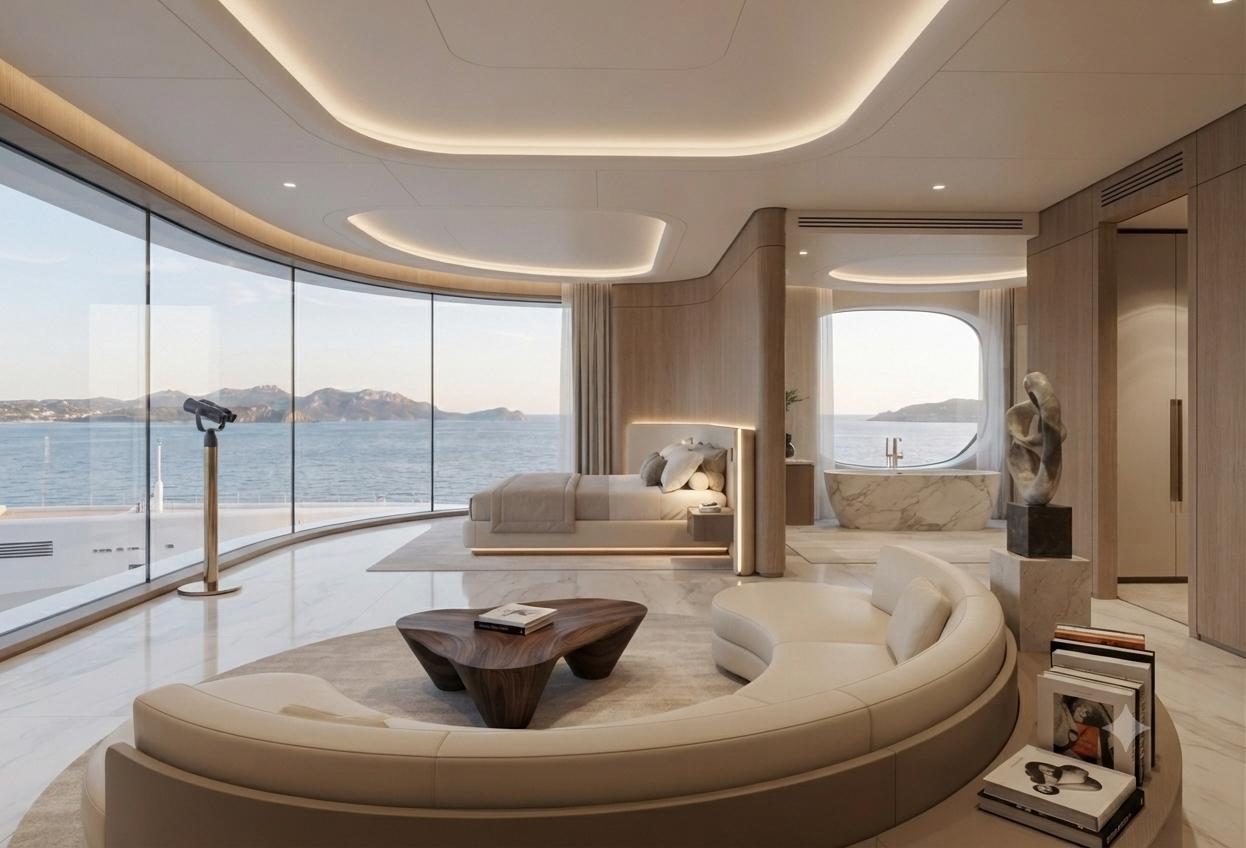
Inside, Atom continues the architectural approach. Floor-to-ceiling glazing is intended to flood the living areas with daylight, while pale timber, polished marble, light stone and softly curved furniture create a calm, contemporary atmosphere with an almost gallery-like quality. A circular staircase forms the centerpiece. Rather than treating circulation as something purely functional, Anseeuw makes the staircase part of the visual experience, allowing sunlight to move vertically between decks. The owner’s sanctuary follows the same philosophy, combining curved glazing, natural wood and pale stone with bespoke furniture and individually selected works of art.

The scale, however, is where Atom leaves Venus far behind. At approximately 4,000 GT, the concept is envisioned to accommodate 18 to 22 guests with a crew of 30 to 40. In comparison, Venun accommodates up to 12 guests across 6 stateroom suites, serviced by a crew of 22. Project Atom’s steel hull would be topped by an aluminum superstructure, with a beam of 16 to 18 meters and a draft of 4 to 5 meters.Twin diesel engines are projected to give the yacht a top speed of 20 to 22 knots and a cruising speed of 15 to 17 knots. Its estimated range is between 6,500 and 7,500 nautical miles. Atom was initially based on a 91-meter Oceanco hull before Anseeuw stretched the concept to 105 meters to enter the increasingly significant 100-meter-plus superyacht category. Unlike Venus, however, it has no owner yet. It remains a blank canvas, ready to be tailored to whoever eventually commissions it.

For Laurene Powell Jobs, that hypothetical connection would be hard to ignore. Venus is a minimalist 78.2-meter statement created around Steve Jobs’ design philosophy, while Atom is a 105-meter interpretation of contemporary yacht architecture built around glass, light and dramatic simplicity. If the idea were ever to replace Venus with something larger without abandoning the visual principles that made the original so distinctive, Atom would be an unusually natural fit.