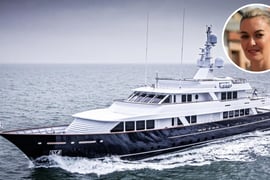
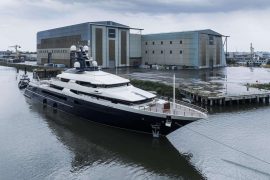
More images of life onboard Gabe Newell’s $500 million megayacht Leviathan have surfaced, and they reveal a vessel that behaves less like a floating palace and more like a highly organized private ecosystem at sea. Built by Oceanco and stretching 111 meters, Leviathan has already stood out for its hybrid-electric engineering and research capabilities, but these newly released visuals shift the focus toward how the yacht is actually used day to day.

Until now, the interior of the vessel, delivered in November 2025, has been largely shrouded in secrecy. What emerges from this latest set of images is not a story about decoration or indulgence, but about rhythm, activity, and a carefully constructed environment where diving, gaming, work, and communal living unfold side by side.

A dive deck that feels like a working platform
One of the most revealing images shows a diver fully equipped, stepping between a low-side platform and a waiting tender, with crew nearby and equipment already staged. The scene is not staged for effect. It feels procedural and efficient, as if repeated several times a day. The open side door exposes a recessed interior space that appears to function as a wet room or dive support area, complete with visible storage and hanging gear.

The tender itself reinforces the point. Its open layout, wide boarding area, and practical seating suggest it is designed to shuttle divers back and forth with minimal friction. This is not a yacht that carries diving equipment for occasional use. It looks like a vessel where diving dictates the flow of the day, aligning closely with Newell’s own description of a routine built around work and repeated dives.

A bridge that looks more like mission control
Another image shifts the narrative indoors, into a bridge that replaces traditional nautical cues with an environment dominated by screens and information. The helm is surrounded by digital displays, while additional panels overhead show feeds, diagrams, and system data in a clean, structured layout.

There is no attempt to romanticize seafaring here. Instead, the bridge resembles a control room, where visibility, data, and coordination take precedence over ornament. This screen-led design language connects directly to other areas onboard, from the gaming lounge to the outdoor cinema, suggesting that Leviathan is built around shared digital interaction as much as physical space.

A pool deck designed for people, not presentation
The aft pool deck appears expansive, symmetrical, and deliberately social. A large central pool anchors the space, flanked by modular seating and open circulation paths that encourage movement and interaction. Glass panels, wide staircases, and layered deck levels create a sense of openness rather than exclusivity.

What stands out is the absence of visual excess. Materials look durable, finishes are restrained, and layouts are practical. The space feels engineered for groups to gather and spend time together, whether that means casual conversation, shared meals, or events that extend into the evening. The pool is not a decorative feature. It acts as a focal point in a broader social system.

A foredeck that doubles as a wellness platform
The bow offers one of the clearest examples of how Leviathan rethinks traditional yacht spaces. Instead of being reserved for sunbathing or symbolic prominence, it is shown hosting a structured yoga session, with participants arranged in formation against an uninterrupted ocean backdrop.

The scale of the deck allows it to function as a flexible platform that can shift between wellness activities, observation, and group gatherings. Its uncluttered design reinforces the idea that spaces onboard are meant to adapt, supporting routines that are shared rather than isolated.

A floating media arena at the stern
Perhaps the most visually striking feature is the enormous outdoor screen positioned on the aft deck. Elevated and integrated into a stepped seating arrangement near the pool, it transforms the area into an open-air theater capable of hosting films, live broadcasts, or even gaming sessions that extend beyond the interior.

This feature gains additional meaning when considered alongside the yacht’s reported gaming lounge with multiple stations and simulators. The screen becomes part of a wider digital ecosystem, where indoor and outdoor experiences are linked, allowing moments to spill from one space into another without losing their communal energy.

Across these images, a consistent narrative takes shape. Leviathan is not defined by private opulence or ornamental design. It is defined by use. Every deck, platform, and interior zone appears calibrated for activity, whether that activity involves diving, exercising, working, or simply spending time with others onboard. In that sense, the yacht reflects its owner as much as its engineering. It is structured around a lifestyle where work and leisure overlap, where people gather rather than retreat, and where the ocean is not just a view but an active part of daily life.