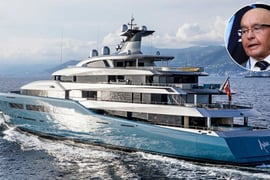
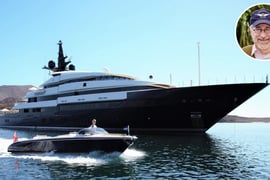
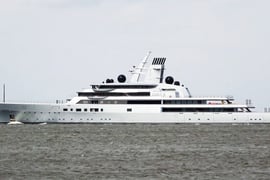
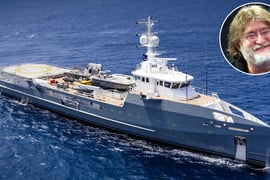
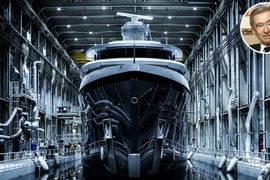
American entrepreneur John Staluppi has never approached yachts as occasional indulgences. For decades, they have been extensions of a life built on momentum, instinct, and a very specific idea of how luxury should function. His latest move, the commissioning of a new 82-meter flagship from Bilgin Yachts, feels less like another addition and more like a closing statement from a man who started with fixing cars in Brooklyn and ended up shaping one of the most recognizable private fleets in modern yachting.

At roughly 269 feet, the vessel known as Project Bond will become both the largest yacht Bilgin has ever undertaken and the largest Staluppi has ever owned. The numbers tell a story of balance rather than excess. A beam of about 13 meters and a volume of nearly 2,150 gross tons point to serious interior space, while a 3.6-meter draft quietly signals something more strategic, the ability to slip into shallow American harbors that many yachts of this size simply cannot access.

A flagship built on precision rather than spectacle
The technical profile is where the yacht begins to reveal its character. A range of 5,000 nautical miles at 10 knots places it firmly in the category of true long-distance cruisers, capable of crossing oceans without drama. At the same time, a projected top speed of 17.5 knots ensures it will never feel sluggish. This is not a yacht chasing records or headlines for outright speed, yet for its scale, that figure is quietly impressive, especially when paired with range and shallow draft. It reflects a philosophy that has defined Staluppi’s fleet for years, a performance that serves real-world use rather than theoretical extremes.

The design team reinforces that sense of continuity. Emrecan Özgün and his studio Unique Yacht Design handle the exterior and naval architecture, while Jonny Horsfield leads the interiors through H2 Yacht Design. Together, they return to a familiar but evolving language built around openness, light, and the deliberate use of floor-to-ceiling glass. The ambition is architectural as much as nautical, dissolving the boundary between interior and ocean so that the yacht feels less like a sealed object and more like a moving environment shaped by its surroundings.

The quiet co-author and the final chapter of a theme
Much of the public narrative centers on John, yet that framing misses a crucial detail. His wife, Jeanette Staluppi, is not a background presence but an active force in shaping how these yachts are lived in. She is deeply involved in the layout, the atmosphere, and the rhythm of onboard life, and has contributed to each of the previous eighteen builds, as pointed out by Boat International. On this project, her role extends into crafting the entertainment and relaxation spaces alongside H2 Yacht Design, continuing a pattern that has quietly defined the Staluppi fleet’s identity. If John sets the direction, Jeanette refines how that vision is experienced.

Then there is the name, which carries more weight than it first appears. Staluppi’s lifelong fascination with James Bond began after watching Goldfinger as a child, and it evolved into a ritual that saw every one of his yachts named after a Bond film.

From his first major yacht, For Your Eyes Only, launched in 1985, to the 18 that followed, the theme became inseparable from his identity as an owner. Project Bond feels like the logical endpoint of that journey. The titles are gone, leaving only the character, distilled and unmistakable.

That arc mirrors the trajectory of Staluppi himself. He began as a mechanic in Brooklyn, with a family willing to mortgage their home so he could open a gas station. From there, he persuaded a then-obscure Honda to grant him a dealership, expanded rapidly, and ultimately built Atlantic Auto Group into a powerhouse generating billions in annual revenue. The distance from that first garage to an 82-meter flagship is immense, yet the throughline remains intact. Practical thinking, relentless growth, and a preference for things that work as well as they impress.

Project Bond brings all of those threads together. It is large, but not gratuitous. It is fast, but not reckless. It is luxurious, yet grounded in how it will actually be used. Most of all, it feels intentional, as if decades of iteration have been compressed into a single final expression.